

Benefits of HGV GPS real-time tracking for UK fleets

Real-time GPS vehicle tracking is defined as the continuous, live monitoring of a vehicle’s location, speed, and status using satellite and cellular networks. For UK fleet managers running HGVs, the benefits of HGV GPS real-time tracking extend well beyond knowing where your lorries are. Platforms such as Fleetalyse deliver integrated telematics that combine live location data with tachograph compliance, driver behaviour monitoring, and fuel analysis. The result is a measurable reduction in operating costs, a stronger compliance posture under DVSA regulations, and a significant improvement in customer service. This article covers the most important advantages, the technology behind them, and how to choose the right system for your operation.
1. How real-time tracking cuts fuel costs and operational spend
Fuel is the single largest variable cost in HGV operations, accounting for roughly 35% of total operating costs. That figure makes fuel management the highest-leverage area for any fleet manager looking to reduce spend.
Route optimisation with proactive idling management reduces fuel consumption by 15–30%. Live traffic data allows dispatch teams to reroute vehicles away from congestion before drivers waste time and fuel sitting still. Integrated GPS fleet tracking systems reduce operational costs by up to 25% when idle time is actively managed alongside route planning.

Driver coaching is a key part of this equation. Real-time data on harsh braking, excessive speed, and prolonged idling gives fleet managers the evidence to have specific, productive conversations with drivers. Behaviour change at the wheel compounds over time and produces consistent fuel savings across the entire fleet.
Pro Tip: Activate idling alerts within your telematics platform and set a threshold of three minutes. Drivers who receive immediate feedback reduce unnecessary idling far more quickly than those who see weekly reports.
- Live rerouting avoids congestion and low-bridge routes restricted by height or weight
- Idling alerts reduce engine-on time at depots and delivery points
- Driver scorecards create accountability without confrontational management
- Fuel card integration cross-references purchases with vehicle location to flag discrepancies
2. Automating tachograph compliance and reducing DVSA risk
Manual tachograph downloads are a legal risk that many operators underestimate. Automated remote tachograph downloads eliminate manual errors and reduce the risk of heavy DVSA fines by pulling driver card and vehicle unit data automatically, without requiring a driver to visit a depot.
The time saving alone is significant. Manual downloads are time-consuming and risky; telematics with remote download capability frees hours of administrative work each week and removes the human error that leads to missed infringement windows. Under UK regulations, tachograph data must be downloaded at set intervals, and missing those windows is a prosecutable offence.
Real-time driver hours monitoring adds another layer of protection. Your compliance team can see at a glance which drivers are approaching their legal limits, allowing dispatch to make informed decisions before a breach occurs rather than discovering it after the fact.
- Automated downloads meet DVSA download frequency requirements without manual intervention
- Infringement alerts flag driving hours violations as they happen
- Driver availability data feeds directly into dispatch planning
- Compliance reports are generated automatically, reducing paperwork for transport managers
Pro Tip: Choose telematics hardware that supports both driver card and vehicle unit downloads remotely. Fleetalyse plug-and-play units connect directly to the tachograph head unit, making this possible without a professional installation visit.
3. Fleet security and HGV theft prevention
HGV theft is a serious and growing problem in the UK. The cargo alone on a single vehicle can be worth tens of thousands of pounds, making professional-grade security a commercial necessity rather than an optional extra.
High-frequency location polling every few seconds is the critical differentiator between a tracker that works during a theft and one that does not. Thieves routinely use signal jammers to block GPS transmissions. A system that polls every 30 seconds or more gives jammers time to work. A system updating every few seconds creates a breadcrumb trail that remains usable even when individual pings are blocked.
Professional monitoring services coordinate directly with police during a theft event, and that coordination produces a recovery rate of approximately 95% with Thatcham S5-approved systems. Self-monitoring, where the fleet manager calls the police themselves, introduces delays that reduce recovery chances significantly.
“The monitoring centre is not a luxury. It is the operational layer that converts a GPS signal into a police response. Without it, you have data but no action.” — Security specialist cited by Lock and Track, 2026
- Thatcham S5 and S7 approved trackers meet insurer requirements and reduce premiums
- 24/7 monitoring centres alert police immediately without relying on the operator being awake
- High-frequency polling defeats jammer attacks that defeat lower-frequency systems
- Geofence alerts notify the monitoring centre the moment a vehicle leaves an authorised area
4. Accurate ETAs and improved customer satisfaction
Delivery reliability is a direct competitive advantage. Customers who receive accurate arrival windows plan their operations around your lorries. Customers who receive vague or incorrect ETAs find alternative suppliers.
Modern tracking platforms deliver over 95% accurate arrival predictions by factoring in real-time traffic, weather, border crossing delays, and driver hours constraints. That level of accuracy is not achievable with manual check-in calls or basic location pins. It requires a system that understands both the live road conditions and the regulatory limits on how long a driver can legally continue.
Predictive ETA platforms factor in EU regulations, traffic, and weather, providing near real-time updates to customers and building trust over time. Geofencing-based proof of delivery, combined with electronic signatures, removes disputes about whether a delivery was made and at what time.
Pro Tip: Share live tracking links with customers proactively rather than waiting for them to chase. Operators who do this report fewer inbound calls and higher satisfaction scores without any change to their actual delivery performance.
- Predictive ETAs account for driver hours, not just traffic, giving genuinely reliable windows
- Geofence triggers generate automatic proof of delivery timestamps
- Electronic signature capture removes delivery disputes entirely
- Customer-facing portals reduce inbound calls to your operations team
5. Driver behaviour monitoring and safety improvement
Real-time tracking advantages go beyond location. Telematics data captures harsh braking, sharp cornering, speeding, and rapid acceleration, giving fleet managers a detailed picture of how each driver operates the vehicle.
This data has a direct safety impact. Drivers who know their behaviour is monitored and who receive regular feedback reduce incident rates measurably. Fewer incidents mean lower insurance premiums, fewer vehicle repairs, and reduced downtime. For a fleet running multiple HGVs, the cumulative saving across a year is substantial.
Driver scorecards create a fair, evidence-based framework for performance management. Rather than relying on complaints or anecdote, managers can point to specific events on specific dates. This protects the business legally and gives drivers a clear standard to work towards.
6. Trailer and asset tracking beyond the cab
HGV fleet management does not stop at the tractor unit. Trailers, containers, and other assets are frequently detached, left at customer sites, or moved between depots without the cab. Without dedicated tracking, these assets become invisible.
Trailer GPS trackers with live fleet tracking solve this directly. A trailer unit with its own GPS device reports location independently of the tractor, so you always know where your assets are. This prevents the common problem of a trailer being unavailable because nobody knows which yard it is sitting in.
Asset utilisation reporting is a secondary benefit. When you can see how long each trailer sits idle between loads, you can make informed decisions about fleet size. Operators who track trailer utilisation often find they can reduce the number of assets they own without reducing capacity.
7. Comparing GPS tracking technologies for HGVs
Choosing the right hardware is as important as choosing the right platform. The two main options for HGVs are plug-and-play OBDII units and dedicated tachograph-connected head units.
Plug-and-play OBDII and tachograph-connected hardware allow remote tachograph downloads and reduce administrative time. Tachograph-connected units offer deeper compliance data, including driver card information and infringement detection, which OBDII units alone cannot provide.
| Feature | Plug-and-play OBDII | Tachograph-connected unit |
|---|---|---|
| Installation | No professional setup required | Requires connection to tachograph head unit |
| Tachograph data | Not available | Full remote download capability |
| Compliance reporting | Basic | Full DVSA-grade reporting |
| Cost | Lower upfront | Higher upfront, lower compliance risk |
| Best for | Vans, light commercial | HGVs, coach operators, regulated fleets |
Successful GPS tracking requires integration with a TMS to automate compliance and operational workflows. A tracker that sits in isolation, without connecting to your transport management system or fuel cards, delivers a fraction of its potential value.
Pro Tip: When evaluating platforms, ask specifically whether the system integrates with your existing TMS and fuel card provider. Fleetalyse supports integration with fuel card data, allowing you to cross-reference fuel purchases against vehicle location and flag any discrepancies automatically.
Key takeaways
Real-time GPS tracking for HGVs delivers its greatest value when location data is integrated with tachograph compliance, driver behaviour monitoring, and fuel management in a single platform.
| Point | Details |
|---|---|
| Fuel and cost savings | Route optimisation and idling management cut fuel use by 15–30% and reduce total operating costs by up to 25%. |
| Compliance automation | Remote tachograph downloads remove manual errors and protect operators from DVSA fines. |
| Security and recovery | High-frequency polling and professional monitoring achieve approximately 95% theft recovery with Thatcham S5 systems. |
| Customer service | Predictive ETA platforms achieve over 95% accuracy, reducing disputes and improving client retention. |
| Technology choice | Tachograph-connected units are the correct choice for regulated HGV fleets needing full compliance data. |
Why integration matters more than the hardware
I have spoken with fleet managers who bought good hardware and still saw poor results. The tracker was working. The data was there. But nobody was acting on it because the information sat in a separate system that the operations team never opened.
The most common mistake I see is treating GPS tracking as a security add-on rather than an operational tool. The location data is the least valuable part. The value is in what that data connects to: tachograph records, driver hours, fuel consumption, and delivery confirmation. When those data streams sit in separate systems, the administrative burden actually increases. When they are unified, the workload drops and compliance becomes almost automatic.
My strong recommendation is to prioritise professional monitoring for any fleet running vehicles overnight or through high-risk areas. The 95% recovery rate with Thatcham S5 systems is not a marketing figure. It reflects the difference between a monitoring centre that calls the police with a live breadcrumb trail and a fleet manager who wakes up to a theft report at 7am.
Start with the compliance use case. Remote tachograph downloads and automated infringement alerts will pay for the system within months through avoided fines and saved administrative hours. Build from there into driver behaviour and fuel management. Incremental adoption aligned with your fleet size and complexity produces better results than trying to use every feature at once.
— Vytautas
Fleetalyse: GPS tracking and compliance built for UK HGV operators
Fleetalyse is a UK-based telematics platform built specifically for commercial fleet operators who need more than dots on a map. Its product range covers HGV GPS trackers with tachograph support, smart AI dashcams, trailer trackers, and plug-and-play units that install without a professional visit.
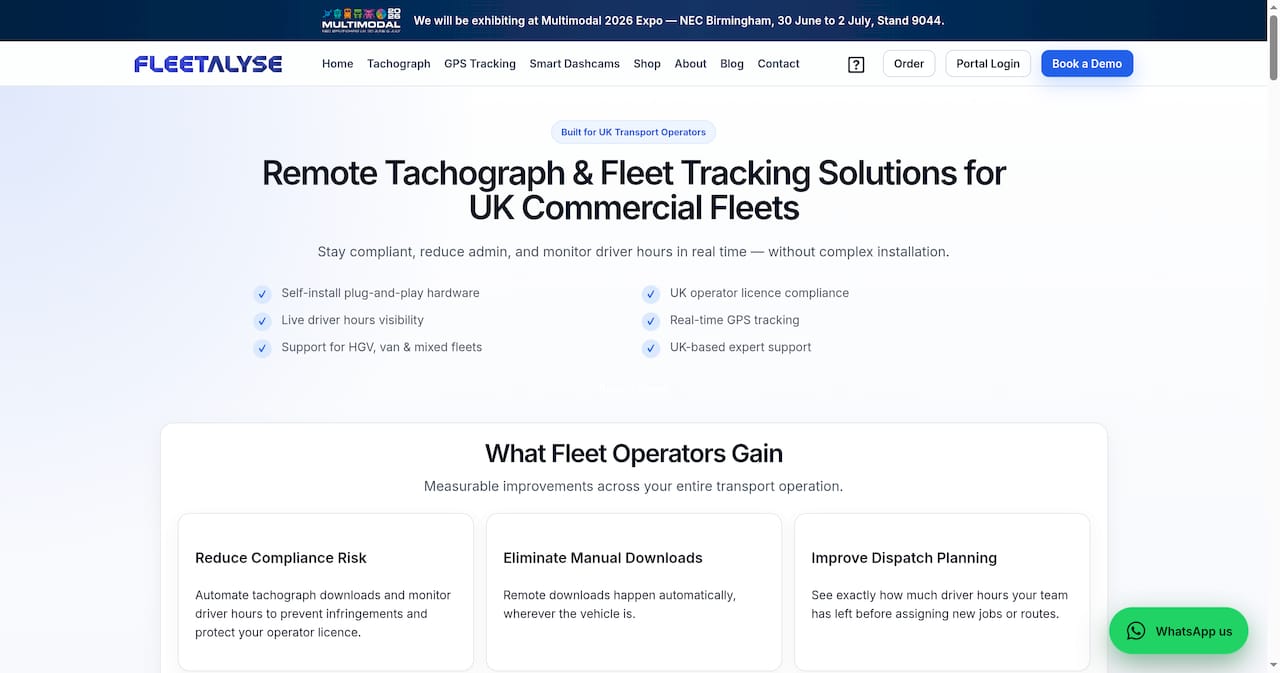
The platform automates remote tachograph downloads, monitors driver hours in real time, and integrates fuel card data to flag discrepancies. Every feature is designed around UK regulatory requirements, including DVSA compliance and Operator Licence obligations. UK-based support means you speak to someone who understands your operating context. Visit Fleetalyse to see the full range of tracking and compliance solutions available for your fleet.
FAQ
What are the main benefits of HGV GPS real-time tracking?
The main benefits are reduced fuel costs, automated tachograph compliance, improved theft recovery, and more accurate customer ETAs. Integrated platforms combine all of these into a single operational tool rather than separate systems.
How much can GPS tracking reduce fuel costs for HGV fleets?
Route optimisation and idling management reduce fuel consumption by 15–30%, and overall operational costs can fall by up to 25% with full implementation.
Does GPS tracking help with DVSA tachograph compliance?
Yes. Telematics with remote tachograph download capability automates data collection, removes manual errors, and ensures download frequency requirements are met, reducing the risk of DVSA fines.
What is the difference between Thatcham S5 and S7 trackers?
Thatcham S5 trackers include a 24/7 professional monitoring centre that coordinates with police during theft events. S7 trackers provide self-monitoring only. S5 systems achieve approximately 95% vehicle recovery rates due to direct police coordination.
Can GPS tracking integrate with a transport management system?
Yes. Platforms such as Fleetalyse integrate with TMS software and fuel card providers, allowing compliance workflows and fuel spend verification to run automatically rather than requiring manual cross-referencing.