
In UK logistics, vehicle tracking is no longer just about finding a van; it's about synchronising location with live compliance data to protect your operator licence. You likely feel the daily weight of manual tachograph downloads and the constant risk of DVSA fines for driver hours infringements. It's a common frustration for regional operators who need total visibility over HGVs, vans, and trailers without the administrative headache. Choosing the right vehicle tracking for logistics companies is the difference between a simple map and a proactive management tool that keeps your business moving.
This article explains how integrated systems transform basic GPS monitoring into a robust engine for efficiency and regulatory adherence. We'll show you how to automate your compliance reporting and gain real-time visibility across your entire asset list. You'll learn how to reduce fuel and maintenance costs by focusing on the data that actually matters. From the July 2026 tachograph requirements for international LCVs to the Progressive Safe System standards in London, we cover the practical steps to modernise your fleet operations while prioritising functional utility.
Key Takeaways
- Shift your focus from basic GPS monitoring to a holistic data ecosystem that synchronises location with live compliance.
- Discover how vehicle tracking for logistics companies automates remote tachograph downloads to eliminate manual admin and prevent DVSA fines.
- Learn to manage HGVs, vans, and trailers through a single interface for total visibility across your entire asset list.
- Secure driver buy-in with a pragmatic rollout strategy based on transparency and clear operational benefits.
- Prioritise regulatory adherence by selecting a specialist partner that values functional utility over unnecessary software features.
What is Vehicle Tracking for Logistics in 2026?
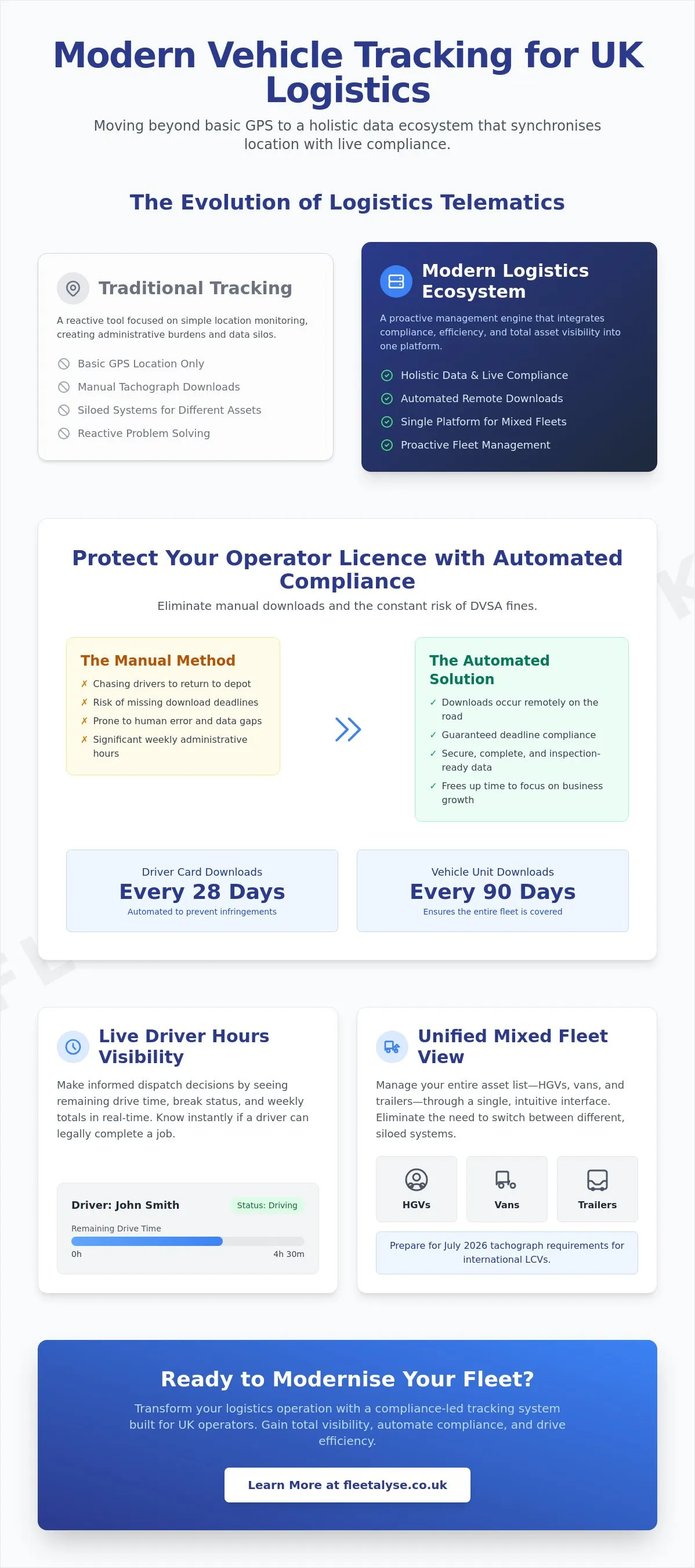
In 2026, vehicle tracking for logistics companies is a holistic data ecosystem rather than a simple location tool. It's the central nervous system of a transport operation. This technology has evolved from basic hardware to a sophisticated blend of GPS devices, cloud-based software, and deep data integration. For UK operators, this infrastructure is vital for managing the complexities of regional motorways and urban low-emission zones. To understand the technical foundation, it helps to ask: What is a vehicle tracking system? At its core, it's a method for monitoring assets, but modern logistics requires much more than a coordinate on a map. It requires the synchronisation of vehicle health, driver behaviour, and legal compliance data into one interface. This shift moves the industry away from reactive monitoring toward proactive management. It's no longer about where your vehicle was; it's about what it's doing right now and how that affects your bottom line.
The hardware itself has become more resilient and easier to install. Many providers now offer plug-and-play OBD devices alongside hardwired units for HGVs. This flexibility allows companies to scale their tracking capabilities as their fleet grows. In the UK, where congestion costs the economy billions, the ability to bypass traffic hotspots using real-time data is a competitive necessity. You aren't just buying a tracker; you're investing in an efficiency engine that supports the entire supply chain.
The Evolution of Logistics Telematics
Connectivity changed everything. The widespread adoption of 4G and 5G networks means live data is now the industry standard. Historical 'passive' tracking is obsolete. Today's 'active' monitoring provides a constant stream of information. Logistics firms are moving away from siloed systems. They want a single platform where van tracking, HGV data, and trailer locations sit side-by-side. This reduces the administrative burden significantly.
Core Benefits for UK Transport Operators
The financial gains are immediate. Effective vehicle tracking for logistics companies reduces fuel costs by identifying excessive idling and optimising routes. It's a cornerstone of regulatory safety. It plays a critical role for those seeking 'Earned Recognition' status with the DVSA. Additionally, providing accurate ETAs improves customer trust. In a sector where timing is everything, real-time visibility ensures you never leave a client guessing.
Compliance-Led Tracking: Integrating Tachograph and Driver Hours
Compliance is the backbone of any UK transport operation. For HGV and PSV operators, a single missed tachograph download can trigger a DVSA audit or a heavy fine. Traditional vehicle tracking for logistics companies often stops at location data, but location alone doesn't protect your operator licence. Managing driver cards and vehicle units manually is a logistical nightmare. It involves chasing drivers, using physical download tools, and managing constant calendar reminders. It's time-consuming and prone to human error. Modern tracking must bridge the gap between GPS and the digital tachograph to ensure you're always legal and efficient.
The transition from manual to automated systems is a significant shift in operational strategy. Many regional operators still rely on drivers to 'swipe' their cards at a depot terminal. This creates data gaps if a driver is away for several days. By integrating tachograph data with your tracking platform, you create a fail-safe system that works in the background. It allows you to focus on growth rather than paperwork.
The Value of Remote Tachograph Downloads
Remote tachograph download technology pulls encrypted data directly from the vehicle whilst it's on the road. You no longer need to wait for a driver to return to the depot to download cards or vehicle units. This saves hours of administrative time every single week. It also eliminates the risk of missing the mandatory 28-day card or 90-day vehicle unit download deadlines. By automating this process, you ensure your records are always up to date and ready for inspection. It provides peace of mind that your data is secure and your business remains compliant without constant manual intervention.
Real-Time Driver Hours Monitoring
Dispatchers need more than a map; they need to know if a driver can legally complete a job. Live driver hours visibility allows you to see remaining drive time, break status, and weekly totals instantly. This data helps you improve fleet productivity by assigning loads based on actual availability rather than guesswork. Integrating this with tachograph analysis software creates a seamless loop of data. It prevents accidental infringements before they happen. If you're ready to automate your compliance workflow, you can configure your setup online today. This integration ensures that every decision made in the transport office is backed by real-time legal data, keeping your drivers safe and your business protected.

Managing Mixed Fleets: HGVs, Vans, and Trailers
Most logistics firms don't rely on a single vehicle type. Your yard likely contains a mix of heavy goods vehicles, transit vans, and unpowered trailers. Managing these assets through separate interfaces is a recipe for operational blindness. A unified strategy for vehicle tracking for logistics companies ensures that every asset, whether it's a 44-tonne tractor unit or a small delivery van, is visible on a single pane of glass. This integration is vital for regional operators who need to balance long-haul trunking with agile last-mile deliveries. It's about having a total overview of your capacity at any given moment.
HGVs have distinct requirements compared to smaller commercial vehicles. They operate on different power voltages and require robust, hardwired installation to ensure data integrity during long shifts. Beyond simple location, monitoring speed limiters and engine idling becomes essential for maintaining safety standards and controlling high fuel overheads. In contrast, van tracking serves a different purpose. It's often the tool of choice for managing tight delivery windows in congested urban centres. Whilst the hardware might vary, the goal remains the same: total operational clarity across the entire fleet.
HGV and Van Tracking Nuances
The technical setup differs significantly between vehicle classes. HGV installations often involve 24V power systems and complex integration with the vehicle's CAN bus. This allows for detailed reporting on fuel consumption and mechanical health. Van tracking focuses more on high-frequency stops and precise urban navigation. For 3.5-tonne vehicles, the priority is often reducing door-to-door time and providing customers with reliable ETAs. A pragmatic approach recognises that a van driver's day is fundamentally different from a long-haul trucker's, and the software must reflect those unique pressures.
Trailer and Asset Security
Unpowered assets are frequently the blind spot in a logistics chain. Trailers and cargo containers spend significant time detached from a tractor unit's power source. Long-life battery trackers solve this problem. These devices can operate for years on a single charge, sending periodic location updates even when parked in a remote yard. It's a simple, reliable way to protect expensive equipment.
Security features like hook and unhook alerts provide immediate notifications when a trailer is moved. This prevents unauthorised use and helps yard managers keep track of available capacity. Asset tracking also extends to mobile plant and expensive equipment. By including these in your vehicle tracking for logistics companies, you protect your capital investments and ensure that every piece of kit is exactly where it's supposed to be. This comprehensive approach eliminates the guesswork that often plagues mixed-fleet operations.
How to Implement a Tracking Strategy for Your Logistics Business
Transitioning from manual logs to automated data collection requires a pragmatic plan. It isn't just about sticking a box in a dashboard. Successful implementation of vehicle tracking for logistics companies involves auditing your current friction points and choosing tools that solve specific problems. Many operators make the mistake of collecting too much data and acting on none of it. Focus on data quality. Start with the information that protects your operator licence and reduces your overheads immediately. Implementing the right vehicle tracking for logistics companies helps you move from reactive fire-fighting to proactive management.
A structured rollout ensures your team adapts quickly. It prevents the operational dip that often follows new technology adoption. Follow these steps to build a strategy that works for your regional infrastructure.
Step 1: Audit Your Compliance Gaps
Identify where your manual processes fail. Are you missing tachograph download deadlines? Do your dispatchers struggle to know who has remaining drive time? Determine if you need full live driver hours or just basic GPS location. A thorough audit prevents you from paying for features you don't need whilst ensuring you cover your legal bases. Verify your current tachograph analysis workflow to see if it integrates with modern telematics.
Step 2: Selecting the Right Hardware and Software
Match the hardware to the asset. HGVs usually require hard-wired trackers for reliable 24V power and CAN bus data. Vans can often utilise plug-and-play options for faster deployment. Your software platform must handle multiple asset types in a single view. This prevents the administrative burden of switching between different apps. Ensure the system can scale as you add more trailers or specialised equipment.
Step 3: Training and Driver Engagement
Clear communication is essential for driver buy-in. Explain the personal benefits to them. Automated downloads mean they don't have to wait around at the depot after a long shift. Accurate tracking provides an objective record that can protect them from unfair claims. Set clear policies on data use. Establish a routine for reviewing reports. This turns data into a catalyst for operational improvement rather than just a monitoring tool.
Choosing the right partner is the final piece of the puzzle. Look for a provider with transparent pricing and a deep understanding of UK transport laws. If you're ready to move away from manual chaos, you can configure your tracking hardware online to get started. Focus on a partner that prioritises functional utility over flashy, unnecessary features.
Why Fleetalyse is the Pragmatic Choice for UK Logistics
Fleetalyse is a specialist in transport compliance. We aren't a distant, generic software provider. Our platform is built specifically for the practical needs of UK operators who face unique regulatory pressures every day. In an industry where hidden costs and complex contracts are common, we prioritise transparency. We understand that vehicle tracking for logistics companies must be more than a theoretical data exercise. It has to be a reliable ally in your daily operations. Our compliance-first philosophy ensures that every feature we develop serves a functional purpose, helping you maintain your operator licence with confidence and ease.
Choosing a partner who understands regional infrastructure makes a significant difference to your bottom line. We've designed our services to withstand the rigours of real-world application. Whether you're managing a handful of vans or a large fleet of HGVs and trailers, our focus remains on operational clarity and fairness. We move quickly from identifying your compliance gaps to offering a detailed, transparent solution. This straightforward approach prevents you from feeling overwhelmed by data, providing instead a steady stream of information that leads to better decision-making.
Specialist Expertise for Regional Operators
Being a UK-based specialist matters for both compliance and support. We understand the specific challenges of domestic regulations and the vital importance of localised industry insight. Generic trackers often neglect the complexities of HGVs and unpowered trailers. We don't. Our system provides seamless integration with tachograph analysis tools, ensuring your data flows exactly where it needs to go without manual intervention. This specialised focus helps you avoid the pitfalls of one-size-fits-all software that lacks deep industry credentials.
Transparent and Reliable Service
Reliability is our signature. We provide straightforward pricing with no hidden complexities or contractual surprises. Our hardware is built for the tough environment of the transport industry. We value your time and resources, which is why we prioritise functional utility over flashy, unnecessary features. You can trust that our data is accurate and our platform is stable. It's time to simplify your compliance workflow and protect your business with a pragmatic expert partner. Book a demo to see our live driver hours and tacho solutions and discover how our vehicle tracking for logistics companies can transform your fleet management into a robust efficiency engine.
Future-Proof Your Fleet Compliance
The shift from simple location monitoring to a holistic data ecosystem is essential for any regional operator. By integrating remote tachograph downloads and live driver hours, you eliminate the administrative burden of manual data collection and protect your operator licence from DVSA infringements. Managing a mixed fleet of HGVs, vans, and trailers through a single interface provides the visibility needed to reduce fuel costs and improve customer service. Implementing effective vehicle tracking for logistics companies isn't just about security; it's about building a robust engine for long-term efficiency.
Fleetalyse offers a pragmatic solution designed specifically for UK transport operator standards. We are specialists in remote tachograph downloads and provide real-time visibility of live driver hours to keep your business moving. Our focus remains on functional utility and operational clarity rather than unnecessary software features. Trust a partner that understands the rigours of the domestic market and values your resources. Optimise your fleet compliance with Fleetalyse tracking today and take control of your asset management with confidence.
Frequently Asked Questions
Is vehicle tracking legal for logistics companies in the UK?
Vehicle tracking is entirely legal in the UK provided you comply with the Data Protection Act 2018 and UK GDPR. You must have a legitimate interest for tracking and be transparent with your employees about what data is collected. It's essential to have a clear policy in place that explains how the information is used to manage the business and ensure safety.
How much does it cost to install tracking across a large logistics fleet?
Installation costs vary based on whether you choose hardwired units for HGVs or plug-and-play devices for smaller vans. Hardwired trackers require a professional technician to ensure the data integration is secure and reliable. Many providers offer hardware as part of a bundled subscription deal, which helps to spread the initial setup costs across the contract term.
Can vehicle tracking help with my DVSA Operator Licence compliance?
Effective vehicle tracking for logistics companies is a vital tool for maintaining DVSA compliance. It automates the remote download of tachograph data and provides live visibility of driver hours. This prevents accidental infringements and ensures your records are always up to date. Proactive data management like this is a core requirement for operators seeking Earned Recognition status.
Will vehicle tracking drain the battery on my HGVs or trailers?
Modern tracking hardware won't drain your vehicle's battery during normal operations. HGV units are designed to draw minimal power from the 24V system whilst the engine is switched off. For unpowered equipment, specialist trailer tracking devices use internal long-life batteries. these units operate independently for several years without needing a constant power source from a tractor unit.
How does remote tachograph download work with a tracking system?
Remote tachograph download works by pulling encrypted data directly from the vehicle unit and driver card via the tracking hardware. This information is transmitted over the 4G or 5G network to a secure server for analysis. The process happens automatically in the background whilst the vehicle is on the road. It removes the need for drivers to manually download data at a depot.
Can I track unpowered trailers and assets in the same system as my vans?
You can manage unpowered trailers, mobile plant, and vans within a single software interface. This provides a total overview of your fleet capacity on one screen. Using a unified system eliminates the administrative burden of switching between different applications. It ensures that every asset, regardless of its power source, is accounted for in your daily operational planning.
How do drivers typically react to vehicle tracking being installed?
Drivers usually respond well when the operational benefits are explained with transparency. Automated downloads mean they don't have to wait around at the depot after a long shift to swipe their cards. Accurate tracking also provides an objective record that can protect them from unfair performance reviews. It acts as a digital witness that supports them in the event of false accident claims.
What is the ROI for a logistics company using advanced vehicle tracking?
The return on investment for vehicle tracking for logistics companies comes from fuel savings and reduced administrative overheads. Automating your tachograph downloads saves hours of manual office work every week. Additionally, real-time visibility helps dispatchers optimise routes and avoid the heavy financial penalties associated with driver hours infringements. These cumulative gains often cover the subscription costs within the first few months.
Frequently asked questions
The Evolution of Logistics Telematics
Connectivity changed everything. The widespread adoption of 4G and 5G networks means live data is now the industry standard. Historical 'passive' tracking is obsolete. Today's 'active' monitoring provides a constant stream of information. Logistics firms are moving away from siloed systems. They want a single platform where van tracking, HGV data, and trailer locations sit side-by-side. This reduces the administrative burden significantly.
Core Benefits for UK Transport Operators
The financial gains are immediate. Effective vehicle tracking for logistics companies reduces fuel costs by identifying excessive idling and optimising routes. It's a cornerstone of regulatory safety. It plays a critical role for those seeking 'Earned Recognition' status with the DVSA. Additionally, providing accurate ETAs improves customer trust. In a sector where timing is everything, real-time visibility ensures you never leave a client guessing. Compliance is the backbone of any UK transport operation. For HGV and PSV operators, a single missed tachograph download can trigger a DVSA audit or a heavy fine. Traditional vehicle tracking for logistics companies often stops at location data, but location alone doesn't protect your operator licence. Managing driver cards and vehicle units manually is a logistical nightmare. It involves chasing drivers, using physical download tools, and managing constant calendar reminders. It's time-consuming and prone to human error. Modern tracking must bridge the gap between GPS and the digital tachograph to ensure you're always legal and efficient. The transition from manual to automated systems is a significant shift in operational strategy. Many regional operators still rely on drivers to 'swipe' their cards at a depot terminal. This creates data gaps if a driver is away for several days. By integrating tachograph data with your tracking platform, you create a fail-safe system that works in the background. It allows you to focus on growth rather than paperwork.
The Value of Remote Tachograph Downloads
Remote tachograph download technology pulls encrypted data directly from the vehicle whilst it's on the road. You no longer need to wait for a driver to return to the depot to download cards or vehicle units. This saves hours of administrative time every single week. It also eliminates the risk of missing the mandatory 28-day card or 90-day vehicle unit download deadlines. By automating this process, you ensure your records are always up to date and ready for inspection. It provides peace of mind that your data is secure and your business remains compliant without constant manual intervention.
Real-Time Driver Hours Monitoring
Dispatchers need more than a map; they need to know if a driver can legally complete a job. Live driver hours visibility allows you to see remaining drive time, break status, and weekly totals instantly. This data helps you improve fleet productivity by assigning loads based on actual availability rather than guesswork. Integrating this with tachograph analysis software creates a seamless loop of data. It prevents accidental infringements before they happen. If you're ready to automate your compliance workflow, you can configure your setup online today. This integration ensures that every decision made in the transport office is backed by real-time legal data, keeping your drivers safe and your business protected. Most logistics firms don't rely on a single vehicle type. Your yard likely contains a mix of heavy goods vehicles, transit vans, and unpowered trailers. Managing these assets through separate interfaces is a recipe for operational blindness. A unified strategy for vehicle tracking for logistics companies ensures that every asset, whether it's a 44-tonne tractor unit or a small delivery van, is visible on a single pane of glass. This integration is vital for regional operators who need to balance long-haul trunking with agile last-mile deliveries. It's about having a total overview of your capacity at any given moment. HGVs have distinct requirements compared to smaller commercial vehicles. They operate on different power voltages and require robust, hardwired installation to ensure data integrity during long shifts. Beyond simple location, monitoring speed limiters and engine idling becomes essential for maintaining safety standards and controlling high fuel overheads. In contrast, van tracking serves a different purpose. It's often the tool of choice for managing tight delivery windows in congested urban centres. Whilst the hardware might vary, the goal remains the same: total operational clarity across the entire fleet.
HGV and Van Tracking Nuances
The technical setup differs significantly between vehicle classes. HGV installations often involve 24V power systems and complex integration with the vehicle's CAN bus. This allows for detailed reporting on fuel consumption and mechanical health. Van tracking focuses more on high-frequency stops and precise urban navigation. For 3.5-tonne vehicles, the priority is often reducing door-to-door time and providing customers with reliable ETAs. A pragmatic approach recognises that a van driver's day is fundamentally different from a long-haul trucker's, and the software must reflect those unique pressures.
Trailer and Asset Security
Unpowered assets are frequently the blind spot in a logistics chain. Trailers and cargo containers spend significant time detached from a tractor unit's power source. Long-life battery trackers solve this problem. These devices can operate for years on a single charge, sending periodic location updates even when parked in a remote yard. It's a simple, reliable way to protect expensive equipment. Security features like hook and unhook alerts provide immediate notifications when a trailer is moved. This prevents unauthorised use and helps yard managers keep track of available capacity. Asset tracking also extends to mobile plant and expensive equipment. By including these in your vehicle tracking for logistics companies, you protect your capital investments and ensure that every piece of kit is exactly where it's supposed to be. This comprehensive approach eliminates the guesswork that often plagues mixed-fleet operations. Transitioning from manual logs to automated data collection requires a pragmatic plan. It isn't just about sticking a box in a dashboard. Successful implementation of vehicle tracking for logistics companies involves auditing your current friction points and choosing tools that solve specific problems. Many operators make the mistake of collecting too much data and acting on none of it. Focus on data quality. Start with the information that protects your operator licence and reduces your overheads immediately. Implementing the right vehicle tracking for logistics companies helps you move from reactive fire-fighting to proactive management. A structured rollout ensures your team adapts quickly. It prevents the operational dip that often follows new technology adoption. Follow these steps to build a strategy that works for your regional infrastructure.
Step 1: Audit Your Compliance Gaps
Identify where your manual processes fail. Are you missing tachograph download deadlines? Do your dispatchers struggle to know who has remaining drive time? Determine if you need full live driver hours or just basic GPS location. A thorough audit prevents you from paying for features you don't need whilst ensuring you cover your legal bases. Verify your current tachograph analysis workflow to see if it integrates with modern telematics.
Step 2: Selecting the Right Hardware and Software
Match the hardware to the asset. HGVs usually require hard-wired trackers for reliable 24V power and CAN bus data. Vans can often utilise plug-and-play options for faster deployment. Your software platform must handle multiple asset types in a single view. This prevents the administrative burden of switching between different apps. Ensure the system can scale as you add more trailers or specialised equipment.
Step 3: Training and Driver Engagement
Clear communication is essential for driver buy-in. Explain the personal benefits to them. Automated downloads mean they don't have to wait around at the depot after a long shift. Accurate tracking provides an objective record that can protect them from unfair claims. Set clear policies on data use. Establish a routine for reviewing reports. This turns data into a catalyst for operational improvement rather than just a monitoring tool. Choosing the right partner is the final piece of the puzzle. Look for a provider with transparent pricing and a deep understanding of UK transport laws. If you're ready to move away from manual chaos, you can configure your tracking hardware online to get started. Focus on a partner that prioritises functional utility over flashy, unnecessary features. Fleetalyse is a specialist in transport compliance. We aren't a distant, generic software provider. Our platform is built specifically for the practical needs of UK operators who face unique regulatory pressures every day. In an industry where hidden costs and complex contracts are common, we prioritise transparency. We understand that vehicle tracking for logistics companies must be more than a theoretical data exercise. It has to be a reliable ally in your daily operations. Our compliance-first philosophy ensures that every feature we develop serves a functional purpose, helping you maintain your operator licence with confidence and ease. Choosing a partner who understands regional infrastructure makes a significant difference to your bottom line. We've designed our services to withstand the rigours of real-world application. Whether you're managing a handful of vans or a large fleet of HGVs and trailers, our focus remains on operational clarity and fairness. We move quickly from identifying your compliance gaps to offering a detailed, transparent solution. This straightforward approach prevents you from feeling overwhelmed by data, providing instead a steady stream of information that leads to better decision-making.
Specialist Expertise for Regional Operators
Being a UK-based specialist matters for both compliance and support. We understand the specific challenges of domestic regulations and the vital importance of localised industry insight. Generic trackers often neglect the complexities of HGVs and unpowered trailers. We don't. Our system provides seamless integration with tachograph analysis tools, ensuring your data flows exactly where it needs to go without manual intervention. This specialised focus helps you avoid the pitfalls of one-size-fits-all software that lacks deep industry credentials.
Transparent and Reliable Service
Reliability is our signature. We provide straightforward pricing with no hidden complexities or contractual surprises. Our hardware is built for the tough environment of the transport industry. We value your time and resources, which is why we prioritise functional utility over flashy, unnecessary features. You can trust that our data is accurate and our platform is stable. It's time to simplify your compliance workflow and protect your business with a pragmatic expert partner. Book a demo to see our live driver hours and tacho solutions and discover how our vehicle tracking for logistics companies can transform your fleet management into a robust efficiency engine. The shift from simple location monitoring to a holistic data ecosystem is essential for any regional operator. By integrating remote tachograph downloads and live driver hours, you eliminate the administrative burden of manual data collection and protect your operator licence from DVSA infringements. Managing a mixed fleet of HGVs, vans, and trailers through a single interface provides the visibility needed to reduce fuel costs and improve customer service. Implementing effective vehicle tracking for logistics companies isn't just about security; it's about building a robust engine for long-term efficiency. Fleetalyse offers a pragmatic solution designed specifically for UK transport operator standards. We are specialists in remote tachograph downloads and provide real-time visibility of live driver hours to keep your business moving. Our focus remains on functional utility and operational clarity rather than unnecessary software features. Trust a partner that understands the rigours of the domestic market and values your resources. Optimise your fleet compliance with Fleetalyse tracking today and take control of your asset management with confidence.
Is vehicle tracking legal for logistics companies in the UK?
Vehicle tracking is entirely legal in the UK provided you comply with the Data Protection Act 2018 and UK GDPR. You must have a legitimate interest for tracking and be transparent with your employees about what data is collected. It's essential to have a clear policy in place that explains how the information is used to manage the business and ensure safety.
How much does it cost to install tracking across a large logistics fleet?
Installation costs vary based on whether you choose hardwired units for HGVs or plug-and-play devices for smaller vans. Hardwired trackers require a professional technician to ensure the data integration is secure and reliable. Many providers offer hardware as part of a bundled subscription deal, which helps to spread the initial setup costs across the contract term.
Can vehicle tracking help with my DVSA Operator Licence compliance?
Effective vehicle tracking for logistics companies is a vital tool for maintaining DVSA compliance. It automates the remote download of tachograph data and provides live visibility of driver hours. This prevents accidental infringements and ensures your records are always up to date. Proactive data management like this is a core requirement for operators seeking Earned Recognition status.
Will vehicle tracking drain the battery on my HGVs or trailers?
Modern tracking hardware won't drain your vehicle's battery during normal operations. HGV units are designed to draw minimal power from the 24V system whilst the engine is switched off. For unpowered equipment, specialist trailer tracking devices use internal long-life batteries. these units operate independently for several years without needing a constant power source from a tractor unit.
How does remote tachograph download work with a tracking system?
Remote tachograph download works by pulling encrypted data directly from the vehicle unit and driver card via the tracking hardware. This information is transmitted over the 4G or 5G network to a secure server for analysis. The process happens automatically in the background whilst the vehicle is on the road. It removes the need for drivers to manually download data at a depot.
Can I track unpowered trailers and assets in the same system as my vans?
You can manage unpowered trailers, mobile plant, and vans within a single software interface. This provides a total overview of your fleet capacity on one screen. Using a unified system eliminates the administrative burden of switching between different applications. It ensures that every asset, regardless of its power source, is accounted for in your daily operational planning.
How do drivers typically react to vehicle tracking being installed?
Drivers usually respond well when the operational benefits are explained with transparency. Automated downloads mean they don't have to wait around at the depot after a long shift to swipe their cards. Accurate tracking also provides an objective record that can protect them from unfair performance reviews. It acts as a digital witness that supports them in the event of false accident claims.
What is the ROI for a logistics company using advanced vehicle tracking?
The return on investment for vehicle tracking for logistics companies comes from fuel savings and reduced administrative overheads. Automating your tachograph downloads saves hours of manual office work every week. Additionally, real-time visibility helps dispatchers optimise routes and avoid the heavy financial penalties associated with driver hours infringements. These cumulative gains often cover the subscription costs within the first few months.