
How much of your week is lost to manual data collection and the nagging worry of a DVSA audit? For most fleet managers, the administrative burden of tracking driver hours and fuel spend has reached a breaking point. You already understand that a modern business van tracking system uk must do more than show a vehicle's location. It needs to act as a shield for your operator licence while actively cutting the costs of a 3.5-tonne fleet.
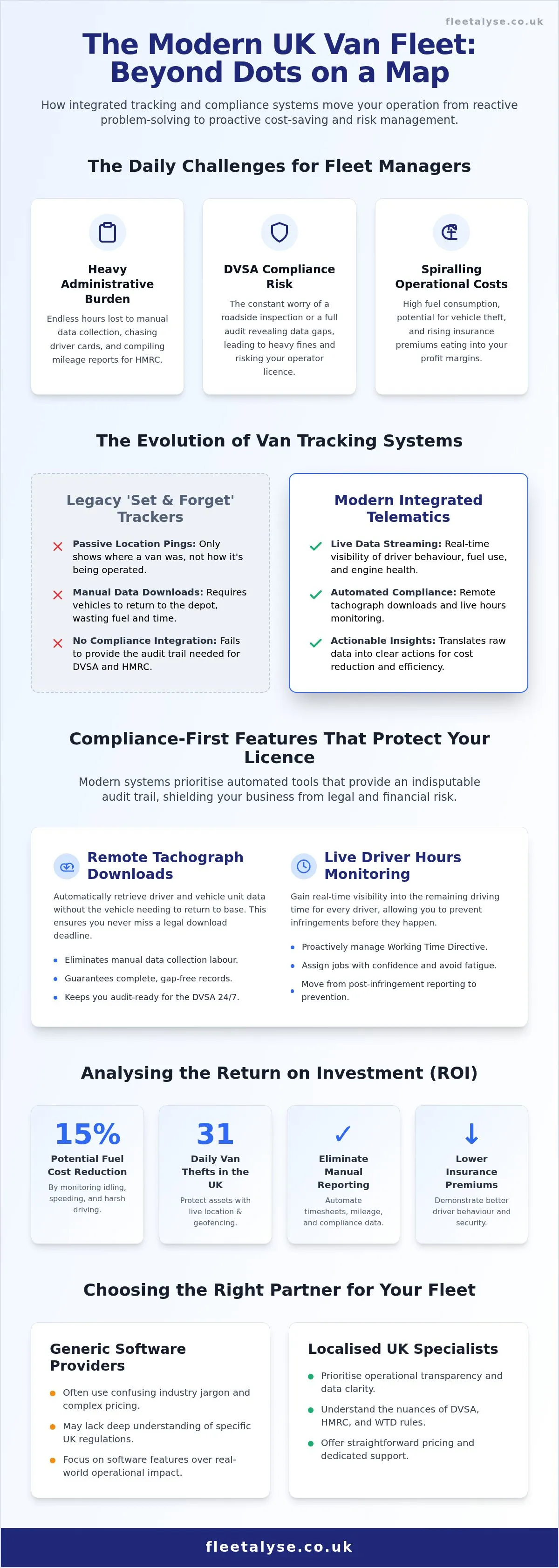
We agree that the era of "set and forget" telematics is over, especially with the Smart Tachograph 2 mandate now affecting light commercial vehicles. This guide outlines how to integrate GPS tracking with automated compliance tools to eliminate manual reporting and reduce fuel consumption by up to 15%. You'll learn how to navigate the 2026 regulatory landscape, protect your assets from the 31 van thefts occurring daily in the UK, and find a specialist partner that offers straightforward pricing without the usual industry jargon. We'll show you how to move from basic dots on a map to a fully automated, compliant operation that values your time and your bottom line.
Key Takeaways
- Understand why a modern business van tracking system uk must integrate live driver hours and remote tachograph downloads to protect your operator licence.
- Learn how to automate manual data collection, significantly reducing administrative overheads and the risk of DVSA fines.
- Discover the specific telematics data points that can reduce fuel consumption and potentially lower insurance premiums through better driver behaviour.
- Evaluate the pros and cons of covert versus visible hardware installations to ensure fleet-wide adoption and clear driver policies.
- Identify the key differences between generic software providers and localised specialists who prioritise operational transparency and data clarity.
Understanding Business Van Tracking Systems in the UK Market
A modern business van tracking system uk is no longer just a security device hidden under a dashboard. While the core technology of a vehicle tracking system relies on GPS hardware, the real value lies in the cloud telematics layer. This software translates raw coordinates into actionable insights. In 2026, the market has shifted from passive logging to comprehensive operational management. Regional operators now use these tools to bridge the gap between office-based planning and real-world execution.
The Evolution of Telematics for UK Fleets
Telematics has moved past simple location pings. High-speed 4G and 5G connectivity allow for real-time data streaming. This means fleet managers don't have to wait for a vehicle to return to the yard to download data. Cloud-based platforms provide instant visibility across the entire fleet. You can monitor driver behaviour, fuel consumption, and engine health as it happens. This level of transparency is essential for managing the rigours of UK infrastructure. It moves the focus from "where is the van?" to "how is the van being operated?"
Regulatory Drivers for Van Tracking
Compliance is the primary reason UK businesses are ditching DIY trackers for professional systems. HMRC requires precise records for business versus private mileage to avoid tax penalties. Beyond tax, the Corporate Manslaughter Act places a heavy duty of care on employers. You must prove your drivers aren't fatigued or speeding. Simple "dots on a map" cannot provide the granular data needed for DVSA standards. A professional business van tracking system uk integrates directly with tachograph analysis software to protect your operator licence.
DIY trackers often lack the reliability and data security required for commercial use. They don't offer the integration needed for remote tachograph downloads or live driver hours monitoring. Professional systems provide a structured audit trail. This is vital during a DVSA inspection. By choosing a specialist provider like Fleetalyse, operators gain a partner that understands the specific challenges of UK regulations. It's about building a reliable operation, not just watching a screen. This shift toward integrated compliance is what separates industry leaders from those struggling with administrative overheads.
Compliance-First Features: Beyond Basic GPS Location
Security is often the first thought for van owners, but for regional operators, compliance is the greater risk. A professional business van tracking system uk must function as a robust compliance asset. It needs to provide a clear, indisputable audit trail for every mile driven. While security protects the physical asset, compliance protects your operator licence and your ability to trade. Moving beyond simple location pings allows you to manage the complex legal requirements of a modern fleet.
Remote Tachograph Downloads Explained
Manual data collection is a significant drain on administrative labour. It usually requires vehicles to return to a central depot specifically for data retrieval, which wastes both time and fuel. Remote tachograph download is an automated compliance safeguard that retrieves driver and vehicle data directly from the digital tachograph unit without physical intervention.
Systems that use automated scheduling ensure you never miss a legal download deadline. The hardware captures data whilst the vehicle is in transit, regardless of its location in the UK or Europe. This removes the need to "chase drivers" for their cards. It guarantees that your office records are always complete and ready for a DVSA inspection at a moment's notice. By automating this process, you eliminate the risk of missing data gaps that often lead to heavy fines.
Monitoring Live Driver Hours
Dispatchers frequently struggle with visibility regarding driver fatigue and legal limits. Integrating live driver hours monitoring into your daily dispatch routine solves this problem instantly. You gain real-time visibility into the remaining drive time for every individual in your fleet. This allows you to prevent infringements before they occur, rather than simply reporting them after the fact. It gives your team the confidence to assign jobs knowing the driver has the legal capacity to finish them.
Proactive management of the Working Time Directive becomes a seamless background process. This constant stream of data is a cornerstone of modern fleet optimization and ROI. It reduces the financial risk of legal penalties and prevents operational downtime caused by driver hours violations. When your system flags a potential breach before it happens, you're no longer just tracking vans; you're actively managing risk.
Engine telematics provide a deeper look into the health of your fleet. You can monitor idling, harsh braking, and fuel consumption patterns across all assets. This transparency helps identify training needs and mechanical issues before they become expensive failures. You can view our full range of compliance-led tracking solutions to see how these features can be tailored to your specific operational needs.
Analysing the ROI: How Tracking Systems Reduce Costs
Investing in a business van tracking system uk isn't just about security. It's a strategic move to recover lost margins. The "Cost of Inaction" is often the most significant financial burden for regional operators. Compliance failures don't just result in small penalties; they can lead to devastating fines or the total revocation of your operator licence. Protecting your bottom line starts with protecting your legal right to operate.
Fuel is likely your second largest expense after wages. Telematics data provides the visibility needed to monitor excessive idling and harsh acceleration. Industry data confirms that businesses can achieve fuel savings of 10-15% by using these insights to coach drivers. Security also plays a role in ROI. With approximately 11,273 vans stolen in the UK last year, or 31 per day, having GPS recovery tools is essential for insurance stability. Thatcham-approved hardware often acts as a lever to reduce premiums, providing immediate financial relief.
Improving Driver Behaviour and Safety
Identify high-risk driving patterns amongst your fleet staff before they lead to costly insurance claims. Use real-time data to organise driver training programmes that focus on safety and efficiency. Smoother driving habits lead to reduced maintenance costs. Tyres, brake pads, and engines last longer when they aren't subjected to aggressive use. It's a pragmatic way to extend the lifecycle of your assets whilst keeping your team safe on the road.
Streamlining HMRC Mileage Claims
Manual data entry is a hidden drain on your resources. Automated reporting separates private and business miles instantly. This precision reduces the risk of audit errors in HMRC fuel benefit claims. It simplifies end-of-month reporting for the finance department, turning a week-long administrative task into a few clicks. By eliminating manual logs, you remove the "hidden" costs of human error and administrative bloat. This transparency ensures that every penny spent on fuel is accurately accounted for, making your operation leaner and more resilient.

Deployment Strategy: Organising Your Fleet for Success
Successful deployment of a business van tracking system uk requires more than just hardware. It demands a structured rollout that aligns your workforce with your operational goals. Choosing between covert and visible installations is your first decision. Covert installations are superior for theft recovery because they are harder for criminals to locate and disable. Conversely, visible installations can act as a constant psychological deterrent against poor driving behaviour. Regardless of the hardware placement, a clear driver policy is essential. This document must outline exactly what data is collected and how it's used. Transparency prevents friction and ensures your fleet remains compliant with UK GDPR. It's about setting expectations from day one.
Hardware Selection and Professional Installation
While some generic providers suggest DIY options, professional installation is essential for a commercial fleet. It ensures that the hardware is correctly integrated with the vehicle's electrical system without voiding manufacturer warranties. Professional fitters also ensure the device is positioned for optimal signal strength, preventing data gaps during critical journeys. When selecting hardware, prioritising units that support tachograph analysis integration is vital. This future-proofs your investment as your fleet grows or as regulations evolve. Minimise vehicle downtime by scheduling installations in blocks. A staggered rollout prevents the entire fleet from being grounded simultaneously, maintaining your service levels whilst you upgrade your infrastructure.
Creating a Data-Driven Culture
Training your fleet managers to interpret telematics reports is the next step. Raw data is useless without the context to act on it. Set up automated alerts for geofencing and compliance breaches so your team can manage by exception rather than watching screens all day. Focus on using "Live Driver Hours" as a tool for support. If a driver is nearing their legal limit, dispatchers can intervene to find a safe stopping point or reassign a final drop. This shifts the perception of tracking from surveillance to a safety net. Review fleet performance metrics on a weekly basis to identify trends. Consistent feedback helps drivers understand that the system is there to protect their licence as much as the company's. When the workforce sees that data leads to better planning and less stress, adoption becomes seamless.
A well-organised deployment turns a technical tool into a core business asset. It provides the clarity needed to make frictionless decisions under pressure. To start your fleet's transition to a professional tracking environment, order your GPS Fleet Tracking hardware today and secure your fleet's future.
Fleetalyse: Integrated Tracking and Compliance for UK Operators
Fleetalyse isn't just another software provider. We're a UK-based technology company founded in 2020 with a narrow, deep focus: transport compliance and operator licence protection. Whether you manage HGVs, trailers, or a small fleet of LCVs, our business van tracking system uk is built for the practical demands of regional infrastructure. We prioritise functional utility over flashy, unnecessary features. This ensures you have the data you need to remain audit-ready without being overwhelmed by administrative noise. Our approach is grounded in transparency and reliability, providing a straightforward solution for operators who value their time.
Our platform simplifies remote tachograph downloads by removing the manual labour from the equation. You no longer need to visit vehicles or chase driver cards to stay compliant. Data is retrieved automatically and integrates seamlessly with your existing tachograph analysis software. This real-time visibility means you can spot issues before they become infringements. It’s about operational clarity. You see exactly where your assets are and, more importantly, how much legal driving time your team has left. This level of detail ensures your fleet is always prepared for a DVSA inspection.
Why Choose a Compliance-First Partner?
Working with a localised specialist gives you a distinct edge over generic competitors. You get direct support from experts who understand the rigours of the UK operator licence system. We don't hide behind global help desks or complex jargon. Fleetalyse integrates GPS fleet tracking with live compliance data to provide a unified view of your entire operation. This approach ensures that your tracking system isn't just a cost centre, but an active catalyst for operational improvement and risk management.
Next Steps for Your Fleet
Start your transition to a more efficient, compliant fleet today. See our published pricing, which sets out all costs upfront with no hidden fees. We value your resources, so we provide all financial and contractual details early in the process to ensure fairness. Arrange a demonstration of our live driver hours dashboard to see how real-time visibility can simplify your dispatching and protect your drivers. Finally, organise a consultation with our team to review your current compliance status. We'll help you identify data gaps and implement a business van tracking system uk that protects your business for the long term. Move away from manual logs and embrace a system built for the rigours of the modern industry.
Protect Your Operator Licence with Integrated Compliance
The function of a business van tracking system uk has evolved into a vital compliance asset. It's no longer sufficient to simply monitor vehicle locations. You must integrate real-time data with automated reporting to meet modern DVSA standards and protect your bottom line. By moving away from manual data collection, you eliminate human error and reduce the administrative overheads that drain your resources. This proactive approach ensures your business remains resilient against rising fuel costs and regulatory scrutiny.
Fleetalyse acts as your pragmatic expert partner. We are UK-based compliance specialists dedicated to providing automated remote tachograph downloads and real-time live driver hours monitoring. Our systems are built for the rigours of real-world application, ensuring your fleet stays audit-ready without the need for flashy, unnecessary features. It's time to replace guesswork with operational clarity. Take control of your fleet's future today.
Optimise your fleet compliance with Fleetalyse
Frequently Asked Questions
Is it legal to track business vans in the UK?
Tracking is legal in the UK when managed under the Data Protection Act and UK GDPR. You must have a lawful basis, such as for the safety of your staff or the security of your assets. It's essential to provide drivers with a clear privacy policy and display signage if dash cams are integrated. Transparency is key; ensuring your workforce understands why the data is collected prevents legal friction and improves trust.
How does a van tracking system help with HMRC compliance?
A business van tracking system uk simplifies HMRC compliance by automatically logging every journey. It distinguishes between business and private mileage with high precision, removing the need for manual mileage logs. This data is vital for calculating Benefit-in-Kind and fuel benefit claims accurately. By providing a digital audit trail, you significantly reduce the risk of errors and potential penalties during an HMRC inspection or financial audit.
What is the difference between GPS tracking and telematics?
GPS tracking is the foundational technology used to identify a vehicle's coordinates. Telematics is a more comprehensive system that combines GPS with onboard diagnostics. Whilst GPS shows you where a van is, telematics provides data on driver behaviour, fuel consumption, and engine health. For professional operators, telematics is the preferred choice because it offers the deep operational insights required to reduce costs and maintain fleet safety standards.
Can I track driver hours for vans under 3.5 tonnes?
Yes, tracking driver hours is both possible and increasingly necessary. As of July 2026, Smart Tachograph 2 devices are mandatory for light commercial vehicles between 2.5 and 3.5 tonnes used for international hire and reward transport. Even for domestic only fleets, monitoring hours is a pragmatic way to manage Duty of Care. It helps prevent fatigue related incidents and ensures your team adheres to the Working Time Directive without manual intervention.
How much does a business van tracking system typically cost?
Pricing for a professional business van tracking system uk typically involves an upfront hardware cost and a recurring monthly subscription. Some providers include hardware within the subscription fee for longer contracts. Costs depend on features like remote tachograph downloads or live driver hours monitoring. Rather than looking for the cheapest option, focus on the ROI gained through fuel savings and reduced administrative labour. Transparent providers will always provide clear, upfront quotes.
Will a tracking system help reduce my fleet insurance premiums?
Most UK insurers recognise the value of telematics and often offer lower premiums for fleets using Thatcham approved hardware. Tracking systems reduce the risk of total loss by improving the chances of vehicle recovery after a theft. Additionally, the data provided can prove a driver's innocence in the event of a non fault accident. Demonstrating a commitment to safer driving behaviour through monitoring makes your fleet a lower risk to underwriters.
What happens if a driver tampers with the tracking device?
Professional tracking hardware is designed with anti tamper features that trigger immediate alerts. If a device is disconnected or the GPS signal is jammed, the system notifies the fleet manager in real time. Tampering is usually a serious breach of company policy and can lead to disciplinary action. Using covert installations makes it significantly harder for unauthorised individuals to locate or disable the device, ensuring your data remains consistent and reliable.
Does van tracking require a monthly subscription?
Professional systems almost always require a monthly subscription to cover the costs of data transmission and software support. This fee ensures your hardware has a live connection via a SIM card and that your data is securely stored in the cloud. It also provides access to regular software updates and technical support. Reliable providers are transparent about these rates from the start, ensuring there are no hidden fees or unexpected contractual complexities.
Frequently asked questions
Why Choose a Compliance-First Partner?
Working with a localised specialist gives you a distinct edge over generic competitors. You get direct support from experts who understand the rigours of the UK operator licence system. We don't hide behind global help desks or complex jargon. Fleetalyse integrates GPS fleet tracking with live compliance data to provide a unified view of your entire operation. This approach ensures that your tracking system isn't just a cost centre, but an active catalyst for operational improvement and risk management.
Is it legal to track business vans in the UK?
Tracking is legal in the UK when managed under the Data Protection Act and UK GDPR. You must have a lawful basis, such as for the safety of your staff or the security of your assets. It's essential to provide drivers with a clear privacy policy and display signage if dash cams are integrated. Transparency is key; ensuring your workforce understands why the data is collected prevents legal friction and improves trust.
How does a van tracking system help with HMRC compliance?
A business van tracking system uk simplifies HMRC compliance by automatically logging every journey. It distinguishes between business and private mileage with high precision, removing the need for manual mileage logs. This data is vital for calculating Benefit-in-Kind and fuel benefit claims accurately. By providing a digital audit trail, you significantly reduce the risk of errors and potential penalties during an HMRC inspection or financial audit.
What is the difference between GPS tracking and telematics?
GPS tracking is the foundational technology used to identify a vehicle's coordinates. Telematics is a more comprehensive system that combines GPS with onboard diagnostics. Whilst GPS shows you where a van is, telematics provides data on driver behaviour, fuel consumption, and engine health. For professional operators, telematics is the preferred choice because it offers the deep operational insights required to reduce costs and maintain fleet safety standards.
Can I track driver hours for vans under 3.5 tonnes?
Yes, tracking driver hours is both possible and increasingly necessary. As of July 2026, Smart Tachograph 2 devices are mandatory for light commercial vehicles between 2.5 and 3.5 tonnes used for international hire and reward transport. Even for domestic only fleets, monitoring hours is a pragmatic way to manage Duty of Care. It helps prevent fatigue related incidents and ensures your team adheres to the Working Time Directive without manual intervention.
How much does a business van tracking system typically cost?
Pricing for a professional business van tracking system uk typically involves an upfront hardware cost and a recurring monthly subscription. Some providers include hardware within the subscription fee for longer contracts. Costs depend on features like remote tachograph downloads or live driver hours monitoring. Rather than looking for the cheapest option, focus on the ROI gained through fuel savings and reduced administrative labour. Transparent providers will always provide clear, upfront quotes.
Will a tracking system help reduce my fleet insurance premiums?
Most UK insurers recognise the value of telematics and often offer lower premiums for fleets using Thatcham approved hardware. Tracking systems reduce the risk of total loss by improving the chances of vehicle recovery after a theft. Additionally, the data provided can prove a driver's innocence in the event of a non fault accident. Demonstrating a commitment to safer driving behaviour through monitoring makes your fleet a lower risk to underwriters.
What happens if a driver tampers with the tracking device?
Professional tracking hardware is designed with anti tamper features that trigger immediate alerts. If a device is disconnected or the GPS signal is jammed, the system notifies the fleet manager in real time. Tampering is usually a serious breach of company policy and can lead to disciplinary action. Using covert installations makes it significantly harder for unauthorised individuals to locate or disable the device, ensuring your data remains consistent and reliable.
Does van tracking require a monthly subscription?
Professional systems almost always require a monthly subscription to cover the costs of data transmission and software support. This fee ensures your hardware has a live connection via a SIM card and that your data is securely stored in the cloud. It also provides access to regular software updates and technical support. Reliable providers are transparent about these rates from the start, ensuring there are no hidden fees or unexpected contractual complexities.