

The popular advice is to check the shipping line portal, confirm the port status, and treat the container as visible. That approach works only while the asset remains inside the data boundary of the carrier or terminal. Once it leaves the gate, the operator can lose sight of its movement, custody, condition and security.
A practical container tracking system UK operators can rely on must connect port-side information with road telematics. It should show where the container or trailer is, identify abnormal movement, preserve journey evidence and support the wider compliance process. GPS alone isn't enough, but a port portal alone is even less useful for a haulage business responsible for the road leg.
Table of Contents
- Rethinking Container Visibility for UK Haulage
- Comparing Tracking Technologies and Power Sources
- Essential Features for Security and Compliance
- Real World Use Cases and Loss Prevention
- Building Your Selection Checklist and Implementation Plan
- Securing Your Fleet and Next Steps
Rethinking Container Visibility for UK Haulage
A container can be visible in a port portal and still be operationally missing. The gap appears when custody passes from terminal to haulier, then to depot or customer. UK container volumes make that gap a practical security and compliance issue, not a niche technology project. Ports handled 15.4 million container units and 66.9 million tonnes of container cargo in 2025. Unit traffic rose 11% year on year, while tonnage increased 10%, according to the Department for Transport.
The quarterly figures point in the same direction. In the second quarter of 2026, container tonnage reached 18.7 million tonnes, up 9% on the same quarter of 2025, and units rose 12% to 1.7 million. London recorded a 19% increase, reaching 6.0 million tonnes during the quarter.
Those volumes explain the value of port portals, while exposing their boundary. A terminal dashboard can show a gate event, booking status or port milestone. It may not show that a trailer has left its approved route, stopped at an unsecured location, changed hands without a recorded event or reached the customer without a clean handover.
What active tracking adds
A dedicated system combines hardware, connectivity, location logic and event records. The device can sit on the container, trailer or vehicle. Its platform then converts telemetry into movement alerts, geofence entries and exits, journey history and exception records. The operational objective is active custody control, supported by evidence that can be reviewed after an incident.
Intermodal work exposes the handover problem clearly. An asset may move from vessel to terminal, terminal to haulier, haulier to depot and depot to customer. The port controls the first data segment, but the road operator remains responsible for visibility after collection. The same principle applies when comparing road workflows with broader shipping solutions for Nigerian importers. Port information and road custody are separate visibility problems.
A useful system should answer four questions quickly:
- Where is the asset? Show current and historical location instead of relying on the last manual scan.
- Has it moved as expected? Apply geofences around ports, depots, customer sites and approved parking areas.
- Has custody changed? Combine movement, arrival and departure events with door or tamper inputs where supported.
- Can the operator prove what happened? Retain timestamps, journeys and exception history for claims, disputes and handovers.
Portals work best inside their own networks. Road telematics takes over once the container or trailer enters the wider transport operation. A practical deployment joins both views without treating either source as complete end-to-end truth. For port-connected road operations, see this guide to container haulage specialists at Felixstowe, London Gateway and Southampton.
Comparing Tracking Technologies and Power Sources
Hardware selection decides whether a tracking rollout becomes a dependable control system or an expensive map with gaps. A powered HGV, an unattended dry container and a refrigerated trailer don't present the same installation, charging or connectivity problem.
Cellular GNSS is usually the practical choice for road assets. A multi-constellation receiver can maintain positioning when one satellite system or local view is less favourable, while cellular connectivity sends events to the platform. The limitation is network availability. Industrial estates, port perimeters and remote roads can create interruptions, so the device should buffer events and forward them when service returns.
Satellite telemetry offers broader coverage where cellular service is unreliable, but hardware, subscription and power demands can be higher. It makes more sense for particular high-value or remote movements than as the automatic choice for every domestic container.
| Hardware Type | Power Source | Best Use Case | Key Limitation |
|---|---|---|---|
| Battery-powered covert tracker | Internal battery | Unattended containers, trailers and assets in yards or parking areas | Battery life depends on reporting frequency, temperature and movement |
| Hardwired trailer tracker | Trailer electrical circuit | Regularly used trailers with accessible power | Installation can be more involved and the unit may lose power when the trailer is disconnected |
| HGV telematics unit | Vehicle battery, FMS connection or tachograph harness | Powered HGVs requiring vehicle location, driver-hours context and fleet reporting | It tracks the tractor well, but not necessarily a detached container or trailer |
| Reefer-connected hardware | Refrigeration or trailer power system | Refrigerated units where condition and equipment status matter | It needs compatibility with the refrigeration and electrical configuration |
| Satellite-enabled tracker | Dedicated satellite power arrangement | Remote routes or assets where cellular recovery isn't sufficient | Cost and energy demands can make it unsuitable for routine UK work |
The passive versus active choice also deserves care. A passive device may record movement for later review, which can suit low-priority assets. Active tracking sends alerts as events occur, making it more appropriate for theft risk, route deviation or high-value cargo. Reporting too often can shorten battery life and create alert noise. Reporting too rarely can leave the operator reacting after the useful moment has passed.
Match the device to the custody risk
For a parked trailer, the priority may be covert installation, movement detection and long dwell endurance. For an active HGV, the priority may be reliable power, driver-hours information, vehicle data and integration with existing fleet workflows. Refrigerated cargo may also need temperature and humidity monitoring, which location-only hardware can't provide.
The Container Owners Association's guide to container tracking and telematics technology describes the move from manual visibility towards digitally managed assets, including the importance of GNSS, geofencing, integrations and recoverable data. Buyers assessing a wider telematics proposition should also compare documented key platform features, but the decision should remain anchored to the asset, the power source and the operational event that must be detected.
For non-powered equipment, the relevant buying questions are different from those for a tractor unit. This overview of non-powered asset tracking is useful when the trailer or container can sit disconnected for long periods.
Practical rule: choose the hardware around the failure you need to detect. Don't buy a vehicle tracker and assume it provides continuous visibility of a detached container.
Essential Features for Security and Compliance
A blinking dot on a map doesn't prevent theft, settle a detention dispute or demonstrate that a fleet followed its operating procedures. The useful system converts location into events, exceptions and records that someone can act on.
UK freight crime gives the security question proper weight. NaVCIS estimated the cost of freight crime to the UK economy at about £428 million in 2021, while later reporting recorded 3,424 incidents in 2025 and £65.1 million in cost-price losses, averaging more than nine crimes per day, as summarised in the NaVCIS freight-crime problem profile. Separate industry reporting found that 74% of cargo thefts happened at unsecured locations, including laybys, independent roadside parking and unmonitored motorway service areas, also referenced in that freight-crime evidence.
Build alerts around operational exceptions
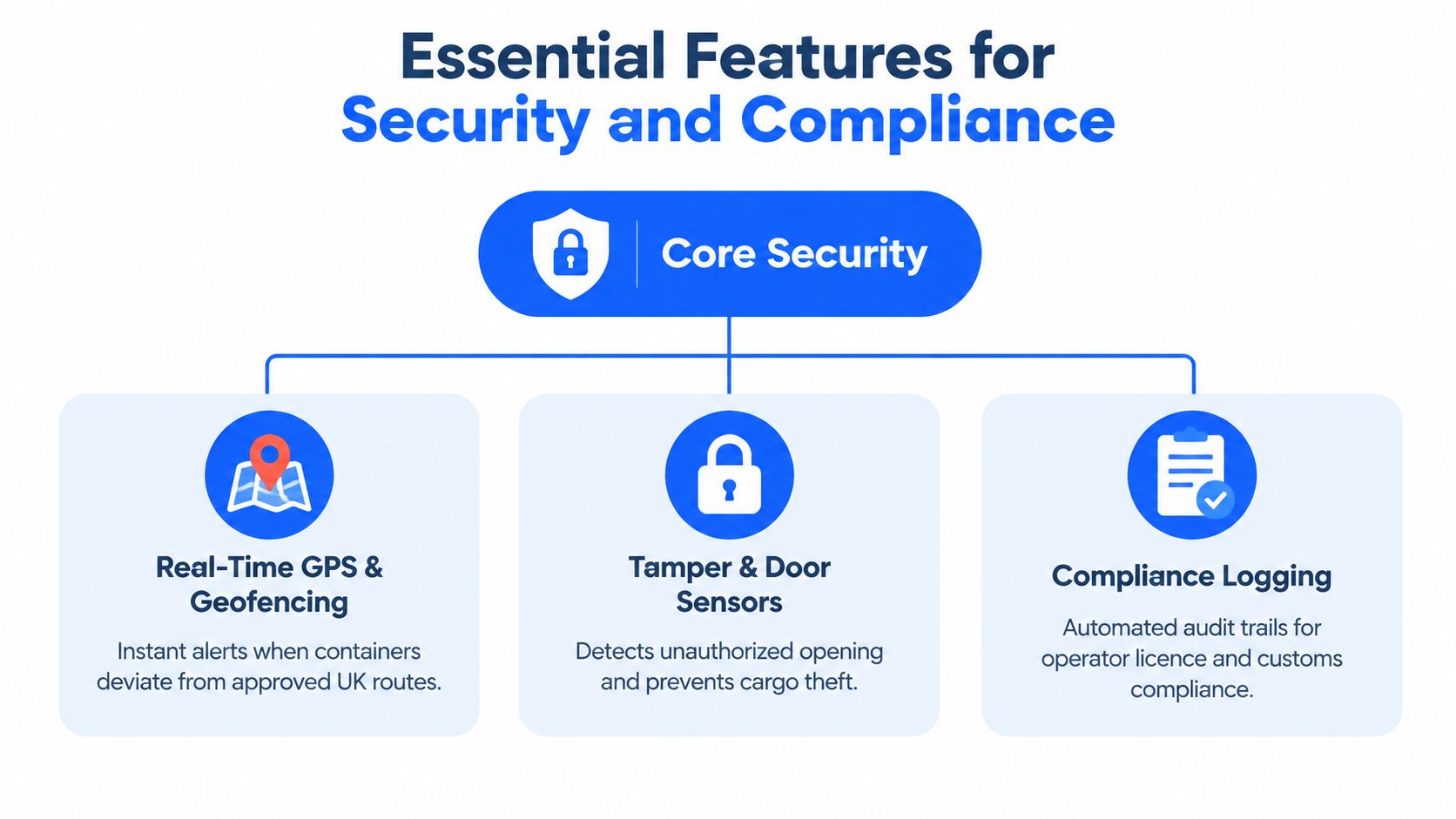
Geofences should represent real places and decisions, not arbitrary shapes drawn around a map. Create zones for the port terminal, company yard, approved customer locations and known handover points. Then define what should happen when the asset enters, exits, arrives outside an expected window or moves after being parked.
Door and tamper sensors add a second layer. A location event may tell you that a container moved, but a door event can indicate that custody or cargo condition changed. MSC describes smart containers with near-real-time visibility across the UK port network, including container position, door status, temperature and humidity through one platform, with GPS and door alerts across all 10 UK ports including Felixstowe, Liverpool and London Gateway, as described by IoT Technologies.
The practical workflow is straightforward:
- Movement alert: notify the control team when a parked asset begins moving.
- Geofence alert: flag an unexpected port exit, depot departure or customer-site arrival.
- Door event: investigate an opening outside an authorised location or time.
- Dwell exception: escalate an asset that remains stationary beyond the agreed operating window.
- Audit record: retain the journey, event timestamps and response notes.
Connect asset visibility with compliance
Container tracking doesn't replace an operator-licence compliance system, a tachograph analysis process or a transport management system. It can, however, provide a more coherent operational picture when paired with HGV telematics, remote tachograph downloads, driver-hours visibility, dashcam evidence, maintenance reminders and driver-behaviour reporting.
Great Britain and EU-assimilated operations set a 9-hour daily driving limit, extendable to 10 hours on no more than two days in a week, with a 45-minute break after 4.5 hours of driving. Weekly driving is capped at 56 hours, and at 90 hours across any two consecutive weeks, according to GOV.UK tachograph guidance. Digital tachograph data must be downloaded every 90 days from the vehicle unit and every 28 days from driver cards, then analysed for compliance, as set out in GOV.UK driver-hours guidance.
For relevant fleets, GB domestic rules also require drivers to keep hours records on a weekly record sheet or tachograph, making capture and retention a documented operating requirement under GB domestic rules.
The dashboard should help planners make lawful decisions, not encourage them to pressure a driver to complete an unrealistic job. Driver monitoring must be transparent, proportionate and supported by a clear privacy notice, access controls and a defined retention policy.
The following video provides a visual introduction to the security feature set:
Real World Use Cases and Loss Prevention
The strongest business case for container tracking often appears after something goes wrong. It may be a trailer that moves from a service area at an unexpected time, a container that arrives with a disputed seal event, or a port collection where the customer and haulier remember the handover differently.
Consider a container collected from a major port and parked overnight before the next delivery. A port portal may confirm that it was released, but it can't show what happened during the road leg. A battery-powered tracker with movement alerts can identify an unexpected departure, while historical journey data can establish when the asset stopped, moved and reached the next approved location.
That evidence doesn't guarantee recovery or eliminate crime. It does shorten the time between an abnormal event and an operational response. Control staff can contact the driver, check the planned job, notify the customer, alert relevant parties and preserve the event history before memories and records become fragmented.
Protect the margin in ordinary disputes
Detention and waiting-time arguments often turn on arrival, departure and handover times. A clean journey record can support the operator's account when a terminal or distribution centre disputes the timing. It can also expose the operator's own delay, which is useful because accurate evidence helps a business challenge an unfair charge without defending an indefensible one.
That record is part of a broader explanation of chain of custody in business. For a transport team, chain of custody isn't only a legal phrase. It means identifying who had control, where the asset was, when an event occurred and what information supports the handover.
Operational test: if a customer asks where the container was between two handovers, the answer should come from a timestamped record, not three phone calls and a driver's recollection.
Treat theft as an exception process
The freight-crime data is particularly relevant to unattended assets. A report from NaVCIS and related industry evidence recorded the scale of loss and the concentration of theft at unsecured locations. That makes movement detection, covert installation and rapid escalation more valuable than a dashboard that someone checks only at the end of a shift.
A sensible response policy might identify the asset, verify the last authorised location, contact the assigned driver, notify the customer and preserve the journey and sensor history. The system supports the response, but people still need a clear escalation tree.
Operators should also distinguish deterrence, detection and recovery. A visible device may deter some opportunistic activity. A covert tracker can remain useful when an asset is moved without authorisation. Neither approach substitutes for secure parking, sensible route planning, physical security and trained staff. The practical value lies in combining those controls with trailer theft prevention measures.
Building Your Selection Checklist and Implementation Plan
A mixed-fleet rollout fails when the buyer starts with a device catalogue instead of an operational problem. Begin with the assets that create the largest blind spots, then select the hardware, alerts and integrations that address those gaps.
Start with an asset and workflow audit
List every container, trailer, HGV and specialist unit in scope. Record whether each asset is powered, regularly connected to a tractor, refrigerated, frequently parked away from base or exposed to high-value cargo risk.
Then map the handoffs. Include port release, collection, roadside parking, depot arrival, loading, customer delivery and return. Mark where the current process depends on a phone call, manual spreadsheet, driver message or carrier portal. Those are the points where an event-driven system may provide the most practical benefit.
Define the minimum useful feature set
Separate mandatory controls from attractive extras. A typical shortlist should test:
- Location quality: GNSS performance, reporting intervals, journey history and map usability.
- Exception control: movement alerts, geofences, route deviation and dwell rules.
- Asset security: covert battery options, tamper detection and door-sensor compatibility.
- Fleet integration: HGV tracking, trailer visibility, remote tachograph downloads and driver-hours information where documented.
- Operational reporting: utilisation, mileage, selected fuel or vehicle data, maintenance reminders and export or integration options.
- Support model: UK onboarding, technical assistance, account management and a clear fault-resolution process.
Don't accept the phrase “integrates with your systems” without asking how. Request the available API, webhook, export or dashboard workflow, and establish whether the connection covers the events your planners use. A container arrival event that never reaches the dispatch process isn't an integration, it's another isolated screen.
Evaluate the commercial and physical deployment
Ask for the full B2B cost structure, including hardware, subscription, installation, replacement and cancellation terms. Confirm whether the supplier supports self-install plug-and-play units, professional fitment, FMS connections or behind-tachograph harnesses. A standard unpowered trailer may suit one approach, while a refrigerated or specialist unit may need a controlled installation plan.
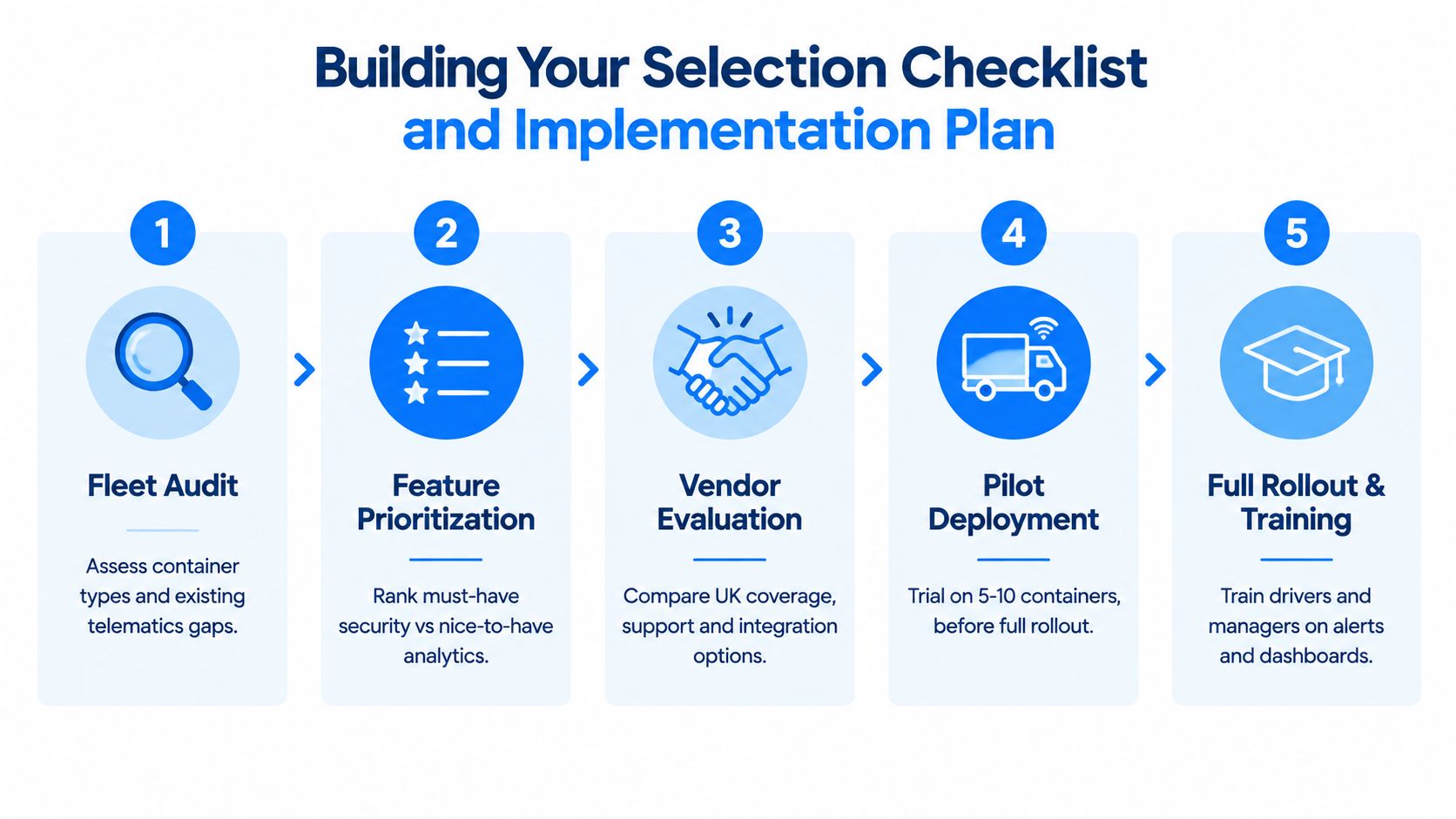
Use a pilot before a wider commitment. The mandatory implementation steps are:
- Fleet audit: identify asset types, power availability and visibility gaps.
- Feature prioritisation: rank security, compliance and operational requirements.
- Vendor evaluation: compare coverage, support, integrations, hardware and terms.
- Pilot deployment: trial the chosen configuration on a representative group of containers or trailers.
- Rollout and training: fit the remaining assets, train planners and define alert ownership.
The pilot should test real journeys, not just whether a device appears on a map. Check port exits, poor cellular coverage, overnight parking, geofence accuracy, battery behaviour, alert delivery and the quality of historical records. Include dispatchers, compliance staff and drivers in the review because each group will use different parts of the system.
Make adoption part of the project
Nominate someone to own alerts during each shift. Define which events require a call, which can wait for review and which must be recorded for compliance or a customer claim. Review false positives weekly during the early deployment and adjust zones, schedules and thresholds.
For commercial UK fleets, Fleetalyse offers GPS tracking for HGVs, vans, trailers, containers and other mobile assets, alongside remote tachograph downloads, smart dashcams, geofences, journey history, driver-behaviour reporting, selected vehicle data and maintenance reminders. Treat that as a documented telematics and fleet-compliance option, not as a replacement for a transport management system or workshop platform.
Securing Your Fleet and Next Steps
Container visibility becomes useful when it changes a decision. A planner reroutes a job before a driver breaches hours, a control team investigates movement before a theft becomes a lost load, or a compliance manager retrieves the relevant record without chasing paper and screenshots. The value isn't the map itself. It is the connection between an event and an accountable response.
The UK port data shows why that connection matters across busy gateways. The freight-crime evidence shows why security can't be treated as a secondary feature. Port portals and shipping-line updates still have a place, but they represent only part of the movement record once a container enters the domestic road network.
Audit the blind spots first
Start with a short review of recent jobs. Ask where the team last had verified visibility, where custody changed, which assets spent time unattended and how quickly someone would know if a trailer moved without authorisation. Include owner-drivers and subcontracted movements in the discussion, because the operational risk often appears at the boundary between organisations.
Prioritise assets rather than trying to instrument everything immediately. High-value loads, unattended trailers, refrigerated units, repeat port corridors and equipment with poor utilisation records usually provide a clearer starting point than a blanket installation programme.
Set the operating rules
A tracking platform needs ownership. Decide who receives a movement alert, who checks a door event, who contacts the driver and who records the outcome. Set a review process for driver-hours information, tachograph downloads, dashcam incidents and maintenance reminders, while keeping driver monitoring transparent and proportionate.
Don't promise that tracking will remove theft, eliminate delays or solve every compliance problem. It provides evidence and earlier warning. Secure parking, lawful scheduling, sound loading procedures, trained drivers and disciplined escalation remain essential.
Choose a system that fits the fleet
Ask vendors to demonstrate the actual workflows, not a generic presentation. Show them a detached trailer, an overnight stop, a port departure, a customer arrival and a tachograph compliance query. Confirm which hardware supports each event, how alerts are retained and what happens when connectivity drops.
The right container tracking system UK operators choose should bridge the port, the road and the handover record without forcing every team into a separate manual process. It should also sit comfortably beside HGV tracking, remote tachograph downloads, dashcams, driver-behaviour tools, maintenance reminders and reporting. That is how a security feature becomes part of daily transport control.
Fleetalyse provides commercial GPS tracking for HGVs, vans, trailers, containers and other mobile assets, with geofences, movement alerts, journey history, remote tachograph downloads and fleet telematics tools. Visit Fleetalyse to review the available commercial options and request a demonstration suited to your port, road and unattended-asset workflows.