
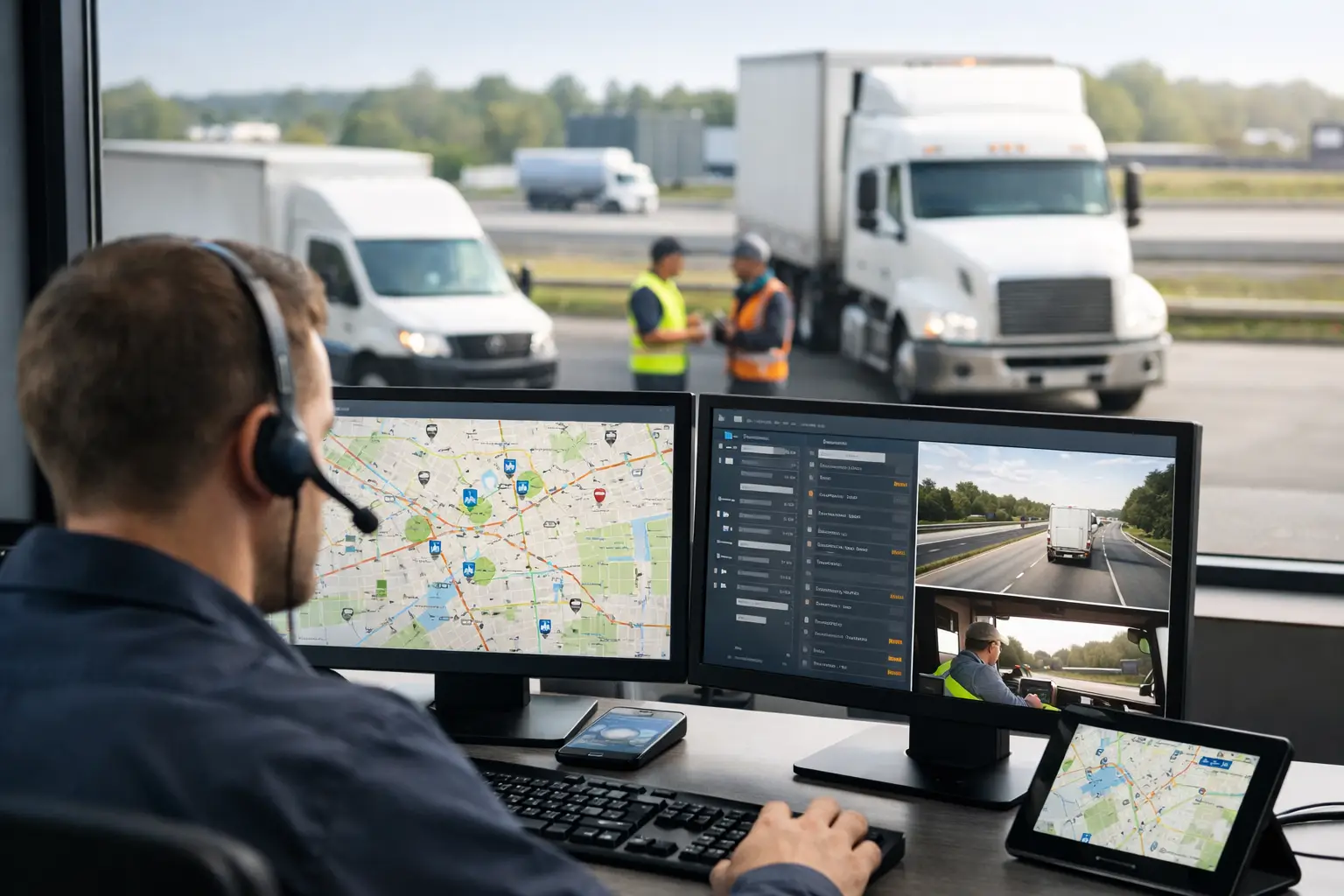
A planner has a collection booked for 14:00, a driver approaching their available hours limit and a vehicle held up on the M6. If those facts sit in separate systems, or worse, in a spreadsheet and a series of phone calls, the original plan is already unreliable. Dispatch planning with telematics puts the operational information in one place, allowing depot teams to make a decision before a delay becomes a missed slot, an infringement or an expensive empty run.
For UK operators, this is not simply a question of knowing where a vehicle is. Good dispatch decisions must account for driver hours, vehicle suitability, maintenance status, trailer availability and the time needed to complete the next job legally. Telematics turns those variables from assumptions into live operational data.
What dispatch planning with telematics changes
Traditional dispatch planning often starts with a planned route, a driver list and yesterday's understanding of where the fleet should be. That may be enough on a quiet day with predictable work. It becomes fragile when traffic, customer delays, breakdowns, late-running drivers or last-minute jobs enter the picture.
Live GPS tracking gives the transport office a current view of vehicle and trailer locations. Rather than ringing several drivers to establish who is closest, a planner can see the nearest suitable asset and its direction of travel. That makes it easier to allocate ad hoc collections, divert a vehicle around a disruption or give a customer a realistic arrival update.
The greater value comes when location data is viewed alongside compliance information. A nearby driver may not be the right driver if their remaining driving time, working time or break requirement makes the job impractical. Remote tachograph data and live driver hours monitoring allow the planner to test the assignment against the real constraints of the shift, rather than finding the issue after the vehicle has been dispatched.
This changes the question from, can that lorry get there, to can that driver complete the work safely, legally and commercially?
Start with the constraints, not the nearest vehicle
The closest vehicle is not always the best allocation. A planner needs to consider whether the vehicle has the right body type, load capacity, access equipment or temperature capability. For trailer operations, the correct trailer must also be available and positioned where it can be collected without creating wasted mileage.
Driver competence and site requirements matter too. A delivery may require a particular induction, ADR qualification, tail-lift experience or familiarity with a customer site. A live map cannot replace local knowledge, but it can give that knowledge a reliable operational foundation.
Driver hours are often the deciding factor. A vehicle that appears to be 30 minutes away may be attached to a driver who needs a break before reaching site, has limited daily driving remaining or will be unable to return to base within the planned shift. Assigning that job without checking creates pressure on the driver and risk for the operator.
A practical dispatch process therefore works in sequence. First, identify assets that are suitable for the job. Then check their live position and current route. Finally, confirm that the driver has sufficient available hours and that the work can be completed within the plan. This takes less time when tracking and tachograph information are visible in the same platform.
Use live visibility to manage exceptions
The original schedule is only the starting point. The best planning teams are measured by how well they handle exceptions without losing control of cost or compliance.
Telematics alerts can highlight a vehicle that has stopped unexpectedly, deviated from its intended area or is running behind its expected progress. A dispatcher can then investigate early, speak to the driver with context and decide whether another vehicle should cover the next movement. This is more useful than discovering the delay only when a customer calls.
For example, an HGV delayed at a distribution centre can affect two later deliveries and a collection window. With live visibility, the planner can assess whether the delay is likely to clear, whether another vehicle can take the collection and whether the current driver still has enough time to complete the revised work. The result may be a simple resequencing of jobs. It may be necessary to move a load, arrange relief or reset customer expectations. The point is that the decision is based on evidence rather than guesswork.
This is where dispatch planning should stay practical. Not every alert needs an intervention. Brief stationary periods, traffic congestion and planned breaks are normal parts of road transport. Set alerts around events that genuinely need attention, such as prolonged idling, unauthorised out-of-hours use, unexpected stops or vehicles entering areas where a collection is due.
Give customers accurate updates
A live estimated arrival time is more useful than a vague promise that the driver is on the way. When the office can see location and journey progress, it can provide a credible update, protect a booking slot where possible and reduce inbound chasing calls.
There is a balance to strike. Sharing every minor movement can create unnecessary administration, particularly for multi-drop work. Focus on the moments that affect a customer decision: a likely missed slot, a significant delay, an early arrival that may require access arrangements, or a revised collection time.
Build compliance into the daily plan
Dispatch pressure is one of the most common causes of poor compliance decisions. A late collection can tempt a planner to allocate the closest available driver without checking the legal position. It can also leave drivers feeling that they must continue when they should be taking a break or ending their duty.
Live driver hours information gives the transport team a clear view before the allocation is made. It supports better conversations with drivers and creates a more realistic schedule from the outset. Remote tachograph downloads also reduce the need to chase cards and vehicle unit data manually, helping compliance teams identify issues without creating another depot task.
Telematics does not remove the need for proper management. Drivers still need clear instructions, planners need a working understanding of drivers' hours rules, and someone must review exceptions. What it does provide is a shared view of the facts. That is particularly valuable where dispatch, transport management and compliance responsibilities are split between different people.
A plan should also allow for the operational time around driving. Loading, unloading, queueing, paperwork, checks and refuelling all consume working time. Plans built only around mileage and map travel estimates can look efficient on screen but fail in real conditions.
Improve utilisation without creating more pressure
Better utilisation is not the same as keeping every vehicle moving at all times. A fleet can be busy and still waste money through poor route sequencing, unnecessary empty mileage, excessive idling and trailers waiting in the wrong place.
Tracking data helps identify patterns over time. If vehicles regularly cross paths, return empty from the same area or spend long periods stationary at a site, that information should influence future planning. It may point to a customer booking issue, an inefficient delivery sequence, insufficient turnaround capacity or a trailer allocation problem.
Fuel and driver behaviour reporting add another layer. A route that looks shorter may be slower, more congested or more fuel-intensive. Harsh driving, avoidable idling and speeding can increase costs and wear while reducing the reliability of service. Dispatch decisions should not be judged on arrival time alone.
Maintenance status belongs in the same conversation. Sending a vehicle towards a planned inspection, service or defect repair may appear to solve a short-term allocation gap, but it can cause a more disruptive problem later. Maintenance reminders give planners visibility of upcoming requirements so fleet availability is managed deliberately rather than through last-minute substitutions.
Make the platform part of the dispatch routine
The value of telematics depends on how consistently the information is used. A map viewed only after something has gone wrong will not transform planning. The most effective teams make live fleet visibility part of the daily rhythm.
At the start of the shift, confirm vehicle and trailer availability, review driver hours, identify maintenance restrictions and check the most time-sensitive jobs. During the day, monitor progress against the plan and intervene only where a meaningful exception appears. At the end of the shift, review recurring delays, idling, empty mileage and missed assumptions so tomorrow's plan improves.
This does not need to create another complicated process. A single platform that combines vehicle tracking, trailer visibility, remote tachograph data, live driver hours and reporting removes much of the manual switching between systems. Fleetalyse is designed around that practical requirement: giving transport teams control of daily operations while supporting the evidence needed for UK operator licence compliance.
The useful next step is to look at one week of actual dispatch changes. Compare what was planned with what happened, then ask which decisions were delayed because location, hours or asset information was missing. Those gaps are usually where telematics starts paying for itself.