
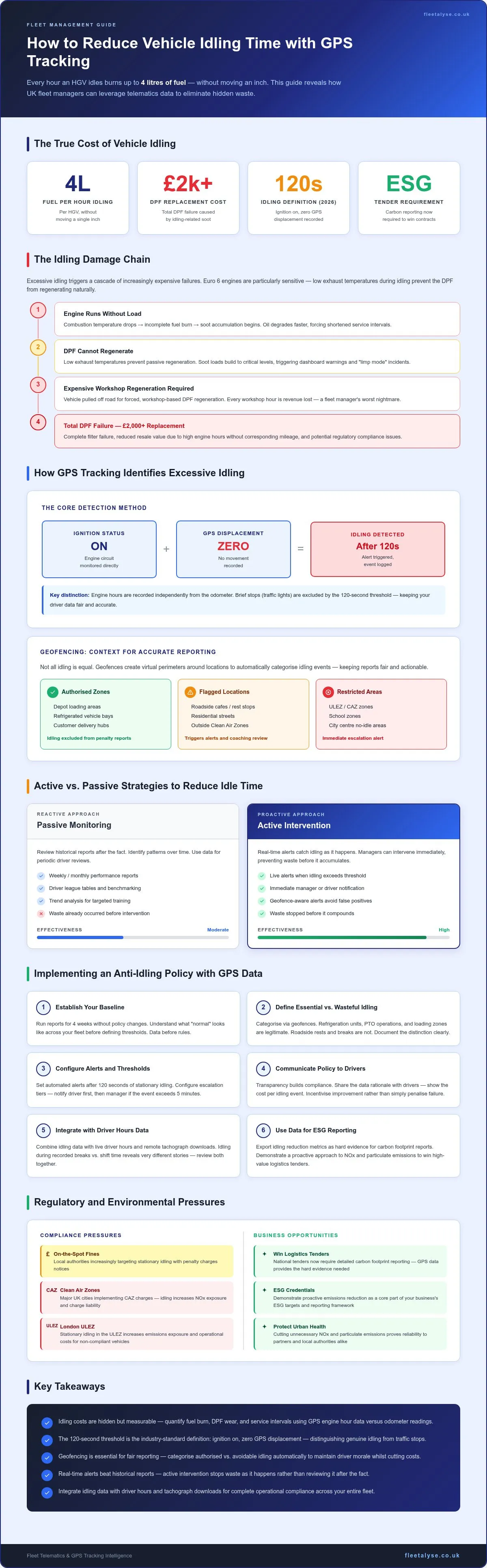
Every hour an HGV spends idling can burn through nearly four litres of fuel without moving a single inch. For a UK fleet manager, this isn't just a statistic; it's a direct hit to your quarterly profit margins and the long term health of your Diesel Particulate Filters. You likely already know that engines running in neutral are a massive drain on resources. However, enforcing a strict policy often feels impossible when you lack the proof to back it up. This guide explains exactly how to reduce vehicle idling time with GPS tracking to transform that hidden waste into tangible savings.
We'll move beyond basic location monitoring to treat your telematics as a precision diagnostic tool. You'll discover how to leverage real time alerts and historical reporting to eliminate wasted fuel, lower maintenance costs, and improve driver behaviour across your entire fleet. This guide covers everything from setting up automated alerts to using performance data to secure better environmental credentials for your next commercial tender. It's time to stop guessing and start using live data to protect your assets and your bottom line.
Key Takeaways
- Quantify the hidden costs of engine idling, including unnecessary fuel burn and accelerated wear on critical components like Diesel Particulate Filters.
- Discover how to reduce vehicle idling time with GPS by monitoring the precise gap between ignition status and actual asset movement.
- Utilise live alerts and historical reporting to transition from passive monitoring to active, real-time driver intervention and training.
- Establish a robust anti-idling policy by defining clear operational baselines that distinguish between essential and wasteful engine use.
- Streamline your fleet management by integrating idling data with live driver hours and remote tachograph downloads for total operational compliance.
The True Cost of Vehicle Idling for UK Fleets
Idling is the most expensive way to go nowhere. For UK operators, an HGV left running for just one hour can consume up to four litres of fuel. Over a year, this equates to thousands of pounds in wasted overheads. It's a silent drain on your cash flow. Understanding how to reduce vehicle idling time with GPS is the first step toward reclaiming these lost margins. Many managers assume idling is an unavoidable part of the job, but the data often tells a different story of habit and oversight.
The mechanical damage is often more costly than the fuel itself. Engines are designed to operate under load. When idling, the combustion temperature drops. This leads to incomplete fuel burn and heavy soot accumulation. This isn't just a theory; it's a direct cause of premature component failure and increased maintenance frequency.
Beyond the Fuel Pump: Engine Longevity
Excessive idling accelerates oil degradation. It forces more frequent service intervals and reduces the overall lifespan of the asset. Modern Euro 6 engines are particularly sensitive. Low exhaust temperatures during idling prevent the Diesel Particulate Filter (DPF) from regenerating naturally. This causes a cascade of mechanical issues that GPS tracking can help you avoid.
The consequences of ignoring idle time include:
- Frequent dashboard warnings and "limp mode" incidents.
- The need for expensive workshop-based forced regenerations.
- Total DPF failure, which can cost upwards of £2,000 to replace.
- Reduced resale value due to high engine hour accumulation without corresponding mileage.
Unplanned downtime is a fleet manager's worst nightmare. Every hour a van sits in a workshop for soot-related repairs is an hour it isn't generating revenue. By learning how to reduce vehicle idling time with GPS, you protect the mechanical integrity of your fleet.
The Environmental and Corporate Responsibility Angle
The legal landscape in the UK is shifting. Local authorities are increasingly targeting stationary idling with on-the-spot fines. Beyond simple fines, Clean Air Zones (CAZ) and London’s ULEZ place immense pressure on operators to prove their environmental credentials. Reducing idle time is no longer just about saving pennies. It's a core part of your business's ESG targets.
Many national logistics tenders now require detailed carbon footprint reporting. If you can't demonstrate a proactive approach to emissions, you'll struggle to win high-value contracts. GPS tracking provides the hard evidence needed to show you're running a clean, efficient operation. It's about protecting the health of urban populations by cutting unnecessary NOx and particulate emissions whilst proving your reliability to potential partners.
How GPS Tracking Identifies Excessive Idling
Identifying waste is the critical bridge between acknowledging a problem and solving it. You cannot manage what you do not measure with precision. GPS telematics provides the necessary granularity to distinguish between a driver stuck in heavy traffic and one leaving the engine running during a depot break. This distinction is vital for maintaining driver morale whilst cutting costs. Understanding how to reduce vehicle idling time with GPS starts with the raw data your assets already produce.
Ignition-On vs. Vehicle Movement
Basic tracking only tells you where a vehicle is. Advanced telematics monitors the vehicle's ignition circuit directly. This allows the system to record engine hours independently of the odometer. By comparing the ignition status against GPS coordinates, the software identifies precisely when fuel is being consumed without any corresponding mileage. It's a transparent way to see which assets are costing you money whilst stationary.
By 2026 telematics standards, idling time is specifically defined as any duration where the ignition remains active whilst the high-frequency GPS sensor records zero displacement for more than 120 seconds. This technical threshold ensures that brief stops, such as traffic lights, do not skew your performance data. It provides a clean, actionable baseline for intervention. You can then use these insights to streamline your fleet operations and focus on the most significant areas of waste.
Leveraging Geofences for Accurate Data
Context is everything in fleet management. Idling in a delivery hub might be necessary for loading, but idling at a roadside cafe is usually avoidable. Geofencing allows you to create virtual perimeters around specific locations to categorise idling events automatically. This ensures your reports are fair and accurate.
Use geofences to manage your data effectively:
- Define "authorised idling zones" for depots where Power Take-Off (PTO) equipment is required.
- Flag "unauthorised idling" at known rest stops or driver homes.
- Filter out unavoidable congestion by cross-referencing idling events with known traffic hotspots.
- Verify if the engine was left running during loading or unloading procedures.
Real-time alerts take this a step further. Instead of waiting for a weekly report, you can receive a notification the moment a vehicle exceeds your pre-set idling threshold. This allows for immediate correction. Historical reporting then lets you identify long-term patterns. You might find that specific routes or certain times of day consistently lead to higher idle times, allowing you to adjust schedules rather than just blaming driver behaviour.
Active vs. Passive Strategies to Reduce Idle Time
Reducing waste requires more than just collecting data; it requires a strategy for how that data is used. Fleet managers generally choose between passive monitoring and active intervention. Passive monitoring relies on historical reporting to inform long-term strategy. You review weekly or monthly logs to identify trends and habitual offenders. This is ideal for structured training sessions and performance reviews. In contrast, active intervention uses live telematics to change behaviour in the moment. Both methods are vital when considering how to reduce vehicle idling time with GPS effectively.
Choosing between driver incentives and disciplinary measures is a common challenge. Whilst disciplinary action might be necessary for persistent policy violations, positive reinforcement often yields better long-term results. Rewarding drivers for fuel-efficient habits builds a culture of cooperation rather than one of surveillance. In-cab feedback systems bridge this gap by providing real-time coaching. A simple visual or audible cue in the cab reminds the driver to switch off the engine, allowing them to self-correct before a manager even needs to get involved.
Driver Coaching and Gamification
Data is most powerful when it's transparent. Use your GPS tracking reports to create league tables that foster healthy competition amongst your team. Don't just reward the top performer; focus on the "Most Improved" driver each month. This motivates those who may have struggled in the past to engage with the new policy. When drivers see that the data is fair and consistently applied, they're more likely to trust the system. Transparency prevents the "Big Brother" stigma and turns telematics into a tool for professional development rather than just a monitoring device.
Automated Alerts and Management Intervention
Efficiency isn't about watching every vehicle in real time. It's about managing by exception. Automated alerts allow you to set specific thresholds, such as a five-minute idling limit in a non-authorised zone. The system only notifies you when these limits are breached. This prevents notification fatigue and ensures you only intervene when it's truly necessary.
There's a significant psychological benefit to this approach. When drivers know that idling events are logged and flagged automatically, they become more mindful of their habits. It creates a subtle but constant pressure to adhere to company policy. However, you must avoid "alarm blindness" by tuning your alert sensitivity. Start with a generous threshold and tighten it as the fleet's overall performance improves. This logical progression ensures your intervention remains a catalyst for improvement rather than a source of frustration.
Implementing an Anti-Idling Policy with GPS Data
A policy without data is merely a suggestion. To truly change culture, you need a structured framework supported by objective evidence. Implementing a formal anti-idling policy provides your team with clear expectations and gives you the leverage to enforce them. This isn't about micromanagement; it's about operational efficiency. By following a step-by-step approach, you can learn how to reduce vehicle idling time with GPS whilst maintaining a positive relationship with your drivers.
- Step 1: Establish a Baseline. Run idling reports for 30 days without intervention to reveal your starting point and identify your highest-cost areas.
- Step 2: Define Acceptable Idling. Distinguish between essential engine use, such as powering a crane, and pure waste.
- Step 3: Communicate the "Why". Explain the benefits to the driver, focusing on reduced breakdown risk, asset health, and better cab air quality.
- Step 4: Conduct Monthly Reviews. Use GPS reports to provide objective feedback in regular 1-to-1 performance sessions.
- Step 5: Continuously Refine Targets. As performance improves, gradually lower the acceptable idling thresholds to drive continuous gains across the fleet.
Defining Acceptable Idling Parameters
Fairness is the foundation of any successful policy. You must distinguish between operational idling, such as using a tail lift or powering a refrigeration unit, and wasteful idling, like leaving the engine running during a paperwork break. Your policy should also account for seasonal extremes. Drivers may need the engine running for short periods to maintain cab temperature during a heatwave or a freeze. The industry benchmark for non-operational idling is generally set at 3 minutes before the engine should be switched off. This provides enough time for brief stops whilst flagging genuine waste.
Communicating Data to the Driving Team
Transparency is the best antidote to "Big Brother" concerns. Focusing on how to reduce vehicle idling time with GPS allows you to have objective, fact-based conversations rather than relying on hearsay. Present the data as a tool for professional development rather than a weapon for punishment. When drivers understand that reducing idle time leads to better vehicle reliability and fewer DPF-related "limp mode" incidents, they're more likely to buy into the programme. Share the data openly. If the fleet saves money on fuel, consider reinvesting some of those savings into driver comfort or bonuses. This turns a monitoring exercise into a shared success. To start building your data-led policy today, invest in a professional GPS tracking solution.
Streamlining Fleet Efficiency with Fleetalyse
Managing a modern fleet involves balancing fuel costs, maintenance schedules, and legal compliance. Fleetalyse provides a unified platform that makes this balance achievable. By integrating GPS tracking with remote tachograph download, you gain a complete picture of your operation. You don't just see where a vehicle is; you see the driver's legal hours and their idling habits simultaneously. This level of detail is essential for anyone serious about how to reduce vehicle idling time with GPS whilst maintaining strict HGV compliance.
Combining live driver hours with idling reports allows for smarter intervention. If a driver is approaching their break, you can monitor whether they switch off the engine immediately or leave it running whilst parked. This data-driven approach removes the guesswork from management. It turns telematics into an active catalyst for operational improvement. You move from simply collecting data to implementing actionable fuel savings that impact your quarterly results.
Comprehensive Asset Visibility
Efficient transport operations rely on having every asset visible in one place. Fleetalyse offers a centralised dashboard for HGVs, vans, and trailers. You can track a high-value trailer as easily as a delivery van. This simplifies the management of regional transport operations. Our UK-based support team understands the specific challenges of domestic regulations and infrastructure. We provide the technical clarity needed to manage your fleet effectively. No more jumping between different software providers; everything is in one secure location.
Driving ROI through Compliance and Tracking
The return on investment for smarter telematics is clear and measurable. Reduced idling lowers your weekly fuel bills and protects your engines from costly soot build-up. Automated compliance monitoring reduces the risk of DVSA fines and administrative errors. These savings directly boost your bottom line and improve your environmental credentials for future tenders. It's time to move beyond generic trackers that offer little more than dots on a map. Review your existing hardware and consider the benefits of a specialist partner that values your resources.
Ready to optimise your fleet? Book your solution now. By mastering how to reduce vehicle idling time with GPS, you transform your fleet into a leaner, more profitable asset that is built for the rigors of the UK road network.
Take Control of Your Fleet’s Efficiency
Eliminating engine idling is one of the fastest ways to recover lost profit and extend the lifespan of your assets. You've seen the mechanical toll that excessive idling takes on modern diesel engines and the financial drain it places on your fuel budget. By understanding how to reduce vehicle idling time with GPS, you move from reactive management to proactive optimisation. This data-led approach ensures your drivers are coached fairly whilst your vehicles remain compliant and roadworthy.
Fleetalyse stands as a reliable partner for UK operators. We provide real-time visibility across HGVs, vans, and trailers, coupled with seamless integration for tachograph analysis. As UK-based specialists in transport compliance, we ensure your technology works for the rigours of the real world. Stop letting your profits evaporate through the exhaust pipe and start making every engine hour count toward your business goals.
Optimise your fleet and reduce costs - Get started today. Your journey toward a leaner, more efficient operation begins with the right data.
Frequently Asked Questions
How much fuel does an HGV actually waste when idling for an hour?
An average HGV burns between two and four litres of fuel for every hour spent idling. This consumption varies based on engine displacement and whether auxiliary equipment like refrigeration units or cranes are active. Whilst it seems minor in isolation, a fleet of twenty vehicles idling for just one hour daily can waste over £10,000 in fuel annually at current UK prices.
Can GPS tracking tell the difference between idling in traffic and parked idling?
Yes, advanced telematics distinguishes between traffic and parked idling by cross-referencing GPS movement with ignition status and geofencing. If a vehicle is stationary but the ignition is on in a known congestion zone, the system categorises it as traffic. If it occurs in a depot or rest stop, it's flagged as manageable waste. This context is essential for fair driver coaching.
Is it better to turn the engine off and on or let it idle for a minute?
It's generally better to turn the engine off if you expect to be stationary for more than 30 seconds. Modern diesel engines and high-duty starters are designed for frequent cycles. Idling for just one minute consumes more fuel than restarting the engine. Switching off also prevents the exhaust temperature from dropping, which protects your Diesel Particulate Filter from soot build-up.
How do I introduce GPS tracking to drivers without causing friction?
Introduce the system as a tool for asset protection and safety rather than surveillance. Explain how to reduce vehicle idling time with GPS to prevent "limp mode" incidents and ensure better cab air quality. Sharing the data transparently and rewarding the most improved drivers helps build trust. When drivers see the fuel savings reinvested into the business, they're more likely to support the initiative.
Will reducing idling really lower my maintenance and repair costs?
Reducing idle time significantly lowers maintenance costs by slowing oil degradation and preventing DPF blockages. Idling causes incomplete combustion, which leads to carbon deposits on valves and injectors. By cutting unnecessary engine hours, you extend service intervals and preserve the asset's resale value. It's a direct way to reduce unplanned downtime and expensive workshop invoices.
What is the "legal" limit for vehicle idling on UK public roads?
Under the Road Vehicles (Construction and Use) Regulations 1986, it's an offence to leave a vehicle engine running unnecessarily whilst stationary on a public road. Highway Code Rule 123 reinforces this requirement. Local authorities can issue Fixed Penalty Notices, typically starting at £20 and doubling if not paid promptly. These fines are becoming increasingly common in designated Clean Air Zones.
Can I use GPS data to challenge idling fines from local councils?
You can use GPS data as objective evidence to challenge unfair idling fines. If a council issues a penalty whilst your vehicle was actually using a Power Take-Off (PTO) for essential work, your telematics report can prove the engine was active for a legitimate operational reason. This transparency protects your business from administrative errors and avoids the payment of unnecessary legal costs.
Does idling affect the accuracy of my tachograph records?
Idling itself doesn't change the mechanical accuracy of the tachograph, but it affects how driver activity is recorded. If a driver leaves the engine running whilst on a break, they may incorrectly record "Other Work" instead of "Rest". Integrating your tracking with tachograph analysis ensures that idling events are correctly categorised, maintaining your fleet's compliance with Drivers' Hours regulations and avoiding potential infringements.
Frequently asked questions
How much fuel does an HGV actually waste when idling for an hour?
HGVs burn between 1.5 and 4 litres of diesel per hour whilst idling. The exact volume depends on the engine capacity and whether ancillary systems like air conditioning are active. This waste costs your business thousands of pounds annually if left unchecked. Understanding these figures is the first step in learning how to reduce vehicle idling time with GPS to protect your operating margins.
Can GPS tracking tell the difference between idling in traffic and parked idling?
Yes, telematics software uses geofencing and logic to separate traffic stops from genuine idling. If a vehicle stops at a known depot or delivery hub for ten minutes, the system flags it as idle time. If the stop occurs on a main road during peak hours, it's identified as congestion. This ensures your data is accurate and doesn't penalise drivers for unavoidable delays.
Is it better to turn the engine off and on or let it idle for a minute?
It's almost always better to turn the engine off if you expect to be stationary for more than 30 seconds. Modern engines don't use excessive fuel to restart, unlike older models. Idling for just one minute burns more fuel than a restart and causes unnecessary soot build-up in the exhaust system. Turning the ignition off preserves fuel and protects your engine's internal components.
How do I introduce GPS tracking to drivers without causing friction?
Start with transparency and focus on the benefits for the driver. Explain that GPS tracking is a tool for asset protection and safety rather than a surveillance device. Show how the data helps reduce breakdowns and improves vehicle reliability. When you share reports openly and reward improvement, drivers are more likely to see the system as a support tool for their professional development.
Will reducing idling really lower my maintenance and repair costs?
Reducing idling will significantly lower your repair costs. Engines idling at low RPMs don't reach the temperatures needed for efficient combustion, which leads to soot accumulation in DPF filters and EGR valves. This process also contaminates engine oil with moisture and unburnt fuel. By cutting idle time, you reduce the frequency of expensive filter cleans and prevent premature wear on internal engine parts.
What is the "legal" limit for vehicle idling on UK public roads?
The Road Vehicles (Construction and Use) Regulations 1986 state that drivers mustn't leave engines running unnecessarily whilst stationary on public roads. Local authorities have the power to issue on-the-spot fines, usually starting at £20. These rules are increasingly enforced in Clean Air Zones to reduce urban pollution. It's a legal requirement to turn off the engine when parked or waiting for long periods.
Can I use GPS data to challenge idling fines from local councils?
You can use telematics reports as objective evidence to contest idling penalties. GPS data shows the exact location, time, and duration of every stop your vehicle makes. If a council issues a fine incorrectly, your report acts as a verifiable log of whether the engine was running. This proof is vital for protecting your business from unfair costs and maintaining a clean compliance record.
Does idling affect the accuracy of my tachograph records?
Idling doesn't change your legal driving hours, but it creates a gap between tachograph records and actual engine wear. A tachograph logs the vehicle as stationary, yet the engine continues to accumulate hours and consume fuel. This is why it's important to understand how to reduce vehicle idling time with GPS. It provides the mechanical context that a standard tachograph report simply cannot capture.