
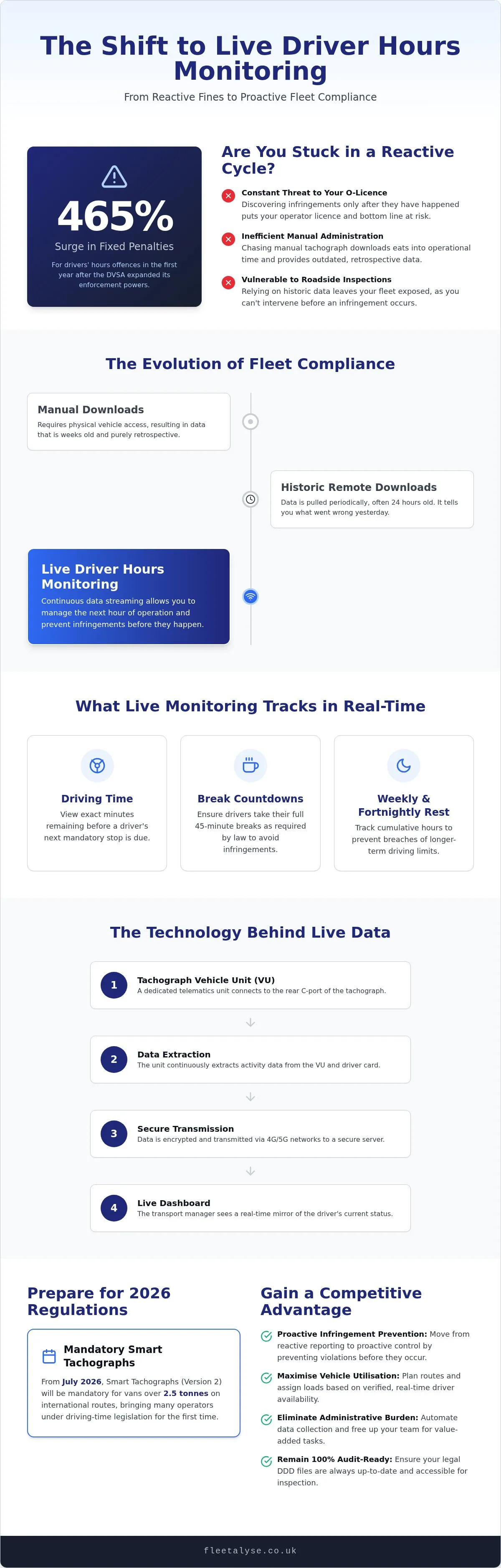
In the first year after the DVSA expanded its enforcement powers, the number of fixed penalties issued for drivers' hours offences surged by 465 per cent. For UK fleet operators, these aren't just statistics; they represent a constant threat to your O-Licence and your bottom line. You're likely tired of the reactive cycle of chasing manual tachograph downloads and discovering infringements only after they've happened. It's a stressful way to run a business, especially when manual admin is eating into your operational efficiency.
We understand that you need more than just a data collection tool. You need a reliable partner that helps you stay ahead of the regulations. Implementing live driver hours monitoring transforms your compliance strategy from a legal burden into a competitive advantage. By moving away from retrospective reporting, you gain the ability to see exactly how much driving time your team has left in real time. This ensures you can plan loads and routes with absolute precision while maintaining 100 per cent audit-readiness.
This guide explores how live data reduces administrative overhead and improves vehicle utilisation. We'll show you how to move from fearing the next inspection to running a leaner, more compliant fleet operation.
Key Takeaways
- Move from reactive reporting to proactive control by streaming continuous tachograph data directly from your fleet vehicles.
- Understand how live driver hours monitoring provides instant visibility into remaining driving time to prevent accidental infringements before they occur.
- Stay compliant with the latest 2026 regulatory changes, including new smart tachograph requirements for light commercial vehicles.
- Maximise vehicle utilisation by planning routes and assigning loads based on verified, real-time driver availability.
- Eliminate the administrative burden of manual data collection and ensure your business remains 100 per cent audit-ready.
What is Live Driver Hours Monitoring?
Live driver hours monitoring is the continuous streaming of tachograph data via telematics hardware directly to your office dashboard. It represents the final stage in the evolution of fleet compliance. In the past, transport managers relied on manual downloads. These required physical access to the vehicle and resulted in data that was weeks old. This moved toward historic remote downloads, where data is pulled periodically. However, even data that is 24 hours old is reactive. It tells you what went wrong yesterday; it cannot stop an infringement happening today.
Truly live visibility allows you to track critical metrics as they happen. This includes:
- Driving time: Exact minutes remaining before a mandatory stop.
- Break countdowns: Ensuring drivers take the full 45 minutes required by law.
- Weekly rest: Tracking cumulative hours to prevent fortnightly limit breaches.
Relying on "historic" data leaves your fleet vulnerable. If a driver accidentally overruns their shift, you only find out when the damage to your safety rating is already done. You need proactive alerts to intervene before the law is broken. This shift from retrospective reporting to active management is what defines a modern, compliant operation.
The Difference Between Remote Download and Live Monitoring
It's vital to distinguish between these two functions. Remote download is the technical process of retrieving DDD files from the vehicle unit and driver card. You need these files for your legal records and analysis. Live monitoring is the operational layer. It provides a real-time dashboard for active shift management. While remote downloads help with your 28-day and 90-day legal obligations, live driver hours monitoring helps you manage the next hour of operation. These systems work in tandem to provide a complete compliance solution.
Why Real-Time Visibility is Essential in 2026
The regulatory landscape has shifted significantly. From July 2026, smart tachographs (Version 2) are mandatory for vans over 2.5 tonnes on international routes. This brings a new wave of operators under the scope of driving-time legislation for the first time. The DVSA now places a heavy emphasis on roadside enforcement and the Earned Recognition scheme. Every infringement recorded at the roadside is a black mark against your Operator Licence. Beyond fines, your reputation is at stake. Tier-one contractors increasingly demand proof of proactive compliance before awarding work. Adhering to the EU rules on drivers' hours is now a prerequisite for supply chain transparency. Using a platform like Fleetalyse ensures you have the expert-led tools to meet these modern standards.
The Technology Behind Real-Time Compliance Data
The transition to live driver hours monitoring relies on a sophisticated hardware handshake between your vehicle and the office. At the centre of this system is a dedicated telematics unit. Unlike basic GPS trackers, these units are designed to interface directly with the tachograph Vehicle Unit (VU). They connect to the rear C-port of the VU to maintain a constant stream of data without interfering with the driver's daily tasks. This setup allows for the continuous extraction of activity data, ensuring that what you see on your screen is an exact mirror of the driver's current status.
Modern systems are built to handle the complexities of Smart Tachograph Version 2 (G2V2) units. These latest tachographs record additional data points, such as automated border crossings and loading or unloading events. Your hardware must be capable of processing these specific signals to remain compliant with evolving GB driver hour rules. Once the data is captured, it's encrypted and transmitted via high-speed 4G or 5G networks. This journey, from the driver card to your analysis platform, happens in seconds. It ensures that the "DDD" files required for your legal records are always backed up and ready for inspection.
How Telematics Units Interface with the Tachograph
The telematics unit does more than just read the tachograph. It often taps into the vehicle's CAN-bus system. This allows the hardware to cross-reference driving activity with actual vehicle performance, such as engine idling or fuel consumption. Security is a primary concern during this transmission. All data packets are heavily encrypted to meet strict GDPR standards, protecting sensitive driver information. By using a secure bridge like Fleetalyse, you ensure that your compliance data is both accurate and protected from external threats.
Software Dashboards: Turning Raw Data into Decisions
Raw data is only useful if it's actionable. The software dashboard translates complex tachograph signals into clear visual cues. Transport managers can view live countdowns for every driver in the fleet. These countdowns show exactly how many minutes remain before a 4.5-hour break is due or when a daily driving limit is approaching. If a driver takes a shorter break than required, the system triggers an automated alert. This allows you to address the issue immediately. For larger operations, multi-vehicle views provide a bird's-eye perspective of the entire fleet. You can quickly identify which drivers have the most available hours, making it easy to optimise your vehicle utilisation and assign new loads with confidence.
Navigating EU Rules and GB Domestic Regulations in 2026
The UK's regulatory environment is notoriously complex. Operators often juggle assimilated EU rules and GB domestic rules within the same week, making manual tracking a high-risk strategy. Using live driver hours monitoring allows you to see exactly which rule set applies to a driver at any given moment. It removes the guesswork that leads to DVSA fines and ensures your planners aren't accidentally breaching limits. Whether your fleet handles international haulage or local deliveries, real-time data is the only way to manage these overlapping requirements with absolute certainty.
Daily and Weekly Driving Limits Explained
Under EU rules, drivers are limited to 9 hours of daily driving. You can extend this to 10 hours twice a week. Whilst these daily limits are straightforward to track, the 56-hour weekly and 90-hour fortnightly caps are where many fleets fail. Live tracking provides a rolling total of these figures. It warns you before a driver starts a shift they cannot legally finish. You must also manage the 4.5-hour break rule. A driver needs a full 45-minute break, or a 15-minute break followed by a 30-minute break, after 4.5 hours of driving. Real-time alerts ensure these breaks are taken correctly, protecting both the driver and your safety rating.
GB Domestic Rules vs EU Rules
Not every vehicle requires a tachograph for every journey. GB Domestic rules apply to drivers not covered by EU legislation, such as those on specific local delivery routes or driving smaller vans. In 2026, the distinction is sharper than ever. Light Commercial Vehicles (LCVs) over 2.5 tonnes involved in international transport or cabotage now fall under EU rules and require smart tachographs. For those remaining on domestic rules, the limits change. You must track a 10-hour daily driving limit and an 11-hour daily duty limit. Tracking duty time is a common stumbling block for van operators who assume they are exempt from strict monitoring.
Managing "mixed" weeks is another significant challenge. If a driver spends part of their week under EU rules and part under GB rules, you must account for the impact of both. The Working Time Directive (WTD) adds a final layer of complexity. You must monitor an average 48-hour working week and ensure no single week exceeds 60 hours. Understanding employer responsibilities for driver hours is essential for anyone holding an Operator's Licence. Fixed penalties for hours offences range from £50 to £300, but the long-term damage to your O-Licence is the greater risk. Fleetalyse provides the expert tools needed to simplify these calculations, integrating WTD tracking with live tachograph data for a complete compliance overview.

Strategic Benefits: How Live Data Improves Fleet Operations
Implementing live driver hours monitoring does more than just tick a compliance box. It changes how you run your business. Instead of spending hours each week reconciling manual records, you gain immediate clarity on your fleet's capacity. This transition from reactive reporting to proactive operational control is essential for modern UK hauliers. You'll stop chasing data and start using it to drive profit. It's about moving away from the stress of potential fines and toward a leaner, more efficient operation.
Optimising Route Planning with Live Hours
Imagine an urgent load becomes available for a late afternoon pickup. Without real-time data, you're guessing which driver has the remaining "spread" to handle the job. You risk an infringement or a wasted journey. By linking your compliance data with GPS fleet tracking, you see exactly who is closest and who has the legal hours to complete the task. This eliminates "dead miles" and ensures every vehicle is earning its keep. You can guide drivers to their breaks exactly when needed, preventing them from being stuck in traffic whilst their 4.5-hour clock runs down. Total visibility means you can make decisions in seconds that previously took dozen of phone calls.
Financial Gains Beyond Fine Avoidance
The commercial value of live monitoring extends deep into your overheads. Demonstrating a history of excellence can lead to lower insurance premiums; providers value the reduced risk of fatigue-related accidents. It also streamlines the audit process. Whether it's a DVSA inspection or a trade body review, having data instantly available reduces the time your staff spend preparing files. You can also use this data to identify specific training needs. If one driver consistently struggles with break timings, you can provide targeted coaching before it becomes a costly legal issue. This proactive approach saves money and builds a more professional culture.
Protecting your Operator Licence is the ultimate goal. A "Green" Operator Compliance Risk Score (OCRS) is your most valuable asset. It reduces the likelihood of being pulled over for roadside checks, keeping your vehicles on the road and moving. Reducing the stress on your drivers by preventing accidental infringements also improves retention. Drivers want to work for professional outfits that value their time and protect their vocational licences. To start protecting your O-Licence today, you can enrol your fleet in our monitoring programme.
Implementing a Live Monitoring Solution with Fleetalyse
Setting up live driver hours monitoring shouldn't be a source of operational friction. We provide a clear, expert-led roadmap that respects your time and resources. Our focus is on practical utility, ensuring your transition from manual to digital compliance is straightforward and transparent. We don't hide behind complex jargon; we deliver a system built for the rigours of real-world application.
The implementation process follows three logical steps:
- Step 1: Assessment. We evaluate your current fleet hardware and tachograph generations. This ensures total compatibility with the latest Smart Tachograph Version 2 requirements.
- Step 2: Installation. Our engineers install remote download units across your vehicles. We organise this to minimise downtime, keeping your fleet moving whilst we upgrade your capabilities.
- Step 3: Training. We configure your dashboard and train your transport office staff. They'll learn how to interpret live alerts and use real-time data to make instant planning decisions.
Our relationship doesn't end at installation. We provide ongoing support to ensure your fleet stays compliant as regulations evolve. You'll always have an expert partner to help you navigate the complexities of UK transport law.
Why Choose a UK-Based Specialist?
UK transport infrastructure has its own unique rigours. Working with a domestic specialist means you get support from people who understand the specific challenges of regional haulage and DVSA enforcement. You won't be navigating global call centres or deciphering generic advice. We offer a direct line to experts and a commitment to total openness regarding our data and contractual terms. This localized expertise ensures your compliance strategy is grounded in the reality of the British road network.
Scaling Your Compliance Solution
Your compliance needs will grow as your business does. You can start with core tachograph monitoring and easily scale to include trailer tracking or van tracking within the same platform. This unified approach integrates seamlessly with your existing tachograph analysis software. By centralising your data, you future-proof your fleet against upcoming regulatory changes. This ensures you remain a reliable partner for your clients whilst protecting your O-Licence safety ratings. Efficiency and compliance are two sides of the same coin; we help you master both.
Secure Your Fleet's Future with Real-Time Compliance
Transitioning from reactive reporting to proactive control is no longer optional for UK hauliers. By adopting live visibility, you eliminate the threat of DVSA fines and the heavy administrative burden of manual data collection. You gain the ability to plan routes with absolute precision, ensuring every vehicle is utilised to its legal limit without risking your Operator Licence. This shift doesn't just protect your reputation; it improves your bottom line through better asset management and reduced operational stress.
Fleetalyse offers a pragmatic, expert-led solution designed specifically for the rigours of the UK market. Our approach combines seamless tachograph analysis integration with transparent contractual terms and direct access to UK-based expert support. We help you stay ahead of 2026 regulatory shifts whilst driving operational efficiency across your entire fleet. It's time to move beyond the uncertainty of historic data and embrace a system built for the modern transport office.
See our published pricing for live driver hours monitoring today. We look forward to helping your business grow safely and efficiently.
Frequently Asked Questions
What is the difference between a tachograph download and live monitoring?
A tachograph download is the periodic retrieval of raw DDD files for your 28-day and 90-day legal records. In contrast, live driver hours monitoring provides a real-time dashboard showing exactly how much driving time is remaining right now. While downloads are reactive and used for historic analysis, live monitoring is a proactive tool for active shift management. Both functions work together to ensure your fleet remains compliant with UK law.
Can live driver hours monitoring prevent all DVSA fines?
While live driver hours monitoring doesn't physically stop a vehicle, it significantly reduces the risk of fines by providing early warnings. Most DVSA penalties arise from simple timing errors or forgotten breaks. The system triggers alerts for transport managers before a driver breaches their 4.5-hour limit or daily driving cap. This allows you to intervene and direct the driver to a safe stopping point, preventing the infringement before it is recorded on the tachograph.
Does live monitoring work with older analogue tachographs?
Live monitoring requires a digital or smart tachograph to function. Older analogue systems that use paper charts don't have the electronic interface or data ports necessary for telematics units to stream information. If you're still operating older vehicles, you'll need to upgrade to at least a first-generation digital tachograph to use these real-time tools. Most modern fleets have already made this transition to meet current UK and EU equipment standards.
How often is the driver hours data updated on the dashboard?
Data updates occur almost instantly, usually within one minute of an activity change. When a driver shifts from "driving" to "rest" or "other work", the telematics unit detects the change in the tachograph and transmits the new status to your dashboard via 4G or 5G networks. This high frequency ensures that planners see an accurate representation of the fleet's availability, allowing for precise load assignments and route adjustments throughout the working day.
Is live monitoring legal under UK GDPR and privacy laws?
Yes, live monitoring is entirely legal under UK GDPR as long as you follow standard data protection principles. Compliance with the Operator Licence and road safety regulations constitutes a "legitimate interest" for processing this data. You must ensure that drivers are informed about the monitoring through clear privacy notices and that the data is stored securely. Fleetalyse prioritises data encryption and secure transmission to help you meet these legal obligations without compromising driver privacy.
Do I still need to carry out manual downloads if I have a live system?
You don't need to carry out manual downloads once a remote system is installed. The hardware automatically retrieves the necessary driver card and vehicle unit data at scheduled intervals, satisfying your 28-day and 90-day legal requirements. This removes the administrative burden of chasing drivers or vehicles to physically plug in a download tool. The system stores these files securely, ensuring they are always available for analysis or a DVSA audit.
How does live monitoring help with the Working Time Directive (WTD)?
Live systems track all tachograph modes, including "other work" and "availability", which are essential for WTD compliance. The software automatically calculates cumulative working time and identifies when a driver is approaching the 60-hour weekly limit or the 48-hour average cap. This visibility is vital for transport managers who need to balance driving hours with total duty time. It ensures you stay within the law for both drivers' hours and working time rules.
What happens if a vehicle enters an area with poor mobile signal?
If a vehicle moves into a "dead zone" with no mobile signal, the telematics unit stores the tachograph data in its internal memory. Nothing is lost or deleted. As soon as the vehicle re-enters an area with 4G or 5G coverage, the device automatically uploads the stored activity logs to your dashboard. Your records remain continuous and accurate, even when drivers are operating in remote regions or areas with poor infrastructure.
Frequently asked questions
Why Choose a UK-Based Specialist?
UK transport infrastructure has its own unique rigours. Working with a domestic specialist means you get support from people who understand the specific challenges of regional haulage and DVSA enforcement. You won't be navigating global call centres or deciphering generic advice. We offer a direct line to experts and a commitment to total openness regarding our data and contractual terms. This localized expertise ensures your compliance strategy is grounded in the reality of the British road network.
What is the difference between a tachograph download and live monitoring?
A tachograph download is the periodic retrieval of raw DDD files for your 28-day and 90-day legal records. In contrast, live driver hours monitoring provides a real-time dashboard showing exactly how much driving time is remaining right now. While downloads are reactive and used for historic analysis, live monitoring is a proactive tool for active shift management. Both functions work together to ensure your fleet remains compliant with UK law.
Can live driver hours monitoring prevent all DVSA fines?
While live driver hours monitoring doesn't physically stop a vehicle, it significantly reduces the risk of fines by providing early warnings. Most DVSA penalties arise from simple timing errors or forgotten breaks. The system triggers alerts for transport managers before a driver breaches their 4.5-hour limit or daily driving cap. This allows you to intervene and direct the driver to a safe stopping point, preventing the infringement before it is recorded on the tachograph.
Does live monitoring work with older analogue tachographs?
Live monitoring requires a digital or smart tachograph to function. Older analogue systems that use paper charts don't have the electronic interface or data ports necessary for telematics units to stream information. If you're still operating older vehicles, you'll need to upgrade to at least a first-generation digital tachograph to use these real-time tools. Most modern fleets have already made this transition to meet current UK and EU equipment standards.
How often is the driver hours data updated on the dashboard?
Data updates occur almost instantly, usually within one minute of an activity change. When a driver shifts from "driving" to "rest" or "other work", the telematics unit detects the change in the tachograph and transmits the new status to your dashboard via 4G or 5G networks. This high frequency ensures that planners see an accurate representation of the fleet's availability, allowing for precise load assignments and route adjustments throughout the working day.
Is live monitoring legal under UK GDPR and privacy laws?
Yes, live monitoring is entirely legal under UK GDPR as long as you follow standard data protection principles. Compliance with the Operator Licence and road safety regulations constitutes a "legitimate interest" for processing this data. You must ensure that drivers are informed about the monitoring through clear privacy notices and that the data is stored securely. Fleetalyse prioritises data encryption and secure transmission to help you meet these legal obligations without compromising driver privacy.
Do I still need to carry out manual downloads if I have a live system?
You don't need to carry out manual downloads once a remote system is installed. The hardware automatically retrieves the necessary driver card and vehicle unit data at scheduled intervals, satisfying your 28-day and 90-day legal requirements. This removes the administrative burden of chasing drivers or vehicles to physically plug in a download tool. The system stores these files securely, ensuring they are always available for analysis or a DVSA audit.
How does live monitoring help with the Working Time Directive (WTD)?
Live systems track all tachograph modes, including "other work" and "availability", which are essential for WTD compliance. The software automatically calculates cumulative working time and identifies when a driver is approaching the 60-hour weekly limit or the 48-hour average cap. This visibility is vital for transport managers who need to balance driving hours with total duty time. It ensures you stay within the law for both drivers' hours and working time rules.
What happens if a vehicle enters an area with poor mobile signal?
If a vehicle moves into a "dead zone" with no mobile signal, the telematics unit stores the tachograph data in its internal memory. Nothing is lost or deleted. As soon as the vehicle re-enters an area with 4G or 5G coverage, the device automatically uploads the stored activity logs to your dashboard. Your records remain continuous and accurate, even when drivers are operating in remote regions or areas with poor infrastructure.