

Driver fatigue monitoring for UK fleets: a practical guide

Driver fatigue monitoring is an in-vehicle and telematics practice that detects signs of drowsiness or attention loss and alerts drivers and fleet managers in real time. For UK fleet operators, it sits at the intersection of safety, DVSA compliance and Operator Licence obligations. TRL analysis of STATS19 police-reported data found fatigue was a contributory factor in 3.3% of fatal collisions, with distraction contributing to a further 6.4%. Both figures are likely underestimates given the difficulty of measuring fatigue post-incident. Fleetalyse integrates fatigue and driver hours data into a single compliance dashboard, giving operators the visibility they need without adding administrative burden.
Key points for busy decision-makers:
- Fatigue monitoring detects physiological and behavioural signs of drowsiness, not just hours worked.
- UK tachograph rules and DVSA expectations require operators to take reasonable steps to manage fatigue risk.
- Camera-based, vehicle-behaviour and hybrid systems each suit different fleet types and privacy requirements.
- Automated driver hours monitoring complements in-cab detection but does not replace it.
Table of Contents
- What driver fatigue monitoring systems actually measure
- Why fatigue risk matters so much for UK fleets
- How UK regulations frame fatigue monitoring obligations
- Camera, vehicle-behaviour or hybrid: which system suits your fleet?
- How to implement fatigue monitoring across your fleet
- Questions to ask vendors before you commit
- Accuracy limits and privacy considerations you need to understand
- How Fleetalyse supports driver fatigue monitoring for UK fleets
- Key takeaways
- The gap between hours compliance and genuine fatigue management
- Fleetalyse: fatigue and compliance monitoring built for UK fleets
- Useful sources for further reading
What driver fatigue monitoring systems actually measure
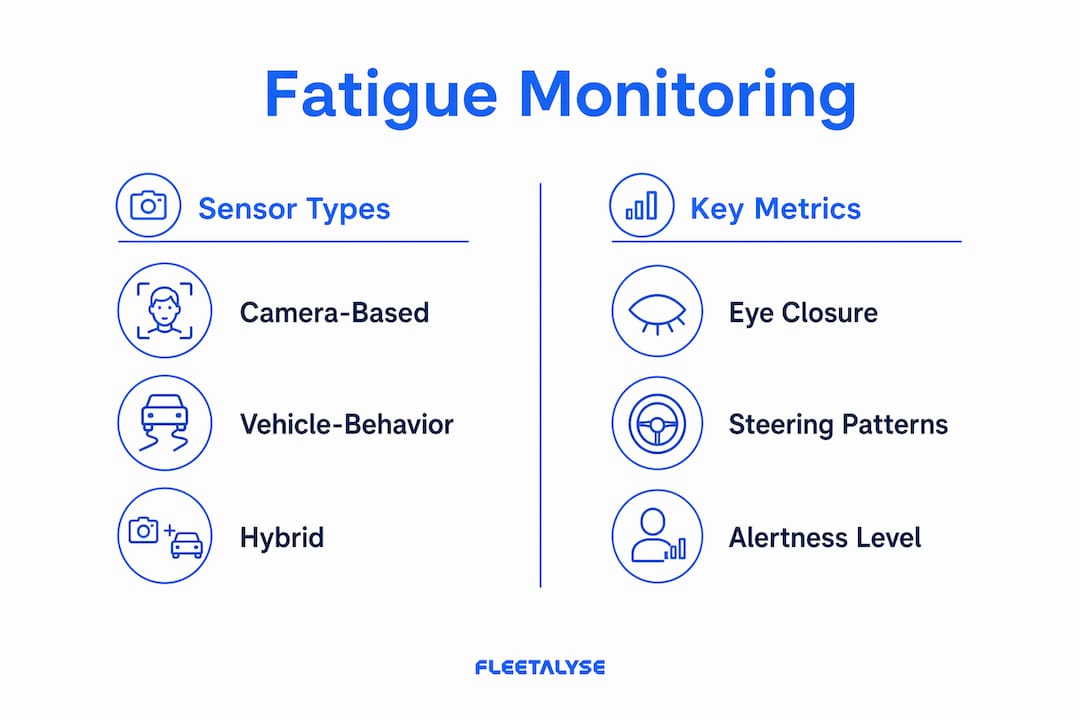
Modern fatigue monitoring draws on four technical detection approaches: camera-based driver state monitoring (DSM), vehicle-behaviour analysis, biological sensors, and hybrid combinations. Camera and vehicle-behaviour methods are the most widely deployed in commercial fleets today.
The table below summarises the measurable signals each approach captures:
| Detection method | Signals measured | Typical hardware |
|---|---|---|
| Camera-based DSM | Eyelid closure, blink rate, gaze direction, head pose, yawning | Infrared in-cab camera |
| Vehicle-behaviour | Steering micro-corrections, lane deviation, braking patterns | Telematics unit, lane camera |
| Biological (wearable) | EEG, heart rate, skin conductance, muscle tension | Wrist band, cap electrodes |
| Hybrid | Combination of the above for higher accuracy | Camera + telematics unit |
The detection pipeline follows a consistent logic regardless of method: sensors capture raw data, onboard processing extracts features (for example, the percentage of time eyelids are closed), a model or threshold evaluates those features against fatigue indicators, and an alert is triggered in-cab or sent to the fleet platform. Infrared cameras measure eyelid closure and head pose even in low-light conditions, which matters for night-shift HGV operations. Telematics units connected via J1939, J1708 or OBD-II simultaneously record cumulative driving hours, giving fleet managers both physiological and hours-based data in one view.
Pro Tip: Think of the sensor layer and the hours layer as two separate but complementary feeds. A driver can be within legal hours yet physiologically impaired. You need both data streams to manage risk properly.
Why fatigue risk matters so much for UK fleets
The safety case is clear. Approximately 20% of road accidents may be fatigue-related according to research literature, and the STATS19 figures cited above represent only the incidents where fatigue was formally recorded as a contributory factor. The real incidence is almost certainly higher.
Operationally, a single fatigue-related incident can trigger:
- Vehicle off-road time, rerouting and missed delivery windows.
- DVSA investigation and potential Operator Licence review.
- Insurance premium increases and third-party liability exposure.
- Driver welfare concerns and potential employment tribunal implications.
For van operators running tight urban schedules, the risk is just as real as for long-haul HGV fleets. Short-haul drivers often accumulate fatigue across multiple shifts without breaching daily hours limits, precisely because hours rules alone do not capture physiological state. AI-assisted hours monitoring that analyses telematics, GPS and historical behaviour can forecast potential violations before they occur, shifting compliance from reactive reporting to proactive risk management.
How UK regulations frame fatigue monitoring obligations
Fatigue monitoring does not replace tachograph compliance. It complements it. UK operators running vehicles subject to EU-derived tachograph rules must record driving time accurately and make records available for DVSA inspection. Electronic logging devices connected via J1939/J1708/OBD-II record driving time automatically, removing the opportunity for manual log errors and displaying remaining legal hours to drivers in real time.
The DVSA and the Traffic Commissioners expect Operator Licence holders to demonstrate a safety management system that actively manages fatigue risk. That means documented policies, evidence of monitoring, and records showing how breaches were investigated and addressed. Regulation (EU) 2021/1341, referenced in TRL’s DSM research, made basic fatigue and attention monitoring mandatory for new M- and N-category vehicles in the EU. UK operators should expect equivalent device-level expectations to develop domestically, making early adoption a prudent step.
For practical compliance guidance specific to UK transport operators, Fleetalyse’s resource on managing driver fatigue regulations covers Operator Licence expectations in detail.
- Tachograph records and fatigue monitoring data should be cross-referenced during internal audits.
- Driver debrief records should note fatigue alerts alongside hours data.
- Policies should specify escalation steps when alerts exceed a defined threshold.
Pro Tip: When preparing for a DVSA audit, export fatigue alert logs alongside tachograph download reports for the same period. Showing that alerts were reviewed and acted upon is far stronger evidence of a functioning safety system than policy documents alone.
Camera, vehicle-behaviour or hybrid: which system suits your fleet?
| System type | Strengths | Limitations | Best fit |
|---|---|---|---|
| Camera-based DSM | High sensitivity; detects micro-sleep and distraction | Privacy concerns; lighting dependency | Long-haul HGVs, coach operators |
| Vehicle-behaviour | Lower privacy risk; no in-cab camera | May miss early fatigue cues; road conditions affect accuracy | Urban vans, mixed fleets |
| Hybrid | Higher accuracy; fewer false alarms | Higher hardware cost; more complex integration | Enterprise fleets, safety-critical routes |

The EU AWAKE project recommends combining driver-state and vehicle-performance measures with traffic risk estimation to improve warning quality. Single-sensor approaches generate more false alarms, which erodes driver trust in the system over time. For mixed fleets running both HGVs and vans, a hybrid approach on high-risk routes with vehicle-behaviour monitoring on urban rounds is a practical middle ground.
How to implement fatigue monitoring across your fleet
A phased rollout reduces disruption and gives you reliable baseline data before full deployment.
- Define objectives and KPIs. Decide what you are measuring: alert frequency, false-alarm rate, hours breach reduction, or incident rate. Without baseline metrics, you cannot demonstrate improvement.
- Select pilot vehicles and drivers. Choose a representative sample covering your highest-risk routes and shift patterns. Aim for at least five vehicles to generate statistically useful data.
- Install hardware. Cab-mounted infrared cameras, telematics units with ECM connectivity, and ruggedised driver-facing displays for in-cab alerts. Plug-and-play units reduce installation time significantly.
- Validate alerts. Review the first two to four weeks of alert data with drivers. Identify false positives caused by road conditions or camera obstruction and adjust calibration.
- Integrate with your fleet platform. Map driver IDs, connect remote tachograph downloads, configure dashboard KPIs and set escalation pathways for high-frequency alerts.
- Train drivers and supervisors. Explain what the system detects, how alerts work, and what happens when one is triggered. Driver buy-in directly affects how useful the data becomes.
- Roll out in phases. Expand from the pilot group to the full fleet, using pilot learnings to refine alert thresholds and integration settings.
For multi-vehicle rollouts, Fleetalyse’s practical fleet monitoring guide covers phased deployment in detail.
Key integration points to confirm before go-live:
- Remote tachograph download connectivity confirmed.
- Driver ID mapping validated against existing HR or dispatch records.
- Alert escalation pathways tested with dispatch and operations managers.
- GDPR data retention periods configured and documented.
Questions to ask vendors before you commit
Technical accuracy and integration depth separate credible systems from those that look good in a demo.
- What are the validated false-positive and false-negative rates, and under what test conditions were they measured?
- Which ECM protocols does the hardware support: J1939, J1708, OBD-II?
- How does the system integrate with existing tachograph download workflows and dispatch systems?
- Where is data stored, for how long, and who has access?
- What is the lawful basis for processing driver biometric data under UK GDPR?
- Is driver consent obtained, and can drivers access their own alert records?
- What UK-based support is available for installation, calibration and ongoing troubleshooting?
- Can you provide a performance report from a pilot with similar vehicle classes and shift patterns?
Understanding driver behaviour monitoring signals before vendor meetings helps you ask sharper questions about what the system actually scores and how.
Pro Tip: Request a pilot performance report from a fleet with comparable operating hours and vehicle mix. Vendor-supplied lab results rarely reflect real-world false-alarm rates on UK roads.
Accuracy limits and privacy considerations you need to understand
No current system is infallible. Camera-based DSM performance degrades in direct sunlight, low-light conditions without adequate infrared, or when the camera is partially obstructed by sunglasses or a visor. Vehicle-behaviour systems can generate false alerts on poorly maintained roads or during legitimate evasive manoeuvres. Calibration after vehicle changes or driver reassignments is often overlooked and is a common source of alert quality problems.
From a privacy standpoint, processing facial images and biometric indicators constitutes special category data under UK GDPR. Operators should:
- Establish a clear lawful basis, typically legitimate interests, and document the balancing test.
- Conduct a Data Protection Impact Assessment before deployment.
- Apply data minimisation: store alert events, not continuous video, unless there is a specific safety justification.
- Give drivers access to their own alert records on request.
- Set defined retention periods and delete data beyond them automatically.
Consult your legal or data protection adviser before deployment. The Information Commissioner’s Office publishes guidance on employee monitoring that applies directly to in-cab systems.
How Fleetalyse supports driver fatigue monitoring for UK fleets
Fleetalyse brings together the data streams that matter for fatigue risk into a single platform built for UK compliance requirements. Core capabilities include:
- Driver-facing in-cab alerts triggered by fatigue indicators from connected dashcam systems.
- Dashboard KPIs showing fatigue alert frequency, hours worked and breach trends across the fleet.
- ECM integration via J1939, J1708 and OBD-II for automated driver hours recording.
- Remote tachograph downloads that overlay hours data with fatigue alert timelines for audit-ready reporting.
- Plug-and-play hardware options that reduce installation complexity for mixed fleets.
- UK-based support for onboarding, calibration and ongoing troubleshooting.
A typical Fleetalyse pilot runs over four to six weeks, covering a defined vehicle group on target routes. Operators track alert frequency and false-alarm rate during the pilot, then use those metrics to configure thresholds before full fleet rollout. The driver behaviour monitoring service page covers the full feature set and integration options.
Key takeaways
Driver fatigue monitoring is most effective when camera-based or hybrid detection is combined with automated driver hours data, giving UK fleet operators both physiological and compliance-level visibility in one platform.
| Point | Details |
|---|---|
| Fatigue goes beyond hours | A driver can be within legal hours yet physiologically impaired; both data streams are needed. |
| UK statistics understate risk | TRL STATS19 analysis found fatigue in 3.3% of fatal collisions; actual incidence is likely higher. |
| Hybrid systems outperform single-sensor | Combining driver-state and vehicle-behaviour data reduces false alarms and improves detection quality. |
| GDPR applies to in-cab cameras | Facial and biometric data is special category; a Data Protection Impact Assessment is required before deployment. |
| Fleetalyse integrates both layers | Remote tachograph downloads and fatigue alert dashboards give audit-ready compliance evidence in one place. |
The gap between hours compliance and genuine fatigue management
Fleet operators often treat tachograph compliance as the endpoint of fatigue management. It is not. Hours rules set a legal floor, not a safety ceiling. A driver who has slept poorly for three consecutive nights can be fully within their legal hours and still represent a serious risk on the road. The research is unambiguous on this: sleep deprivation produces impairment comparable to alcohol intoxication, and cumulative fatigue across a working week is not reset by a single rest period.
The practical implication is that monitoring driver alertness requires both layers. Hours data tells you whether the rules were followed. In-cab detection tells you whether the driver is actually alert. Operators who invest in one without the other are managing paperwork, not risk. The most credible safety management systems pair automated hours recording with in-cab monitoring, then use the combined data to have informed conversations with drivers rather than simply issuing warnings after the fact. That shift, from surveillance to structured safety dialogue, is where fatigue monitoring genuinely changes outcomes.
Fleetalyse: fatigue and compliance monitoring built for UK fleets
Fewer incidents, cleaner audits, and drivers who understand their own risk profile: that is what a properly integrated fatigue monitoring setup delivers. Fleetalyse combines driver behaviour monitoring with automated tachograph downloads and live hours dashboards, giving your compliance team a single source of truth rather than three separate systems to reconcile.
UK-based support means your team gets practical help with installation, calibration and DVSA audit preparation, not a generic helpdesk. Whether you are running a mixed van and HGV fleet or managing a single vehicle type across multiple depots, Fleetalyse can be configured to your operating pattern. Explore the fleet analytics platform or book a demo to see how fatigue alert data and tachograph records work together in practice.
Useful sources for further reading
- TRL PPR2068: Driver Fatigue and Attention Monitoring — The most authoritative UK technical review of DSM technologies, validation methods and regulatory context. Essential reading before any procurement decision.
- EU AWAKE project: In-vehicle detection and warning devices — Covers best-practice detection design, including the case for hybrid driver-state and vehicle-performance approaches.
- PMC systematic review: Technologies for detecting drivers’ states — Comprehensive academic review of wearable and unwearable sensor technologies published between 2014 and 2024; useful for understanding detection accuracy claims.
- DVSA Operator Compliance Risk Score (OCRS) guidance — Explains how DVSA scores operator compliance and why fatigue-related incidents affect licence standing. Available via GOV.UK.
- APTS: Driver safety practices — Practical operator-level safety guidance covering fatigue policies, driver engagement and safety culture.
- UK tachograph rules (GOV.UK) — The primary reference for drivers’ hours rules, tachograph obligations and exemptions applicable to UK-registered vehicles post-Brexit.