

A transport planner's most urgent question often arrives without warning: how much legal driving time has this driver got left? The answer may decide whether a trunk load can be accepted, whether a vehicle swap is safe, or whether a job must move to another cab. If that answer depends on a phone call to the driver, a spreadsheet, or the next tachograph download, dispatch is working with yesterday's picture.
Live driver hours software puts current driver activity beside vehicle location and job planning. Used properly, it gives transport managers a dispatch control rather than another report to review after the shift. It can sit alongside GPS tracking, remote tachograph downloads, driver behaviour data, dashcam evidence, geofences, trailer visibility and maintenance reminders, while the operator remains responsible for interpreting the records and managing compliance.
The practical question isn't whether a dashboard looks modern. It's whether the system can help a planner make a defensible decision before the next load is assigned, especially as mixed fleets face a wider tachograph scope from 1 July 2026 for certain light goods vehicles on international journeys, as set out in GOV.UK guidance on the 2026 tachograph rules.
Table of Contents
- When a Planner Needs to Know the Remaining Drive Time
- What Live Driver Hours Software Actually Does
- How Tachograph and Telematics Data Becomes a Live View
- UK Legal and Operator Licence Context
- Core Features Worth Comparing Side by Side
- A Mixed-Fleet Scenario in Practice
- Selection Criteria and Rollout Checklist for UK Operators
- Frequently Asked Questions for UK Fleet Buyers
When a Planner Needs to Know the Remaining Drive Time
At mid-morning, a planner at a Midlands haulier is balancing three trunkers against a four-hour driving slot and a 7.5-tonne vehicle that has already used a significant part of its available time. One driver calls from a depot, another responds over the radio, and a third sends an email asking whether a job can be added. The question behind all three messages is the same: how long has this driver got left?
A back-office tachograph download every 28 days can't answer that question reliably during the shift. It provides an archive for review, not a trusted operational view of what the driver can legally accept next. UK operators must download each driver card at least every 28 days and retain records for at least 12 months, but that historical obligation doesn't replace live dispatch information, as explained in UK tachograph data guidance for operators.
The decision happens before the infringement
A useful system puts the current driver activity between the cab and the dispatch desk. It combines tachograph activity with the driver identity, vehicle position and current assignment, then shows the planner a remaining-drive figure or an alert that a break is due. The planner can then reject, amend or reassign the load before the work creates a breach.
The workflow should be simple:
- Confirm the driver and vehicle pairing. A cab change or second-driver arrangement can make a perfectly accurate vehicle location view misleading if the activity is attached to the wrong person.
- Check the active rule status. The dashboard should distinguish driving, other work, availability, rest and break activity rather than treating every minute as driving.
- Compare the remaining time with the job. A route that fits geographically may not fit the driver's legal availability once loading, waiting and the return leg are considered.
- Record the decision. Where a load is declined or reassigned, the operator should be able to explain what information informed that choice.
Practical rule: If dispatch has to phone three people to establish whether a driver can take one more job, the system isn't providing live control yet.
Electronic records matter beyond driver hours. A fleet that exchanges delivery instructions, tachograph files, proof of delivery and compliance documents across disconnected channels may benefit from reviewing EDI logistics solutions as part of its wider information flow. That doesn't turn a telematics platform into a transport management system, but it can reduce the number of places where operational evidence gets trapped.
What Live Driver Hours Software Actually Does
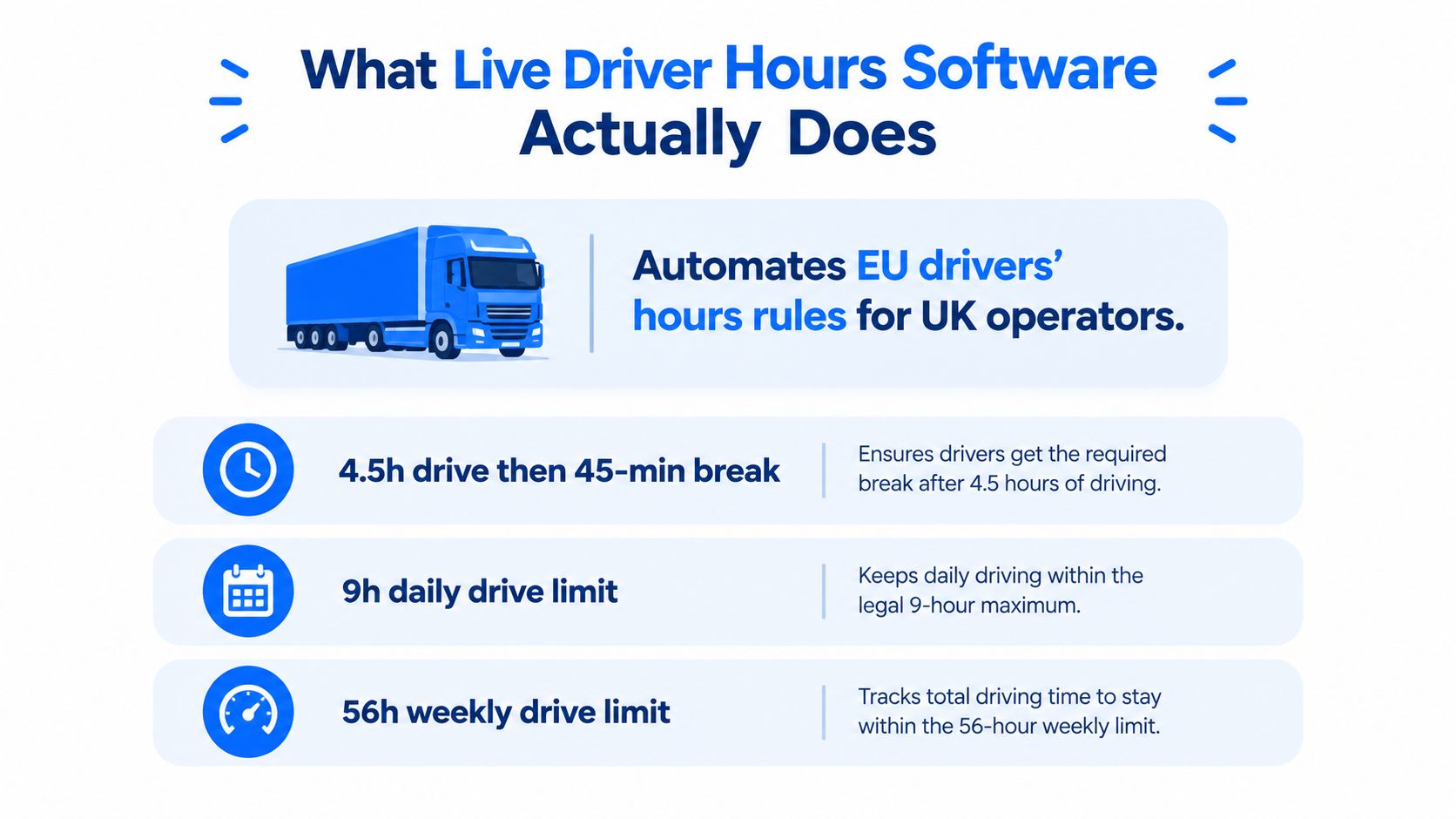
The core job is to turn activity data into a decision a planner can use. Under the UK's assimilated drivers' hours framework, the baseline includes 9 hours of driving in a day, extendable to 10 hours twice in a week, a maximum of 56 hours in a week, and 90 hours across any two consecutive weeks. A driver must take a 45-minute break after 4.5 hours of driving, and daily rest is generally at least 11 hours, as summarised in UK drivers' hours rules.
Live means usable during the shift
A historical tachograph package may identify infringements after files have been downloaded and processed. That remains valuable, but it's retrospective. Live driver-hours software aims to maintain a current activity timeline by receiving driver-card and vehicle-unit data through remote tachograph connections, then recalculating the driver's available time as new events arrive.
The output should answer operational questions such as:
- Remaining daily drive: Can the driver complete the proposed movement within the daily limit?
- Break eligibility: Has the accumulated driving reached the point where a break is needed?
- Weekly exposure: Is the assignment likely to push the driver towards the weekly or two-week ceiling?
- Rest position: Can the planned duty fit around the required daily or weekly rest?
- Exception status: Is a warning caused by a genuine activity event, a missing download, a pairing problem or a communication failure?
The software isn't deciding whether an operator has complied in every respect. It's calculating from the data available, and the transport manager still needs to investigate exceptions, check records and apply the correct exemptions or special rules.
The ruleset matters more than the screen
A supplier may describe its product as live because it shows a vehicle moving on a map. That's GPS tracking, not necessarily driver-hours control. A proper evaluation should ask how the platform receives tachograph data, how frequently it refreshes, how it handles second drivers and how it distinguishes driving from other work.
Teams considering wider automation should also separate genuine operational calculations from broader claims about AI agent logistics insights. The useful test is straightforward: can the system show the source activity, the applied ruleset and the reason for the warning? If it can't, a colourful status indicator may create false confidence rather than reduce risk.
How Tachograph and Telematics Data Becomes a Live View
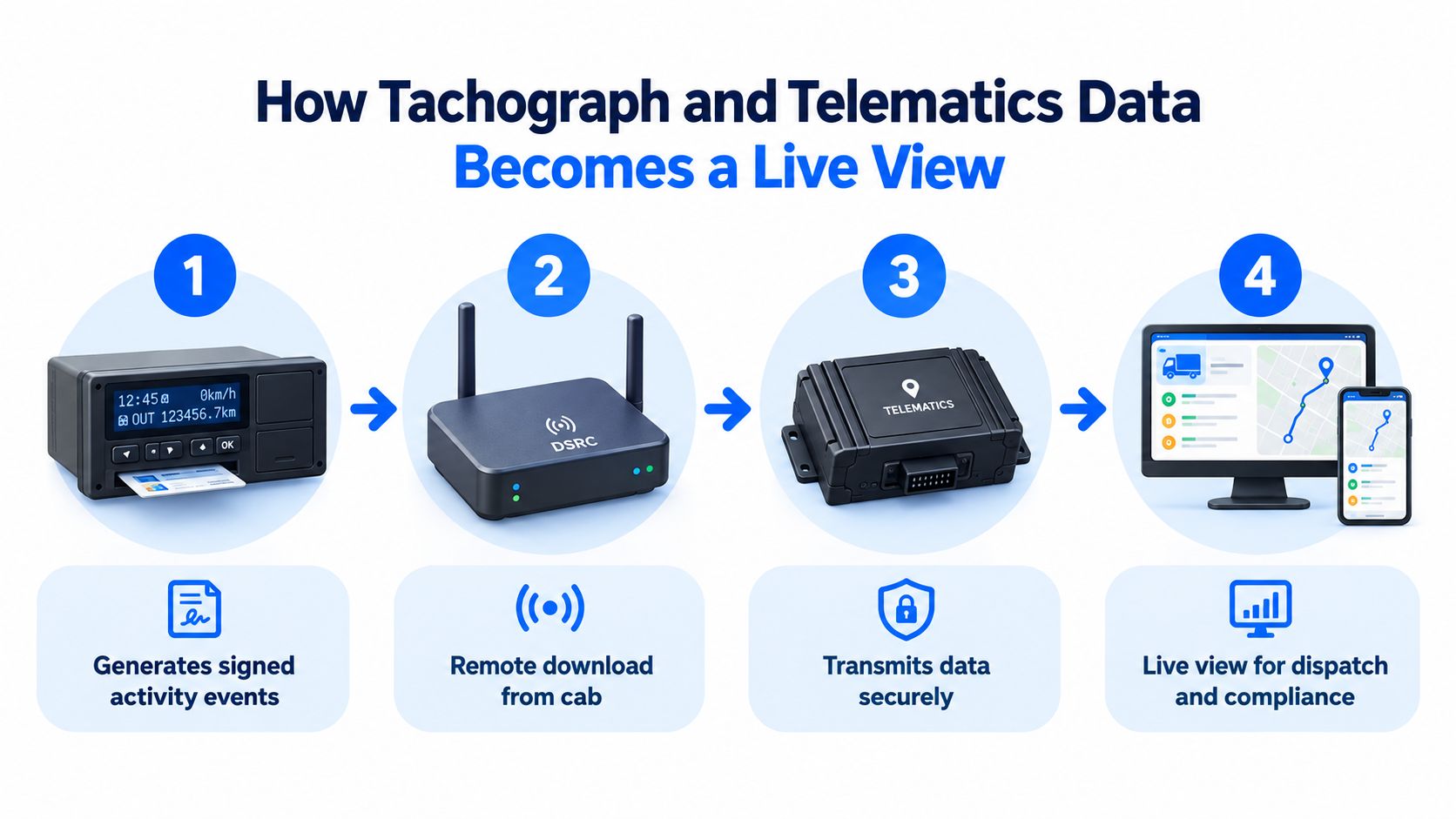
A reliable live view is a data pipeline, not a single device. The tachograph supplies legally relevant driver and vehicle activity, while the telematics unit contributes location, movement and selected vehicle signals. The cloud platform then combines those streams into a timeline that dispatch can read.
Four points where implementations succeed or fail
First, the tachograph creates activity events. A digital or smart tachograph records driver activity, vehicle activity and card information. The platform must preserve the identity of the driver, including a second driver where applicable, rather than relying only on the vehicle's location.
Second, a remote-download connection retrieves the files. The cab needs a compatible gateway or harness arrangement that can obtain the relevant driver-card and vehicle-unit data. Download scheduling is separate from live visibility, so operators should confirm both the refresh process and the archive process.
Third, the telematics unit adds context. GPS position, ignition, movement and selected CAN bus signals can help dispatch understand whether a vehicle is travelling, stationary, at a site or potentially disconnected. These signals should support the tachograph data, not override it.
Finally, the rules engine calculates the operational view. The platform fuses the activity timeline with the applicable drivers' hours rules and produces information such as remaining daily drive, weekly exposure, next break due and a red, amber or green status. The status is only useful if the user can drill into the underlying event.
Integration questions to settle before buying
Operators usually negotiate across several suppliers. The tachograph may be from VDO, Stoneridge or Wincor, while the telematics service may be Webfleet, Trimble or Microlise. Data may move through an API, a structured file exchange or a proprietary connector, and each route affects implementation effort, support ownership and the time needed to diagnose a missing record.
Ask who owns the fault when a dashboard shows no current hours. Is it the tachograph manufacturer, the telematics provider, the connectivity service or the software vendor? Also establish whether the system can export the underlying files and whether the records remain usable if the operator changes platform.
For a practical explanation of the collection side, see remote tachograph download for fleet operations. The key is to treat the live dashboard as the visible end of a chain that must remain traceable from cab activity to compliance archive.
UK Legal and Operator Licence Context
Live driver-hours software supports an operator's existing legal duties. It doesn't replace the transport manager, the tachograph archive, infringement review or the records needed to demonstrate effective control under an operator licence.
The assimilated drivers' hours rules set the driving and rest framework for vehicles within scope. Separate working-time rules also matter. UK guidance says mobile workers' weekly working time must not exceed an average of 48 hours over a 17- or 26-week reference period, although a single week can reach 60 hours if the reference-period average remains respected, as explained in GOV.UK working-time rules for goods vehicles.
The archive still has to stand up
The operator must manage downloads, retain the records and produce them when requested. There's conflicting interval information in industry guidance, so buyers should confirm the applicable current requirement and configure the system accordingly. One UK compliance reference states a minimum of 28 days for driver cards and 90 days for vehicle units, while another operator guide describes a 56-day vehicle-unit interval, making supplier configuration and legal verification essential rather than something to assume from a sales demonstration.
The retained archive is an auditable artefact. A live status screen cannot prove what happened if the underlying file is missing, overwritten or incorrectly paired with a driver. For international journeys, the DVSA says operators must produce 56 days of drivers' records, and journeys between the UK and non-EU countries can bring AETR rules into play, as set out in the DVSA bulletin on international journeys and smart tachograph 2.
The LGV boundary changes the operating model
From 1 July 2026, assimilated drivers' hours and tachograph rules apply to certain LGVs over 2.5 tonnes on international journeys, according to GOV.UK's 2026 tachograph guidance. The operator must classify the journey correctly, check exemptions and ensure that a vehicle moving between domestic and international work isn't left under the wrong workflow.
| Rule | Scope | Live-System Role | Manual/Archive Duty |
|---|---|---|---|
| Driving limits | Vehicles and drivers within assimilated rules | Show remaining daily, weekly and two-week driving time | Review tachograph records and investigate exceptions |
| Breaks and rest | Drivers subject to the relevant hours rules | Alert dispatch when a break or rest constraint affects allocation | Preserve records and document corrective action |
| Working time | Mobile workers covered by working-time rules | Overlay duty and other-work information where supported | Maintain working-time evidence and reference-period records |
| Tachograph downloads | Applicable driver cards and vehicle units | Schedule collection and flag missed or failed downloads | Retain files and produce them for inspection |
| International LGV scope | Certain vehicles over 2.5 tonnes on international journeys from 1 July 2026 | Apply the correct vehicle and journey workflow | Check scope, exemptions and equipment requirements |
A live platform is therefore a dispatch aid and early-warning layer, not a complete operator-licence compliance system. Transport managers still need an organised archive, an infringement process and evidence that the business acted on warnings.
For a plain-English review of the legal framework, use legal driving hours for UK operators.
Core Features Worth Comparing Side by Side
A buyer should score a live-hours platform against the decisions the team makes, not against the length of the supplier's feature list. Start with the question, “Can dispatch assign tomorrow's work without guessing?” Then test the data, calculation, workflow and governance behind the answer.
| Feature Band | Capability | HGV Haulier | Mixed LGV/HGV |
|---|---|---|---|
| Data capture | Remote tachograph download and driver-card pairing | Non-negotiable | Non-negotiable, with scope checks |
| Data capture | GPS position, speed source and vehicle signals | Important for operational context | Important across different vehicle types |
| Live calculation | Remaining drive, break and rest status | Non-negotiable | Non-negotiable for vehicles in scope |
| Live calculation | Working-time overlay | Important for compliance reporting | Important where duties combine vehicle categories |
| Operational use | Planner alerts and availability view | Non-negotiable | Non-negotiable |
| Operational use | Second-driver and cab-out detection | Important for articulated and long-distance work | Valuable where vehicles and crews change |
| Governance | Audit log and role-based access | Non-negotiable | Non-negotiable |
| Governance | API or structured export | Useful when linked to planning software | Useful for keeping mixed-fleet records aligned |
What deserves the most scrutiny
Data capture comes first. If the system can't identify the driver, vehicle unit and source file consistently, the remaining-hours figure is only an estimate. Confirm support for the tachograph brands and connection methods already installed in the fleet.
The calculation layer should be visible. Ask to see the event behind a break warning and the calculation behind a remaining-drive figure. Ferry or train rest, mixed duties and changes between vehicle types can expose weaknesses that a simple demo won't show.
Operational features create adoption work. A driver app, consent flow or infringement acknowledgement process may improve the record, but it also creates training and change-management overhead. Don't add a driver workflow unless the cab team can complete it without delaying the job.
Deeper tachograph integration generally brings more hardware and configuration work. A lighter GPS-only setup may be cheaper and quicker to deploy, but it won't provide the same driver-hours evidence. The right choice depends on whether the business needs live compliance control, location visibility, or both.
A Mixed-Fleet Scenario in Practice
A representative operator runs 18-tonne rigids, 44-tonne artics and a growing 3.5-tonne LGV trunking fleet. From 1 July 2026, the international work in the LGV group needs the same disciplined scope checks as the HGV operation, so dispatch can't treat the vans as a separate blind spot.
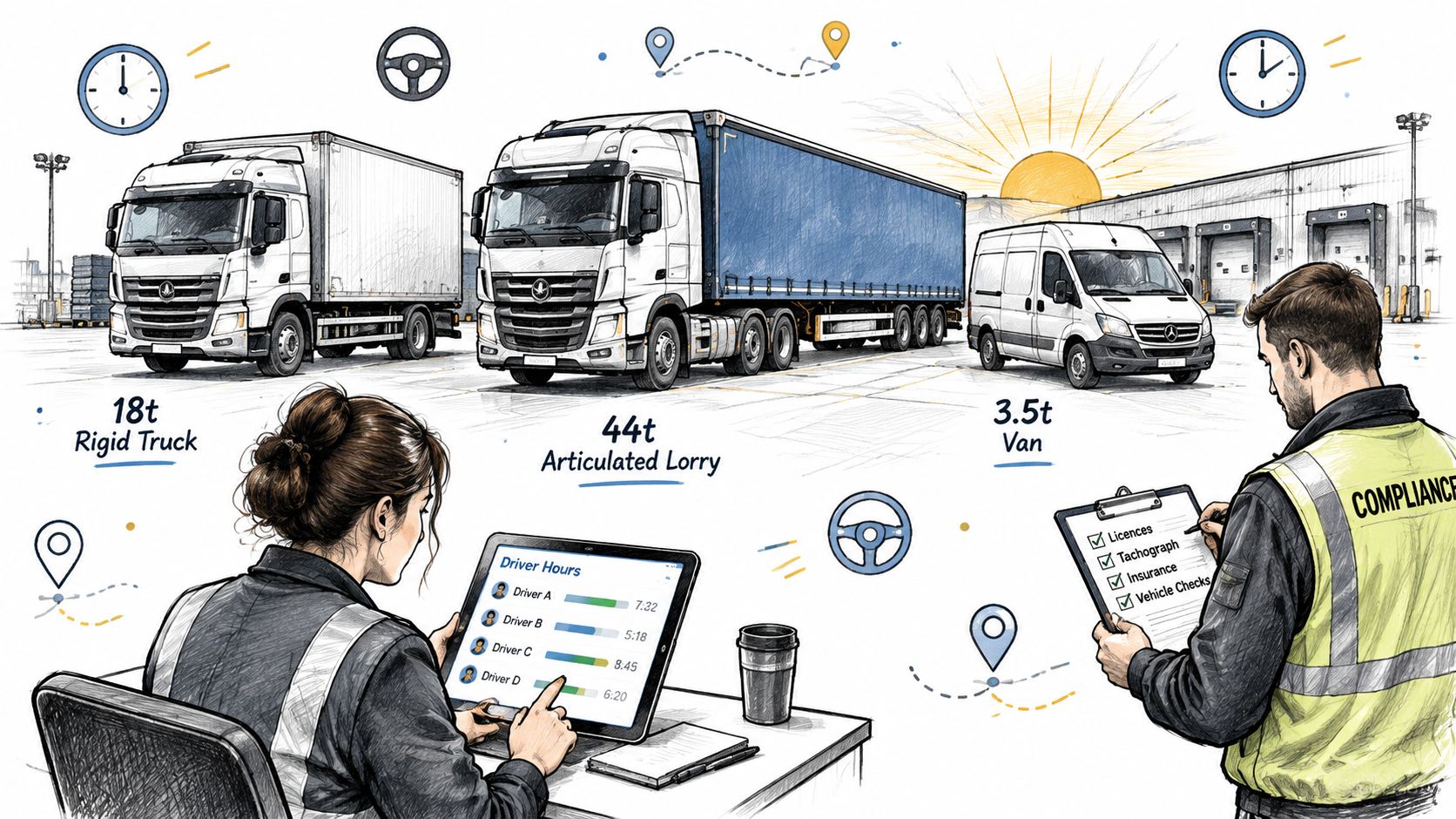
At 06:00, the planner considers swapping a trunk job between two drivers. The live calculation shows that one driver would exceed the daily driving ceiling by 21 minutes, so the swap is rejected before the vehicle leaves. That decision protects the schedule as well as the record, because the planner has an auditable reason for choosing another driver rather than discovering the problem during a later review.
At 11:15, an LGV driver receives a phone-pickup warning before reaching the accumulated driving threshold that would require the relevant break. The warning isn't a substitute for the driver's own tachograph responsibility, but it gives the cab and office a shared prompt at the point where a route decision can still be changed.
One dashboard, different rule positions
At 14:30, the compliance lead reviews overnight infringements against the recorded DVSA test data. Some events need investigation, some need a driver conversation, and some may reflect missing or misclassified activity. The value of the queue is that it directs attention to exceptions rather than asking the team to search every vehicle manually.
At 18:00, the transport manager checks the working-time report beside the infringement queue. The two views answer different questions. Driving limits concern the hours behind the wheel, while working time includes the wider duty pattern and requires its own record and reference-period oversight.
The integration problem is more important than the dashboard design. A mixed fleet needs clear vehicle scope, journey classification, driver pairing, alerts and archive rules. If one van switches from domestic work to an international route, the system must help the team identify that change instead of carrying forward a false assumption.
A short operational walkthrough can help managers explain this shared view to planners and drivers:
Selection Criteria and Rollout Checklist for UK Operators
Procurement should begin with evidence, not a promise of effortless compliance. Ask the supplier to demonstrate how its platform handles VU-download files from the tachograph brands used by the fleet, how often the live view refreshes, and how the calculation changes when the driver's activity changes.
A sensible shortlist tests four areas:
- Compatibility: Confirm support for the installed tachograph equipment, including VDO, Stoneridge and EFKON where relevant, plus the vehicle connection method.
- Calculation: Require a demonstrable remaining-hours calculation against the assimilated UK rules, not just a map showing vehicle movement.
- Evidence: Check that the platform keeps an audit trail, supports usable exports and can provide the records a Traffic Examiner may request.
- Operational fit: Test alerts, permissions, driver pairing, offline behaviour and the handover between dispatch and compliance.
Run the rollout as a controlled change
Start by mapping every data source. List the tachograph units, driver cards, telematics devices, planning tools, archive locations and people who need access. Then configure the driver-card and vehicle-unit download schedules, with the current legal intervals checked against the operator's compliance advice rather than copied blindly from a vendor template.
Next, issue API keys or file-exchange credentials to the relevant planning system, set transport-manager permissions and create a fallback procedure for a telematics outage. The fallback should state who contacts the driver, which source becomes authoritative, how the event is logged and when the missing data is reconciled.
A phased deployment is safer than switching every vehicle at once. Use a scored shortlist, then run a 30-day pilot on two vehicles before fleet-wide deployment. Include a vehicle with a different tachograph setup if the fleet is mixed, and test a driver change, a missed communication event, a break warning and an archive export.
Fleetalyse can be considered as one option for UK commercial fleets requiring GPS tracking, remote tachograph downloads, live driver-hours visibility, trailer and container tracking, dashcams, driver behaviour information, geofences, maintenance reminders and related management reporting. It should still be evaluated against the operator's own tachograph, planning and archive requirements.
For the implementation work itself, use this fleet telematics implementation guide to structure the data mapping, responsibilities and rollout checks.
Frequently Asked Questions for UK Fleet Buyers
Does live driver-hours software monitor drivers continuously?
It can process current tachograph activity alongside telematics information, but that isn't the same as unrestricted personal surveillance. GPS tracking shows vehicle movement, while tachograph data records the driver's selected activity categories. Operators should explain the purpose, limit access by role, follow data-protection requirements and avoid collecting personal-location information outside a lawful business need.
Will it cover a mixed fleet after the July 2026 LGV change?
It may, but the buyer must confirm the platform can distinguish domestic from international work and apply the relevant scope. From 1 July 2026, certain LGVs over 2.5 tonnes on international journeys come within the assimilated drivers' hours and tachograph rules, so the operational change is classification, equipment readiness and alert configuration, not adding vans to an existing vehicle list.
How does it calculate time when drivers switch between tachographs?
The platform needs a continuous driver activity history, not just a vehicle feed. Ask how it joins analogue records, digital card files and smart tachograph data, how it handles a second driver and what happens when a card download is late. If the answer can't be traced back to source records, treat the displayed figure as a prompt for investigation rather than final evidence.
Can it produce records for DVSA or a Public Inquiry?
A useful system should make the relevant tachograph files, activity timeline, infringement history and audit actions easy to retrieve. It shouldn't imply that a dashboard alone satisfies an inspection. Confirm the archive window, export format, retention process and whether the team can replay the required period without manually searching disconnected systems.
Fleetalyse provides commercial fleet telematics covering GPS tracking, remote tachograph downloads, live driver-hours visibility, dashcams, driver behaviour data, asset tracking and operational alerts. Visit Fleetalyse to discuss a relevant vehicle setup, request a quote or arrange a demonstration focused on your dispatch and compliance workflow.