
£5–£15 extra for 99% uptime: Multi network SIMs for UK fleets
For UK commercial fleets that need continuous telematics, a multi-network IoT SIM with private APN and connectivity management platform (CMP) controls is the pragmatic default. It gives you automatic failover across UK networks instead of dependence on one, backed by eUICC support and features like fixed IP that a single-network SIM cannot match. Fleetalyse builds this approach into its telematics deployments precisely because a dropped GPS signal or a missed dashcam upload is rarely a hardware fault. It is usually a coverage gap.
TL;DR:
- Multi-network IoT SIMs carry multiple IMSI profiles and switch networks based on signal quality, improving uptime above 99% compared to 95-98% for single-network SIMs.
- Features like private APN and fixed IP are essential for telematics data security and direct device access, and should be standard in contracts.
- Dual-SIM and eUICC architectures offer higher resilience by enabling remote profile switching and independent network failover, suitable for long-term fleet deployments.
- Proper monitoring, usage alerts, and regular testing routines are critical to avoid policy-based connectivity failures mistaken for hardware faults.
- UK-specific roaming terms depend on commercial agreements, requiring fleet managers to verify SIM-level roaming costs, especially when crossing into EU borders.
Table of Contents
- What is a multi-network SIM UK fleets should actually use?
- Why fleets benefit: coverage resilience, uptime and ROI
- Procurement checklist: what to demand in a multi-network SIM contract
- SIM, eUICC or dual-SIM: choosing your deployment architecture
- Running it well: monitoring, alerts and a testing routine
- Which UK mobile networks matter for fleet IoT?
- Regulatory considerations for multi-network SIM usage in the UK
- Fleetalyse perspective: matching connectivity to operational reality
- Get multi-network connectivity built into your fleet setup
- Sources
What is a multi-network SIM UK fleets should actually use?
A multi-network IoT SIM is not the same product as a consumer multi-network SIM you might put in a mobile phone or a home router. Consumer SIMs auto-switch between EE, O2, Three and Vodafone to keep a call connected. Fleet-grade IoT SIMs do something more deliberate: they carry multiple International Mobile Subscriber Identity (IMSI) profiles, one per network, and switch between them based on signal strength, network health, and sometimes routing rules set by your provider’s portal.
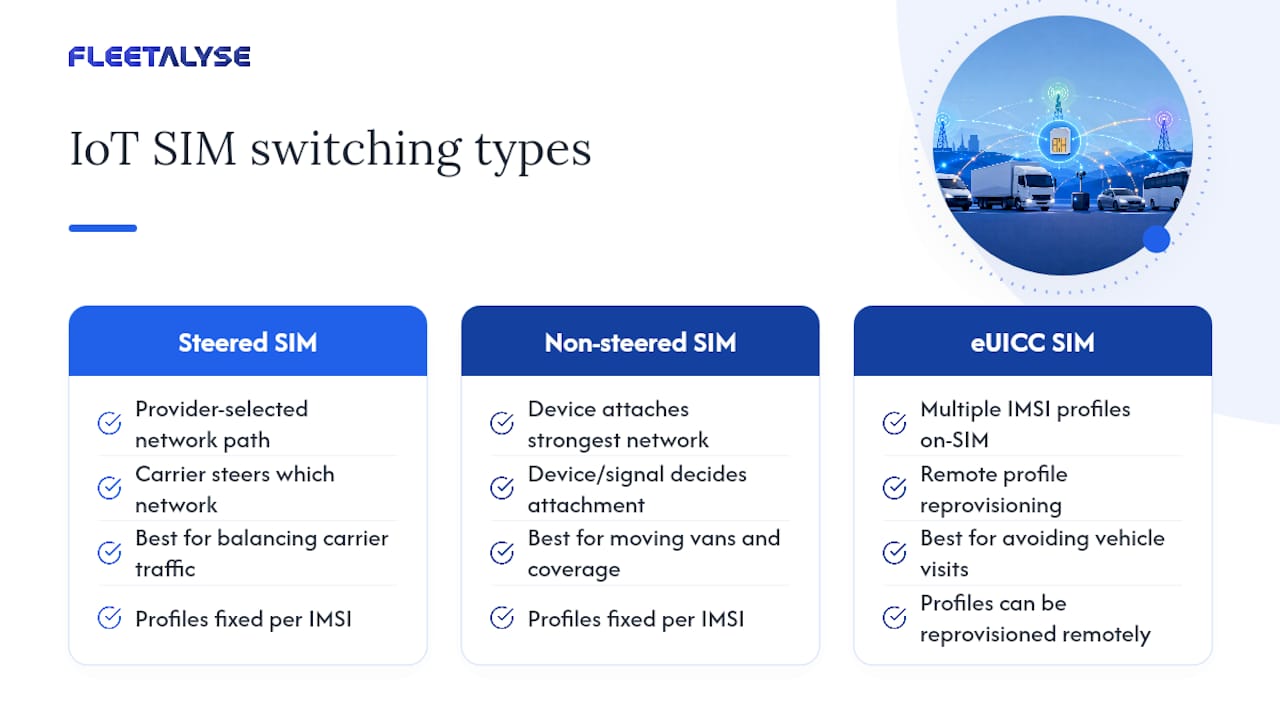
That switching comes in two flavours. Steered SIMs let a carrier decide which network you sit on, often to balance their own traffic. Non-steered SIMs let the device attach to whichever network gives the strongest signal at that moment, which matters far more for a van moving through Cumbria than a stationary sensor. eUICC (embedded universal integrated circuit card) takes this further by allowing the network profile to be reprovisioned remotely without a technician touching the vehicle.
The features that separate an IoT SIM from a phone SIM are just as important as the switching. Private APN (Access Point Name) keeps your telematics traffic off the public internet. Fixed IP lets your platform reach a device directly, rather than the device only reaching out. Consumer SIMs offer neither.
There is also a UK-specific wrinkle. Post-Brexit, roaming terms for IoT and machine-to-machine (M2M) SIMs are governed by commercial agreements, not the EU roaming protections consumer phone users enjoy. If any part of your fleet crosses into the EU, confirm the roaming terms at SIM level, not at brand level.
Why fleets benefit: coverage resilience, uptime and ROI
A single vehicle covers dozens of micro-locations in a working day, from motorway service stations to rural depots and underground loading bays. A single-network SIM has one shot at coverage in each of those spots. A multi-network SIM has three or four.
That difference shows up in the numbers. Multi-network SIMs typically deliver effective uptime above 99%, compared with roughly 95 to 98% for single-network SIMs covering the same routes. For a vehicle carrying a live GPS tracker, a dashcam uploading incident footage, or a tachograph feed, those gaps land at the worst possible moments, usually when the vehicle is somewhere unfamiliar and coverage was never guaranteed in the first place.
In numbers: Multi-network SIMs commonly cost 20 to 50% more per month than single-network SIMs, typically in the region of £5 to £15 per SIM. Against that, weigh the cost of losing visibility on a vehicle carrying compliance-critical data, or missing the dashcam evidence you need after an incident.
The ROI question fleet managers should ask isn’t “what does the SIM cost?” It’s “what does one hour of blind driving cost if it happens during an insurance dispute or a DVSA audit?” For most commercial fleets, that answer justifies the premium comfortably.
Procurement checklist: what to demand in a multi-network SIM contract
Buying a multi-network SIM on price alone is how fleets end up with a product that behaves like a consumer SIM in a fleet-grade wrapper. Work through this checklist before signing anything.
- Private APN and fixed IP as standard options. You need private APN to keep telematics traffic off the open internet, and fixed IP if your platform needs to reach devices directly, for example to pull dashcam footage on demand rather than waiting for a scheduled upload.
- Full CMP visibility. Insist on per-SIM monitoring, usage alerts, API access, and cost-centre allocation so you can attribute data spend to specific vehicles or depots rather than one lump invoice.
- Bulk provisioning that doesn’t need a field visit. If you’re scaling past a handful of vehicles, manual SIM activation becomes a bottleneck fast.
- A clear permanent-roaming policy. Ask specifically how UK to EU roaming is priced and whether it’s confirmed at SIM level, given how IoT roaming now depends on commercial agreements rather than EU-wide protections.
- An SLA with a named escalation path. Not just an uptime percentage. Ask who you call at 2am when a fixed fleet of refrigerated vans goes dark.
- Billing granularity and a sample report. Ask to see an actual monthly report before you commit, not a mock-up.
Watch for red flags: consumer-style roaming language in the contract, no per-SIM logs, opaque bundled billing, or a provider unwilling to supply test SIMs before purchase.
Pro Tip: Ask any prospective provider for a live demo of their CMP portal, not a screenshot. If they can’t show you a real per-SIM attachment log during the sales call, assume it doesn’t exist in production either.
SIM, eUICC or dual-SIM: choosing your deployment architecture
Physical SIMs remain the simplest option for smaller fleets, but they carry a hidden cost: every carrier migration means a technician visiting every vehicle. eUICC removes that cost by allowing carrier profiles to be swapped remotely, which matters most for fleets planning to run vehicles for five years or more, where renegotiating a connectivity contract mid-life is a near certainty.
Dual-SIM architectures push resilience further still. Some fleets pair two independent multi-network SIMs from separate providers in a dual-SIM router, so a fault at the CMP level for one provider doesn’t take down the whole vehicle. This layered approach creates genuinely independent failure modes, which single-provider redundancy can’t offer.
Before deploying either approach, check device compatibility properly. Confirm supported radio bands: LTE-M (Cat-M1) is generally the better choice for moving vehicles, balancing mobility, building penetration and battery life, while full 4G is worth reserving for dashcam units pushing video. Confirm the SIM form factor your hardware actually takes, whether network attachment status is visible in your dashboard, and whether the device supports fixed IP if inbound access is part of your design.
Running it well: monitoring, alerts and a testing routine
A multi-network SIM only performs as well as the policies wrapped around it. Most “connectivity failures” fleet managers report are actually policy problems, not hardware faults; a device stuck on a weak network because of an invisible steering rule looks identical to a dead SIM from the outside.
Build these habits into your operations from day one:
- Check usage thresholds and per-SIM attachment logs weekly, not just when something breaks.
- Set hard data caps per cost centre so one misconfigured device can’t blow a monthly budget.
- Avoid aggressive network steering on vehicles that move constantly. Let the SIM attach to whichever network is genuinely strongest.
- Tune heartbeat and upload intervals to the task. A tracker pinging every 30 seconds needs different bandwidth planning than a dashcam pushing footage.
- Use fixed IP wherever inbound access to a device is operationally critical.
Pro Tip: Before rolling a new SIM contract across the fleet, pilot it on two or three representative routes, including the worst-coverage leg you run regularly, and deliberately simulate a carrier outage to confirm failover actually holds for both data and video streams.
Which UK mobile networks matter for fleet IoT?
The UK’s IoT and M2M connectivity ultimately routes through the same four physical networks that consumers use: EE, Vodafone, O2 and Three. What differs for fleet applications is how a multi-network provider licenses access to those networks and bundles it with fleet-relevant features.
EE and Vodafone typically carry the widest rural and motorway coverage, which matters most for fleets running long-haul or agricultural routes where a single-network gap can mean hours without a signal. O2 and Three tend to perform strongly in urban and suburban depots, where density of coverage matters more than raw geographic reach. No single network wins everywhere, which is the entire argument for multi-network SIMs in the first place: a SIM that can attach to whichever of the four is strongest in that postcode outperforms any single carrier on its own.
Providers offering unsteered multi-network access with UK breakout let your devices pick the best available network at each location rather than being tied to a carrier’s own traffic-balancing priorities. That distinction, unsteered versus steered, is worth confirming directly with any provider, since marketing material rarely spells it out clearly.
Regulatory considerations for multi-network SIM usage in the UK
Multi-network SIM deployments sit inside the same regulatory framework as any other connected vehicle data system, but a few points deserve specific attention for fleets.
Data protection is the first. Vehicle telematics data, particularly driver behaviour and location history, falls under UK GDPR. A private APN helps here by keeping data traffic off public infrastructure, but it doesn’t remove your obligation to have a lawful basis for processing driver location and behaviour data, or to be transparent with drivers about what’s collected.
Roaming rules are the second. As covered earlier, UK IoT roaming agreements are commercial rather than protected by EU-wide rules, so any cross-border operation needs its roaming terms confirmed at SIM level and reviewed periodically, since providers can and do change terms between contract renewals.
Security is the third, and often the most overlooked. eUICC and remote provisioning reduce the need for field visits, but they also mean carrier credentials live in a portal somewhere. Ask any provider how SIM profile changes are authenticated and logged, since a compromised CMP account can reroute or disable connectivity across an entire fleet in one action. For operators managing tachograph and compliance data alongside connectivity, that security question deserves the same scrutiny as the DVSA-facing side of the business.
Fleetalyse perspective: matching connectivity to operational reality
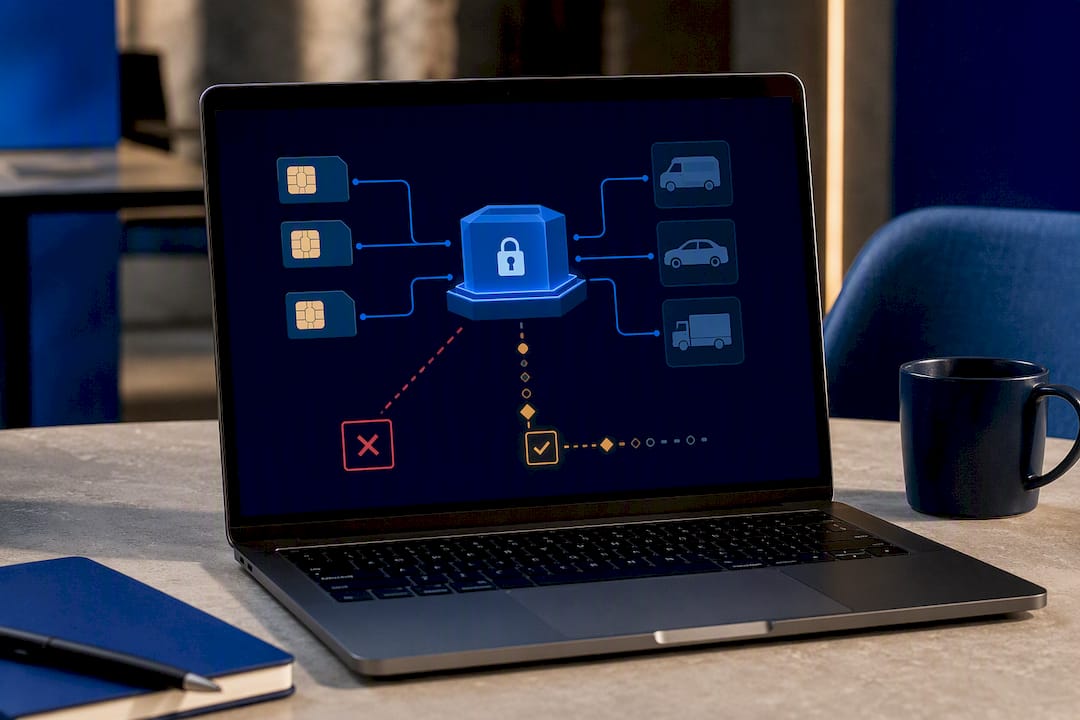
Multi-network SIMs solve a connectivity problem, but they only pay off inside a system built to use them properly. That’s the piece most fleets underestimate: the SIM is not the solution, it’s an input to one.
Fleetalyse pairs multi-network IoT SIM options with plug-and-play telematics hardware, automated DVSA and Operator Licence compliance workflows, and UK-based support that understands both the connectivity side and the regulatory side of a fleet’s obligations. The aim is straightforward: fewer administrative hours spent chasing missing data, and continuous visibility on vehicles that can’t afford to go dark, whether that’s a refrigerated van or an HGV mid-route.
— Vytautas
Get multi-network connectivity built into your fleet setup
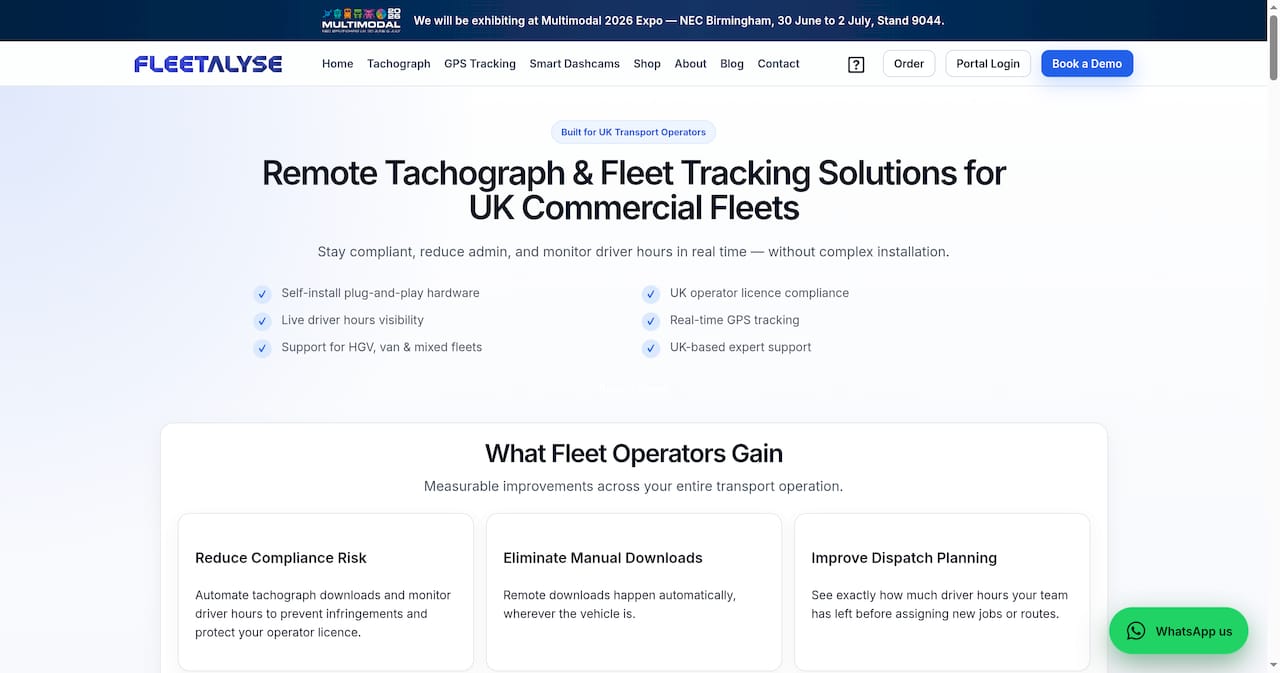
The alternative to living with coverage gaps isn’t a bigger data plan. It’s connectivity that fails over automatically and hardware that’s actually compatible with it. Fleetalyse supplies both: multi-network IoT SIMs built for GPS trackers and telematics units, alongside unlocked GPS trackers for fleets that want to pair their own SIM choice with reliable hardware.
If you’re weighing up carriers more broadly, practical guidance on choosing UK mobile carriers is worth a read before you commit to any single provider. For fleets running EVs alongside diesel or petrol vehicles, connectivity resilience also feeds directly into charging logistics, and Swift Charging’s UK infrastructure work is a useful reference point for that side of the operation.
The practical next step is simple. Request a demo of Fleetalyse’s platform, trial a multi-network SIM on your worst-coverage route, and ask for a failover report before you scale the rollout across the rest of the fleet.