
Most UK transport managers spend more time chasing drivers for location updates than actually managing their operations. It is a frustrating cycle of manual tachograph downloads, unpredictable ETAs, and the constant, underlying anxiety of a surprise DVSA audit. You already know that manual processes are a drain on your time and your bottom line. Relying on guesswork for vehicle locations or driver hours isn't just inefficient; it's a direct risk to your operator licence.
The pressure of rising operational costs and the 2026 shift toward smarter tachograph technology for smaller vehicles makes manual monitoring a liability. This guide explains how real-time delivery fleet tracking transforms these daily headaches into a streamlined, automated workflow. We will show you how to gain full visibility over every asset while cutting fuel costs by up to 15% and eliminating the administrative burden of compliance. You'll discover how to protect your business with live data, ensuring your fleet remains efficient and fully compliant without the usual paperwork mountain.
Key Takeaways
- Eliminate Operational Blind Spots: Learn how real-time delivery fleet tracking combines live GPS data with telematics to give you complete visibility over vehicle locations and accurate ETAs.
- Protect Your Operator Licence: Discover why location data alone is not enough for UK fleets and how integrating live compliance data shields your business from DVSA penalties.
- Automate Tacho Management: See how moving away from manual driver card downloads reduces administrative overhead and ensures accurate, continuous compliance records.
- Deploy Without Friction: Gain a practical roadmap for implementing high-frequency tracking hardware across your HGVs, vans, and trailers without disrupting daily operations.
Why real-time delivery fleet tracking is vital for UK logistics
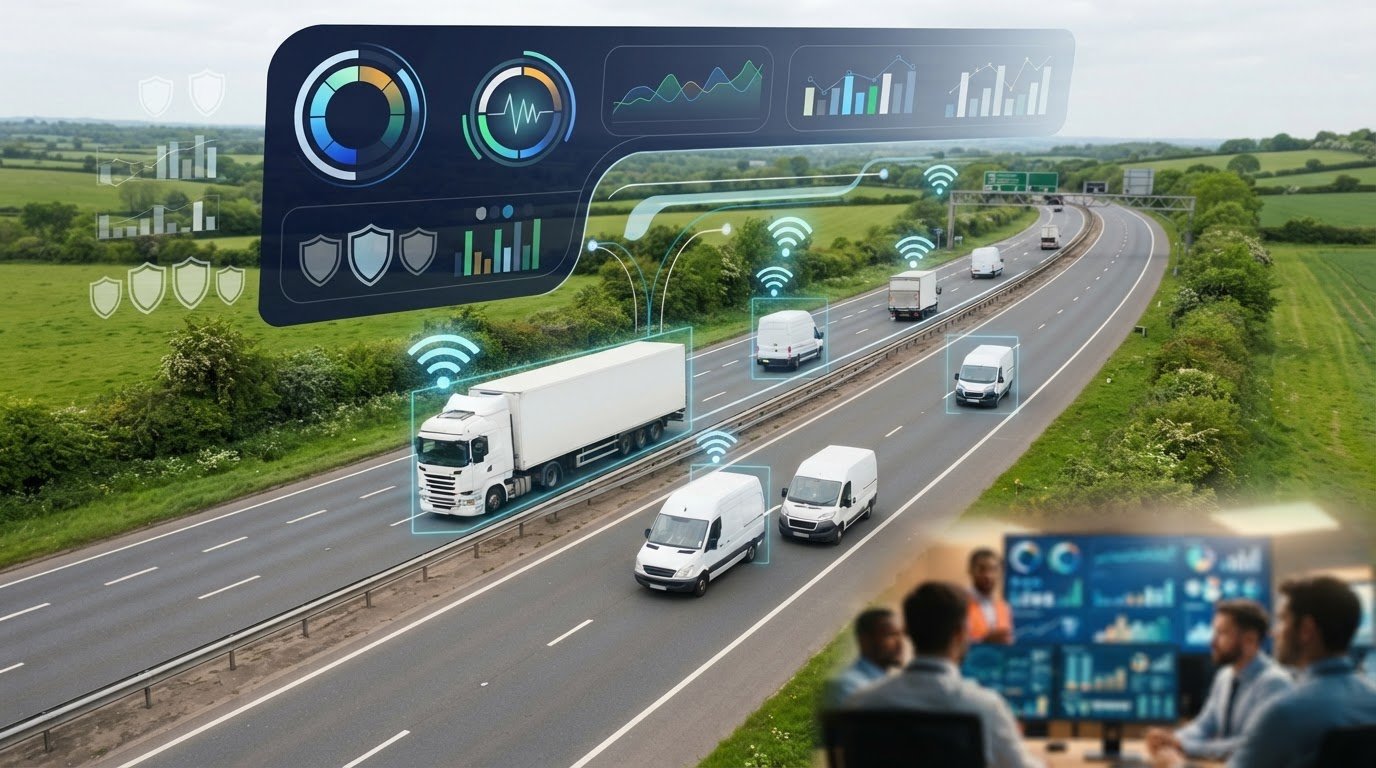
Real-time delivery fleet tracking is the cornerstone of a modern transport operation. It isn't just a simple vehicle tracking system that shows where a van is every ten minutes. It is the integration of live GPS monitoring with deep telematics data, providing a constant stream of information. This level of visibility eliminates the blind spots that traditionally plague commercial delivery operations. You no longer have to wonder if a driver is stuck in traffic on the M25 or if they've already reached the depot.
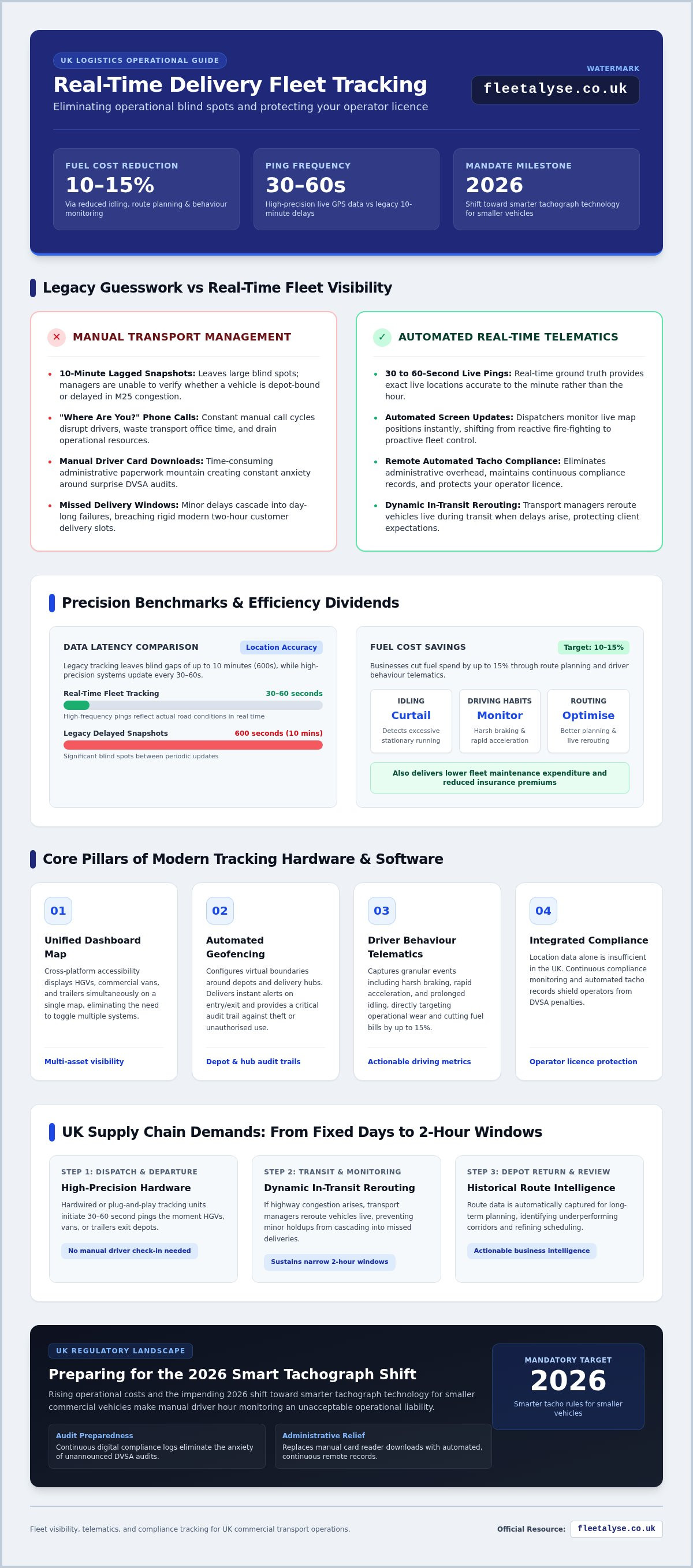
UK supply chains now demand extreme precision. Fixed delivery days have been replaced by narrow, two-hour windows. Meeting these requirements without live data is nearly impossible. Real-time delivery fleet tracking provides the ground truth required to maintain these standards. It reduces the constant back-and-forth between transport offices and drivers, allowing your team to focus on proactive management rather than reactive fire-fighting.
Meeting modern delivery expectations across the UK
Accurate ETAs are no longer a luxury. They are a baseline requirement for protecting customer relationships and your brand’s reputation. If a delivery is late without warning, the trust is broken. Research suggests businesses can achieve fuel savings of 10-15% by using vehicle tracking systems, often through better route planning and reduced idling. When a delay is unavoidable, live tracking allows managers to reroute vehicles dynamically whilst they're in transit. This agility prevents minor hold-ups from cascading into missed deliveries across the entire day.
Eliminating the hidden inefficiencies in transport offices
Transport offices often bleed money through invisible time-sinks. The most common is the "where are you?" phone call. These manual updates disrupt drivers and waste the time of dispatchers. Automated location updates streamline these workflows entirely. Instead of calling, the transport team looks at a screen. Beyond the immediate day, this system captures historical route data. This information is vital for long-term planning, helping you identify which routes consistently underperform and where you can improve fleet efficiency. It turns daily operations into a source of actionable business intelligence.
Core features of a robust delivery tracking system
A reliable system for real-time delivery fleet tracking relies on two pillars: rugged hardware and intuitive software. The hardware, often a hardwired unit or a plug-and-play device, must provide high-frequency location pings. Low-frequency updates leave gaps in your data. If a vehicle only updates every ten minutes, you aren't seeing the reality of the road. True visibility requires updates every 30 to 60 seconds. This precision is a major driver behind the UK fleet telematics market growth, as operators move away from legacy systems that offer only delayed snapshots.
Modern transport managers need cross-platform accessibility. You might be at a desk, but you're just as likely to be in the yard or at a client site. A unified dashboard that displays HGVs, vans, and trailers simultaneously on a single map is essential. It prevents the need to toggle between different providers for different assets. This clarity allows transport teams to make frictionless decisions during peak periods. High-frequency pings ensure that the real-time delivery fleet tracking data you see is accurate to the minute, not the hour.
High-precision GPS tracking and geofencing
Securing your assets is a primary concern. High-precision GPS tracking is vital for protecting high-value HGVs and trailers. Geofencing adds an extra layer of automation. You can set virtual boundaries around delivery hubs or depots. The system sends an immediate alert when a vehicle enters or leaves these zones. This helps prevent unauthorised use and provides a critical audit trail if a vehicle is stolen. It is a pragmatic way to manage assets without constant manual oversight. You can browse our tracking hardware to find the right fit for your specific vehicle types.
Driver behaviour monitoring and fuel efficiency
Telematics data goes beyond location. It captures specific driver behaviour like harsh braking, rapid acceleration, and excessive idling. Monitoring these metrics leads directly to lower fuel consumption. In fact, businesses using these systems often see fuel savings of 10-15%. Better driving habits also mean lower fleet maintenance costs and reduced insurance premiums. It turns a tracking tool into a long-term cost-saving asset. Safer driving habits also protect your reputation. A van with your company logo being driven aggressively is a liability. By using telematics to coach drivers, you ensure your fleet represents your business professionally on UK roads.
Why compliance must be integrated into real-time tracking
Knowing where your vehicles are is only half the battle. For regulated UK commercial fleets, basic location tracking is simply insufficient. A map pinpointing a vehicle on the road doesn't tell you if the driver is minutes away from a serious driving hours violation. Operating with disjointed systems, such as using one tool for GPS and another for tachograph management, creates administrative chaos. It increases the risk of human error and leaves your operator licence vulnerable during a DVSA audit. True operational efficiency requires a single source of truth that unifies location data and regulatory compliance.
This is where standard telematics platforms fall short compared to a specialised system. Integrating compliance directly into your real-time delivery fleet tracking workflow allows you to manage risk proactively. This level of integration is what separates practical fleet management from generic asset tracking. You protect your business from heavy DVSA fines whilst simultaneously keeping your delivery schedule moving. It shifts your transport team from reacting to compliance breaches to preventing them entirely.
The reality of live driver hours monitoring
Transport managers face the daily challenge of balancing tight delivery windows with strict legal requirements. Live driver hours monitoring provides instant visibility into exact remaining driving times. You don't have to guess or wait for a driver to text their hours at the end of a shift. When an urgent delivery request comes in, you can check the live dashboard instantly. This allows you to assign the job to a driver who has the legal capacity to complete it safely. It simplifies adherence to DVSA regulations and eliminates the risk of accidental driving limit violations entirely.
Automating compliance with remote tachograph downloads
Manual tachograph data collection is a notorious time-sink for regional operators. It requires vehicles to return to the depot, causing unnecessary downtime and disrupting delivery routes. Remote tachograph download technology removes this friction by automatically retrieving driver card and vehicle VU data over the air. This automation ensures you never miss a legal download deadline. The data flows directly into your system, enabling seamless tachograph analysis integration. It provides a clear, unalterable digital audit trail that protects your business. Your transport office remains permanently audit-ready, and your drivers can focus entirely on the road instead of administrative paperwork.
How to implement real-time tracking without operational friction
Transitioning to real-time delivery fleet tracking doesn't have to disrupt your daily delivery schedule. Success lies in a phased approach that treats technology as a tool for improvement rather than a sudden overhaul. Start by mapping out your fleet’s specific needs. A regional operator with a mix of HGVs and light vans has different requirements than a specialist trailer fleet. Choosing industry-grade hardware is the first step toward long-term durability. Consumer-grade devices often fail under the vibration and temperature swings of a commercial cab.
Reliable hardware is only half the solution. You also need a platform that stays current with the industry. Future-proofing your investment requires a commitment to ongoing software updates. As UK regulations evolve, your tracking platform must adapt. Regular updates ensure you remain compliant with changing DVSA standards without needing to replace your hardware every few years. This logical, steady progression ensures your system remains a reliable asset for the long term.
Selecting and installing the right tracking hardware
Different assets require tailored solutions. HGVs need units capable of interfacing with the tachograph for live driver hours. Light commercial vans often benefit from simpler three-wire installs that capture ignition data. For trailers, look for rugged, battery-backed units that continue reporting even when uncoupled. Robust, hidden installations are vital. They prevent accidental damage and deliberate tampering, ensuring your data stream remains unbroken. To protect your revenue, schedule these installations during natural fleet downtime. Many operators find that evening or weekend fitments prevent vehicles from being pulled off the road during peak delivery hours. You can order your tracking hardware online to begin your fleet upgrade.
Managing driver onboarding and addressing tracking concerns
Introducing tracking often triggers "big brother" anxieties among driving staff. You can overcome this by being transparent from the start. Explain that the system is a tool for safety and compliance, not just surveillance. It protects drivers by providing objective proof against false claims of delivery delays or aggressive driving. If a customer complains about a missed window, the data acts as the driver's best witness. Use the telematics data for positive reinforcement rather than just discipline. Many successful UK firms use driver league tables and reward programmes to encourage better behaviour. This approach builds trust and turns your staff into active participants in fleet efficiency. It shifts the perception of real-time delivery fleet tracking from a monitoring tool to a professional support system.
Optimise your transport operations with Fleetalyse
Fleetalyse is a dedicated UK specialist in transport compliance and fleet telematics. We don't believe in flashy, unnecessary features that clutter your screen and complicate your day. Instead, we focus on straightforward functionality that addresses the specific challenges of regional infrastructure. By combining GPS fleet tracking with automated remote tachograph downloads, we provide a solution built for the rigours of real-world application. You get the data you need to protect your operator licence without the typical marketing hyperbole or hidden costs found with global telematics giants.
Taking control of your data is the only way to ensure long-term operational stability. Our platform is designed to be an active catalyst for your improvement, moving away from theoretical data collection toward functional utility. This focus on practical results is why we prioritise transparency in everything we do, from our contract terms to our software interface. It is a reliable, grounded approach to real-time delivery fleet tracking that respects your time and your budget.
A unified platform built for UK transport operators
Managing a diverse fleet often means juggling multiple software providers for different vehicle types. Fleetalyse brings your van, HGV, and trailer tracking into one clear dashboard. This unified approach allows you to monitor live driver hours alongside real-time asset locations without switching tabs or logging into separate systems. You can see exactly where a trailer is parked or how many minutes a driver has left before their next legal break. Our UK-based team brings practical industry knowledge to every interaction, ensuring you receive support from people who understand the local regulatory environment. It is a deeply practical way to manage your mobile assets whilst maintaining full visibility over your operations.
Streamline your compliance workflow today
Manual tachograph downloads are a significant drain on your resources. Transport clerks often spend hours chasing driver cards and vehicle units, leading to high administrative overhead and unnecessary stress. Fleetalyse automates this process entirely. Our remote tachograph download technology retrieves data on a schedule that suits your business, ensuring you never miss a legal deadline. This seamless integration with your existing workflow reduces the risk of human error and keeps you audit-ready at all times.
Transitioning to an integrated setup for real-time delivery fleet tracking and compliance is a straightforward process designed to cause zero disruption to your daily routes. You can protect your operator licence and reduce fuel consumption by focusing on the metrics that actually matter. Get started with Fleetalyse today to simplify your transport office and start seeing immediate efficiency gains.
Take control of your transport operations
Managing a commercial fleet without live data is a significant risk to your profitability and your operator licence. Relying on manual updates creates unnecessary administrative friction and leaves your business vulnerable to compliance breaches. Implementing a system for real-time delivery fleet tracking solves these challenges by combining high-precision location data with automated compliance workflows. It gives your transport office the visibility needed to plan routes efficiently and protect customer relationships.
Fleetalyse delivers this clarity through a unified platform expertly designed for UK transport operators. We eliminate the guesswork by combining live driver hours monitoring for total compliance with automated remote tachograph downloading. You get a reliable, practical tool that keeps your vehicles moving and your office audit-ready without unnecessary software bloat. Take control of your fleet's efficiency and secure your business against rising operational costs today.
Ready to transform your fleet operations? Secure your tracking and compliance solution now.
Frequently Asked Questions
What is real-time delivery fleet tracking?
Real-time delivery fleet tracking is the combination of live GPS location data and vehicle telematics, providing updates at high frequencies. This allows transport managers to see exactly where HGVs, vans, or trailers are on a map. Unlike legacy systems that provide delayed snapshots, this technology offers a continuous stream of information. It enables precise ETA calculations and proactive route management. It's an essential tool for maintaining standards in modern UK logistics operations.
How does remote tachograph download work alongside GPS tracking?
These systems work in tandem by using the same hardware to transmit both location and compliance data. While the GPS tracker reports the vehicle's coordinates, the remote download tool connects to the tachograph unit. It automatically retrieves driver card and vehicle VU data over the air. This eliminates the need for manual downloads at the depot. The integrated approach ensures that your compliance records are always current alongside your live operational data.
Can tracking software help my business pass a DVSA compliance audit?
Yes, by providing a robust and unalterable digital audit trail of all vehicle and driver activity. Integrated systems monitor live driver hours, flagging potential infringements before they become serious violations. Automated remote downloads ensure you never miss legal deadlines for data collection. This level of organisation demonstrates to the DVSA that you have professional systems in place to manage your operator licence responsibilities effectively. It turns compliance into a streamlined, digital process.
Is it possible to track unpowered assets like trailers in real time?
It is entirely possible using specialised trailer tracking hardware. These units are ruggedised and often feature long-life internal batteries that continue to report location data even when the trailer is uncoupled from the tractor unit. You can set geofences around depots or client sites to receive alerts when a trailer moves. This ensures you maintain full visibility over your entire asset pool, not just the powered vehicles in your fleet.
How does real-time tracking help reduce fleet fuel costs?
Real-time delivery fleet tracking identifies specific driver behaviours that burn excessive fuel, such as prolonged idling, harsh acceleration, and speeding. By monitoring these telematics metrics, you can coach drivers toward more efficient habits. Research indicates that businesses using these systems often achieve fuel savings of 10-15%. Additionally, live traffic data allows for dynamic rerouting. This prevents vehicles from wasting fuel while stuck in avoidable congestion on UK motorways.
Will tracking systems cause friction or pushback from my drivers?
Friction is usually avoided through transparent communication about the system's benefits. Drivers often appreciate that tracking provides objective proof in their favour if a customer makes a false claim about a late delivery. It also enhances their safety by providing a lifeline in the event of a breakdown or accident. Many UK operators successfully use the data to run reward programmes, turning the technology into a positive tool for professional development.
What types of vehicles can be monitored with Fleetalyse tracking solutions?
Fleetalyse provides comprehensive coverage for all commercial vehicle types used in UK logistics. This includes heavy goods vehicles (HGVs) requiring tachograph integration, light commercial vans, and unpowered trailers. The platform is designed to unify these different assets into a single dashboard. Whether you operate a small fleet of delivery vans or a large-scale HGV operation, the hardware is tailored to the specific electrical and data requirements of each vehicle class.
Frequently asked questions
What is real-time delivery fleet tracking?
Real-time delivery fleet tracking is the combination of live GPS location data and vehicle telematics, providing updates at high frequencies. This allows transport managers to see exactly where HGVs, vans, or trailers are on a map. Unlike legacy systems that provide delayed snapshots, this technology offers a continuous stream of information. It enables precise ETA calculations and proactive route management. It's an essential tool for maintaining standards in modern UK logistics operations.
How does remote tachograph download work alongside GPS tracking?
These systems work in tandem by using the same hardware to transmit both location and compliance data. While the GPS tracker reports the vehicle's coordinates, the remote download tool connects to the tachograph unit. It automatically retrieves driver card and vehicle VU data over the air. This eliminates the need for manual downloads at the depot. The integrated approach ensures that your compliance records are always current alongside your live operational data.
Can tracking software help my business pass a DVSA compliance audit?
Yes, by providing a robust and unalterable digital audit trail of all vehicle and driver activity. Integrated systems monitor live driver hours, flagging potential infringements before they become serious violations. Automated remote downloads ensure you never miss legal deadlines for data collection. This level of organisation demonstrates to the DVSA that you have professional systems in place to manage your operator licence responsibilities effectively. It turns compliance into a streamlined, digital process.
Is it possible to track unpowered assets like trailers in real time?
It is entirely possible using specialised trailer tracking hardware. These units are ruggedised and often feature long-life internal batteries that continue to report location data even when the trailer is uncoupled from the tractor unit. You can set geofences around depots or client sites to receive alerts when a trailer moves. This ensures you maintain full visibility over your entire asset pool, not just the powered vehicles in your fleet.
How does real-time tracking help reduce fleet fuel costs?
Real-time delivery fleet tracking identifies specific driver behaviours that burn excessive fuel, such as prolonged idling, harsh acceleration, and speeding. By monitoring these telematics metrics, you can coach drivers toward more efficient habits. Research indicates that businesses using these systems often achieve fuel savings of 10-15%. Additionally, live traffic data allows for dynamic rerouting. This prevents vehicles from wasting fuel while stuck in avoidable congestion on UK motorways.
Will tracking systems cause friction or pushback from my drivers?
Friction is usually avoided through transparent communication about the system's benefits. Drivers often appreciate that tracking provides objective proof in their favour if a customer makes a false claim about a late delivery. It also enhances their safety by providing a lifeline in the event of a breakdown or accident. Many UK operators successfully use the data to run reward programmes, turning the technology into a positive tool for professional development.
What types of vehicles can be monitored with Fleetalyse tracking solutions?
Fleetalyse provides comprehensive coverage for all commercial vehicle types used in UK logistics. This includes heavy goods vehicles (HGVs) requiring tachograph integration, light commercial vans, and unpowered trailers. The platform is designed to unify these different assets into a single dashboard. Whether you operate a small fleet of delivery vans or a large-scale HGV operation, the hardware is tailored to the specific electrical and data requirements of each vehicle class.