

Proof of delivery tracking for UK fleets: 2026 guide

Proof of delivery (POD) tracking is the auditable, time-stamped record that confirms a vehicle completed a handover to the intended recipient, capturing who received the goods, when and where the handover occurred, and the condition of the delivery. For UK commercial fleet operators, it is the difference between a defensible audit trail and an unresolved dispute.
- A minimal defensible POD contains three layers: recipient confirmation (name, signature or electronic acceptance), a timestamped GPS coordinate or geofence confirmation, and photographic or condition evidence of the goods at handover.
- POD is not the same as shipment tracking. Tracking records movement; POD records the handover event itself, answering what was delivered, who received it, when it happened, and what evidence supports it.
- Three entities shape how UK operators must handle POD data: the DVSA (which expects auditable delivery records under Operator Licence obligations), UK GDPR (which governs how recipient photos and signatures are captured and retained), and Fleetalyse (which integrates ePOD capture directly into telematics and compliance workflows).
Table of Contents
- What does a defensible proof of delivery record contain?
- How does POD tracking differ from ordinary shipment tracking?
- How digital ePOD systems integrate with telematics and invoicing
- Why POD tracking matters for UK fleet compliance and claims
- Best practices for collecting defensible POD in the UK
- Common pitfalls and legal limits to watch for
- How to implement POD tracking: rollout steps and cost ranges
- How Fleetalyse supports proof of delivery tracking in practice
- Key takeaways
- The gap most operators miss with POD
- Ready to add ePOD to your fleet telematics?
- Useful sources and further reading
What does a defensible proof of delivery record contain?
A single carrier scan or lone signature is rarely enough to resolve a dispute or satisfy an audit. Multi-layer evidence combining photo, GPS coordinate and timestamp gives each POD record independent corroboration at every point of the four-question test: what, who, when, and supporting evidence.
The core elements of a defensible POD are:
- Recipient name and confirmation method — electronic signature, typed name, or acceptance click with a clear audit trail.
- Timestamp — device-generated, not manually entered, and normalised to UTC to avoid timezone ambiguity.
- GPS coordinates or geofence confirmation — verifying the vehicle stopped at the delivery address, not merely nearby.
- Delivery photo — showing the item in situ, the doorstep or loading bay, and any visible condition issues.
- Driver condition notes — standardised vocabulary for damaged, missing, or refused items.
- Shipment and vehicle reference — order number, vehicle ID and driver ID linking the POD to the TMS record.
For Operator Licence audits, DVSA expects operators to retain delivery records as part of their transport documentation. High-value or regulated loads warrant a documented chain of custody, with each handover point recorded and accessible on demand.
Pro Tip: Set a minimum retention period of at least two years for POD records to align with typical DVSA audit windows, and store records in a system that produces a tamper-evident export.
How does POD tracking differ from ordinary shipment tracking?
Shipment tracking tells you where a vehicle or parcel is. POD tracking tells you that a specific handover happened, to a specific person, at a specific place, in a specific condition. The distinction is operational and legal, not just semantic.
A continuous GPS breadcrumb trail shows a vehicle passing an address. A carrier hub scan confirms the parcel entered a sorting facility. Neither answers the liability question: did the right person receive the goods in acceptable condition?
A delivered-but-not-received claim is one of the most common disputes in last-mile logistics. GPS alone shows the vehicle was near the address. Only a photo combined with a geotag and recipient confirmation closes the loop — the driver was at the door, the goods were present, and someone accepted them.
That distinction matters acutely for UK fleet operators managing contractual SLAs. If a customer disputes receipt and your only evidence is a tracking scan, you have a status update, not proof. The freight tracking systems that underpin modern logistics are built for visibility, not evidentiary handover. POD fills that gap.
How digital ePOD systems integrate with telematics and invoicing
Electronic POD systems capture signatures, barcodes, photos and GPS data that upload directly to logistics software, giving real-time visibility and integration with TMS and WMS platforms. The data flow in a well-configured ePOD workflow follows a clear sequence.

| Step | Action | Integration point |
|---|---|---|
| 1. Capture at delivery | Driver uses mobile app to photograph goods, record recipient name/signature | Device GPS tags the event |
| 2. Timestamp and geotag | App attaches UTC timestamp and GPS coordinate automatically | Geofence rule validates stop location |
| 3. Sync to platform | Record uploads to central fleet platform in real time or on reconnect | Matches to TMS/ERP order reference |
| 4. Invoice trigger | Confirmed POD event fires billing workflow | Finance system receives delivery confirmation |
| 5. Audit storage | Record archived with tamper-evident log | Accessible for DVSA or customer audit |
Key integration requirements for operators planning a rollout:
- API connectivity between the ePOD app and your TMS or ERP, with event mappings for delivery confirmed, delivery failed, and damaged goods.
- Offline capture and sync so drivers in low-connectivity areas (rural routes, underground loading bays) can still complete a POD that uploads when signal returns.
- Reconciliation rules for unmatched PODs, flagging records where the GPS coordinate does not match the expected delivery address within an acceptable tolerance.
- Retention and archival paths that meet your data governance policy and UK GDPR obligations.
Why POD tracking matters for UK fleet compliance and claims
For UK commercial operators, POD tracking is not a nice administrative addition. It sits at the intersection of Operator Licence recordkeeping, invoicing speed and customer dispute resolution.
- DVSA and Operator Licence compliance: Operators must demonstrate that deliveries were completed as contracted. Auditable POD records support this directly, particularly for DVSA transport compliance reviews where evidence of fulfilment is requested.
- Invoicing and aged debt: Digital POD reduces administrative effort by enabling instant matching of delivery data with order records, accelerating invoicing cycles and reducing aged debt caused by disputed deliveries.
- Dispute resolution: POD acts as both a receipt and legal evidence for the shipper or carrier, providing the documentation needed to resolve claims about missing or damaged goods without lengthy back-and-forth.
- UK GDPR: Capturing recipient signatures and photos constitutes processing personal data. Operators must document a lawful basis (typically legitimate interests or contractual necessity), minimise what is captured, and set clear retention limits. The ICO’s guidance on data minimisation applies directly to delivery photo retention.
Best practices for collecting defensible POD in the UK
A clear policy, consistently applied, is what separates a defensible POD record from a collection of inconsistent photos and partial signatures.
- Mandate multi-layer capture for every delivery — photo, geotag, timestamp, and recipient confirmation as a minimum. No single element is optional.
- Use geofencing to validate stop location — configure a tolerance radius around each delivery address so the system flags any POD captured outside the expected zone.
- Standardise condition note vocabulary — give drivers a fixed list of condition codes (e.g., “damaged packaging”, “short delivery”, “refused”) rather than free text, which is harder to analyse and easier to misinterpret.
- Require recipient name even for contactless deliveries — a typed name or door-number confirmation is better than a blank field.
- Train drivers on refusal and exception procedures — drivers should know exactly what to capture when a delivery is refused, goods are damaged, or no one is present.
- Set retention periods and access controls — define who can view, export or delete POD records, and align retention periods with your Operator Licence obligations and UK GDPR policy.
- Audit POD data quality monthly — spot-check a sample of records for missing fields, poor photo quality or GPS mismatches before they become a problem in a live dispute.
Pro Tip: Run a short tabletop exercise with your drivers using real disputed-delivery scenarios. Drivers who understand why each capture step matters are far more consistent than those following a checklist they have never thought about.
Common pitfalls and legal limits to watch for
Even well-intentioned POD systems produce unreliable records when the implementation has gaps. The most common failure points are:
- Over-reliance on carrier scans — hub scans confirm a parcel entered a facility, not that it reached the recipient. Never treat a scan event as a substitute for handover evidence.
- Inconsistent capture policies — if some drivers photograph goods and others do not, your POD data is patchy and harder to defend in a dispute.
- GPS inaccuracy in dense urban areas — signal multipath in city centres can place a GPS coordinate 20–50 metres from the actual delivery point. Geofence tolerances should account for this, and photo evidence becomes more important where GPS is unreliable.
- Photo quality issues — dark, blurred or incomplete photos are legally weak. Enforce minimum quality standards in the capture app.
- Mismatched order references — a POD record that cannot be linked to a specific order is useless for invoicing or audit. Validate the order reference at sync time.
- Unnecessary personal data capture — photographing recipients’ faces or capturing more information than needed breaches UK GDPR data minimisation principles. Capture the goods and location, not the person.
- No documented lawful basis — if you cannot state why you are processing recipient data, you are exposed to ICO enforcement. Document your lawful basis before rollout.
How to implement POD tracking: rollout steps and cost ranges
A phased rollout reduces risk and gives you time to refine capture policies before scaling.
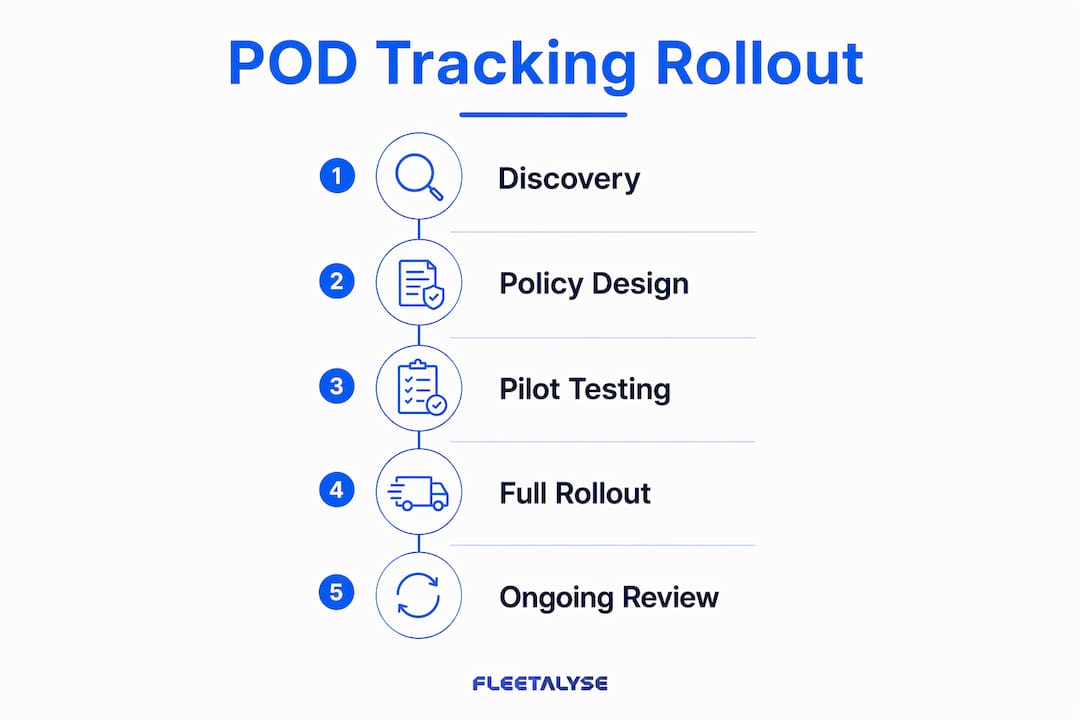
| Phase | Activity | Typical duration |
|---|---|---|
| Discovery and policy design | Define capture requirements, data governance, retention policy | 1–2 weeks |
| Pilot | Deploy on a small vehicle cohort, test capture and sync | 2–6 weeks |
| TMS/ERP integration | API build, event mapping, reconciliation rules | 4 weeks |
| Full rollout and training | Scale to full fleet, driver training, QA checks | 1–3 months post-pilot |
| Governance review | Audit data quality, update retention policy, GDPR review | Ongoing quarterly |
Indicative cost ranges vary by fleet size and existing infrastructure. Software subscription uplifts for ePOD capability typically sit alongside your existing telematics subscription. Mobile device costs depend on whether drivers already carry compatible hardware. For operators using mixed fleet tracking across HGVs, vans and trailers, plug-and-play telematics units reduce installation cost significantly. Internal training and administration effort is often the largest hidden cost, typically 1–2 days per cohort for initial training plus ongoing QA time.
How Fleetalyse supports proof of delivery tracking in practice
Fleetalyse integrates ePOD capture directly into its telematics platform, so delivery evidence and vehicle compliance data sit in the same auditable record rather than separate systems.
Key capabilities relevant to UK operators:
- ePOD capture via mobile app — drivers record recipient confirmation, photos and condition notes at the point of handover.
- Geofenced stop confirmation — the platform validates that the vehicle stopped within the expected delivery zone before accepting the POD record.
- Photo and timestamp storage — records are stored with tamper-evident logs, accessible for DVSA audits or customer disputes.
- TMS and invoicing integration — confirmed POD events map directly to order references, triggering billing workflows and reducing manual reconciliation.
- Secure retention controls — data retention settings can be aligned to Operator Licence expectations and UK GDPR obligations.
When a driver records a damaged delivery through Fleetalyse, the platform creates an immediate incident trail: the photo, GPS coordinate, timestamp, condition note and order reference are all linked in a single auditable record. That record is available to your transport manager, finance team and, if needed, a DVSA examiner, without anyone having to chase the driver for details after the fact.
UK-based onboarding means your team gets compliance guidance that reflects DVSA and Operator Licence requirements, not generic logistics advice. For operators who want to understand how vehicle tracking supports regulatory compliance, Fleetalyse connects those dots directly.
Key takeaways
Defensible POD tracking requires multi-layer evidence, UK GDPR compliance, and direct integration with telematics and invoicing workflows to protect operators during DVSA audits and commercial disputes.
| Point | Details |
|---|---|
| Multi-layer evidence is non-negotiable | Photo, GPS geotag, timestamp, and recipient confirmation together create a defensible record; any single element alone is insufficient. |
| POD and tracking are not the same | Tracking records movement; POD records the handover event and answers who, what, when, and with what evidence. |
| UK GDPR applies at capture | Document your lawful basis, minimise what you capture, and set clear retention periods before rollout. |
| Integration accelerates invoicing | Linking confirmed POD events to TMS order references automates billing and reduces aged debt from disputed deliveries. |
| Fleetalyse connects POD to compliance | Fleetalyse bundles ePOD capture, geofenced stop confirmation, and secure retention into a single telematics platform aligned to DVSA and Operator Licence requirements. |
The gap most operators miss with POD
Most fleet operators I speak with understand that they need proof of delivery. Where they consistently underestimate the requirement is in the gap between “we have a system” and “we have a defensible record.” A driver photographing a doorstep on a personal phone, with no geotag, no order reference, and no standardised condition note, is not producing POD. It is producing a photo. The legal and commercial weight of a POD record comes from the chain of custody: every element captured automatically, linked to a specific order, stored in a tamper-evident system, and retrievable on demand.
The GDPR dimension catches operators off guard too. Capturing a recipient’s signature is processing personal data. Retaining delivery photos that include people’s faces or home interiors goes further still. The ICO’s data minimisation principle is not a technicality; it is a genuine constraint on what you can capture and how long you can keep it. Operators who build their POD policy around what is technically possible, rather than what is legally proportionate, create compliance risk in a different direction.
The practical answer is to treat POD as a telematics output, not a paper process with a digital wrapper. When capture, validation, storage and invoicing integration are built into the same platform, the policy almost enforces itself.
Ready to add ePOD to your fleet telematics?
Fleetalyse gives UK fleet operators ePOD capture, geofenced stop confirmation, and secure record storage within the same platform that handles GPS tracking, driver behaviour monitoring, and DVSA compliance reporting. There is no need to bolt a separate delivery app onto an existing telematics stack and then manually reconcile the two.
For operators running HGVs, vans or mixed assets, the unlocked GPS trackers in the Fleetalyse shop are compatible with the ePOD workflow out of the box, with UK-based onboarding included. If driver behaviour and compliance monitoring are your priority alongside delivery confirmation, the driver behaviour monitoring service page sets out exactly what the platform captures and how it maps to Operator Licence requirements. Get in touch with the Fleetalyse team to scope a pilot for your fleet.
Useful sources and further reading
Operators building or reviewing a POD policy will find the following authoritative references useful:
- DVSA operator compliance guidance — the DVSA publishes guidance on Operator Licence recordkeeping obligations, including what transport documentation operators must retain and for how long. Start at GOV.UK.
- ICO guidance on UK GDPR — the Information Commissioner’s Office sets out the lawful bases for processing personal data, data minimisation requirements, and retention principles that apply directly to signature and photo capture at delivery. See ico.org.uk.
- Wikipedia: Proof of delivery — a concise reference definition of POD and its role in contracts of carriage, useful for policy documents.
- Fleetalyse blog: DVSA compliance guide — the 2026 DVSA compliance guide maps specific recordkeeping requirements to Fleetalyse features.
- Fleetalyse blog: haulage compliance example — a practical compliance walkthrough showing how audit evidence is assembled from telematics data.
- Implementation checklist — a one-page POD implementation checklist covering policy design, capture requirements, GDPR documentation, integration steps and training is available from the Fleetalyse support team on request.