
A customer says a delivery arrived late. Your dispatch notes suggest otherwise, but the driver’s message and GPS record show different times. Proving delivery times with GPS data can help establish when a vehicle reached and left a location, but a point on a map doesn’t automatically prove that goods were handed over.
That distinction matters when records are spread across tracking, dispatch, driver updates and customer communications. Bringing these sources together creates a clearer timeline, shows what each record can confirm and helps reveal gaps. It also gives your team a more consistent way to answer delivery queries.
This guide explains how to build a timeline from timestamped location information and supporting operational records, and where GPS evidence has limits. You’ll learn what to check when arrival or departure times are disputed, why location alone can’t confirm a completed handover, and how organised records and fleet visibility can make reviews more straightforward.
Key Takeaways
- Use timestamped GPS locations to trace a vehicle’s journey, arrival and departure, but don’t treat proximity to an address as proof of handover.
- Build a clearer timeline by comparing location records with available dispatch logs, delivery notes, driver reports and customer messages.
- When proving delivery times with GPS data, identify the order, set the relevant time window and check vehicle records against operational information.
- Keep records organised so your team can investigate disputed arrival times without searching through disconnected sources.
- Use fleet tracking for vehicle-location context. Fleetalyse GPS tracking covers HGVs, vans, trailers and other mobile assets.
What does proving delivery times with GPS data actually show?
GPS delivery evidence consists of location and timestamp records that can help reconstruct a vehicle’s movements around a delivery. It can provide context about when a vehicle was near a destination, how long it remained in the area and when it moved on. A fleet telematics system brings together vehicle location and other fleet information, but the records available depend on the system in use.
The key distinction is simple: GPS can show where a vehicle was, but it doesn’t, by itself, show that goods changed hands. That matters when a customer questions an arrival time, a delivery is reported late or an operations team is reviewing a route. Treat location data as one part of the account, not the whole story.
What can GPS data confirm about a delivery visit?
Recorded coordinates can indicate a vehicle’s approximate location at a particular time. When several points are available, they can show a sequence: the vehicle approaches the destination, remains in the vicinity, then departs. For example, records may support that a van was near a customer’s premises during a particular period. Dispatch notes can then help establish whether this matched the planned delivery window.
How precisely the records reflect a visit depends on the tracking device, satellite reception and the information available. A point near an address could relate to a nearby road, entrance or holding area rather than the delivery bay itself. Gaps or limited detail in the timeline can also affect what you can reasonably conclude.
Does a GPS timestamp prove that goods were delivered?
No. A vehicle’s presence doesn’t establish that unloading took place, that a customer received the goods or that anyone signed for them. The vehicle could have been waiting, unable to access the site or stopped nearby for another reason. Proving delivery times with GPS data means establishing a useful movement timeline, not treating a timestamp as conclusive proof of completion.
Compare the location record with any relevant delivery note, dispatch log, driver report or customer message. A delivery note may record receipt; GPS can add context about the vehicle’s location and timing. Together, these records provide a fuller account, although no single record will resolve every dispute. Assess what the records support and be clear about any remaining uncertainty.
How GPS tracking builds a delivery timeline from journey to departure
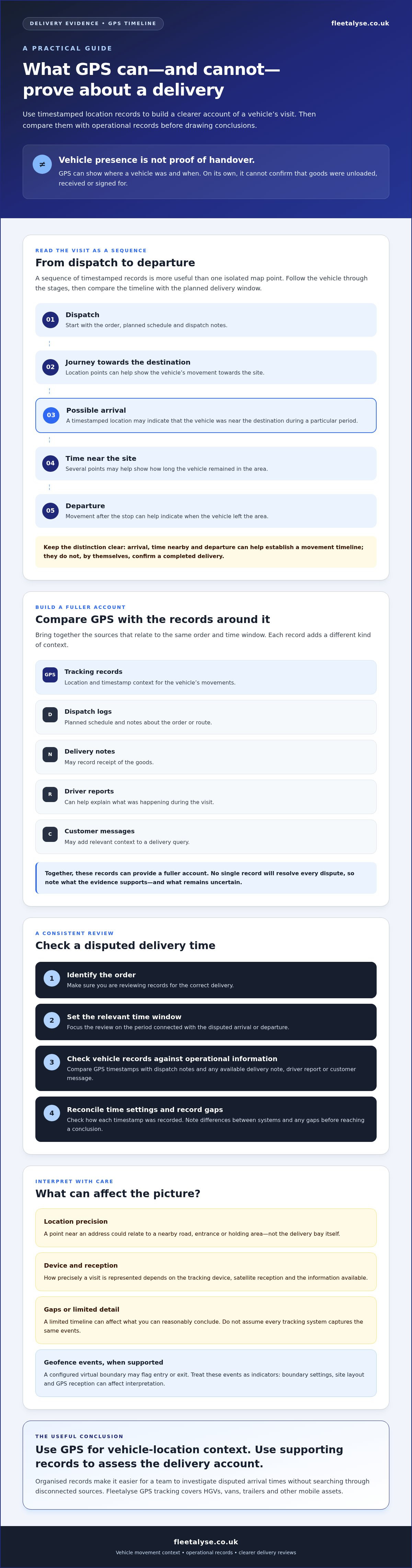
A useful delivery timeline follows the vehicle through distinct stages: dispatch, journey, arrival, time on site and departure. GPS points add a record of movement to the planned delivery window. Dispatch notes and driver updates can help explain what was happening at each stage.
A sequence of records tells a more useful story than one isolated location point. A point near a customer’s site may show that the vehicle was in the area. Movement before and after it can help indicate whether the vehicle arrived, stopped and later left. This still doesn’t confirm a handover, but it gives the team a clearer timeline to compare with other records.
Which GPS events help identify arrival and departure?
Review recorded locations and timestamps alongside changes in movement. A vehicle moving towards a site, slowing or stopping nearby, then continuing its journey can help identify a possible visit window. The detail available depends on the tracking system and its records, so don’t assume every system captures the same events.
Some systems can use a geofence, a virtual boundary around a location, to flag entry or exit when the feature is supported and configured. Treat these events as indicators, not exact confirmation. Boundary settings, site layout and GPS reception can affect how an event should be interpreted.
How do dispatch records add context to GPS timestamps?
Compare the vehicle’s recorded journey with the planned schedule and dispatch notes. Match timestamps to the correct order, then check any available customer communication or driver update. If a delivery was expected in the morning but the vehicle appears to arrive later, these records may help establish whether the plan changed, access was delayed or the time needs further checking.
Check that records use consistent time settings before comparing them. If a dispatch system, driver message and tracking record show different times, note the difference and establish how each timestamp was recorded. Consider any clock discrepancy before drawing a firm conclusion.
These checks sit alongside wider transport management responsibilities. For background on the UK framework for commercial operators, see the UK goods vehicle operator licensing guide. Fleet operators seeking centralised vehicle-location visibility can also explore GPS fleet tracking as a source of movement context for delivery reviews.
Which records make GPS delivery evidence more reliable?
A delivery query is easier to assess when location records can be matched to other information about the same order. GPS may show where a vehicle was and when. Dispatch logs can show the planned schedule or a change to it, while a driver report or customer message may explain a delay or access issue.
Use records your business actually holds. A delivery note may record what was delivered or received. A customer message may confirm a revised time. A driver report may describe waiting or an unsuccessful attempt. Before treating records as part of the same event, check that the order reference, vehicle and times align. For commercial operators, operational record-keeping sits within wider responsibilities outlined in the GOV.UK guide to Goods Vehicle Operator Licensing. That guidance does not make a GPS point proof of delivery.
GPS location records versus proof of delivery
Keep evidence of vehicle presence separate from evidence of receipt. A GPS record can support that a vehicle was near the delivery address at a particular time. It doesn’t show that goods were unloaded, accepted or signed for. If your business collects a signed delivery note, photograph or other receipt record, that may help establish what happened at the handover. Don’t assume every fleet has these records or that GPS tracking captures them.
GPS supports the delivery account; a handover record supports whether goods were received. Read the sources together and be precise about what each one confirms. That is more credible than relying on location alone when proving delivery times with GPS data.
What can weaken confidence in a delivery timeline?
Missing or conflicting information can leave uncertainty. GPS signal gaps, poor reception, an inaccurate device clock or imprecise address boundaries may make a recorded time or location harder to interpret. A brief stop near a destination could indicate a visit, but it could also reflect traffic, waiting or a nearby stopping place. Check surrounding records before deciding what it means.
For each query, match the order reference across available sources and compare their timestamps. If the records don’t line up, note the discrepancy. If a GPS gap leaves part of the journey unclear, mark it as unknown rather than filling it with an assumption. A transparent account of what the evidence shows, and what it doesn’t, is more useful than a timeline that appears complete but isn’t supported by the records.
Using GPS Data to Answer Delivery-Time Queries
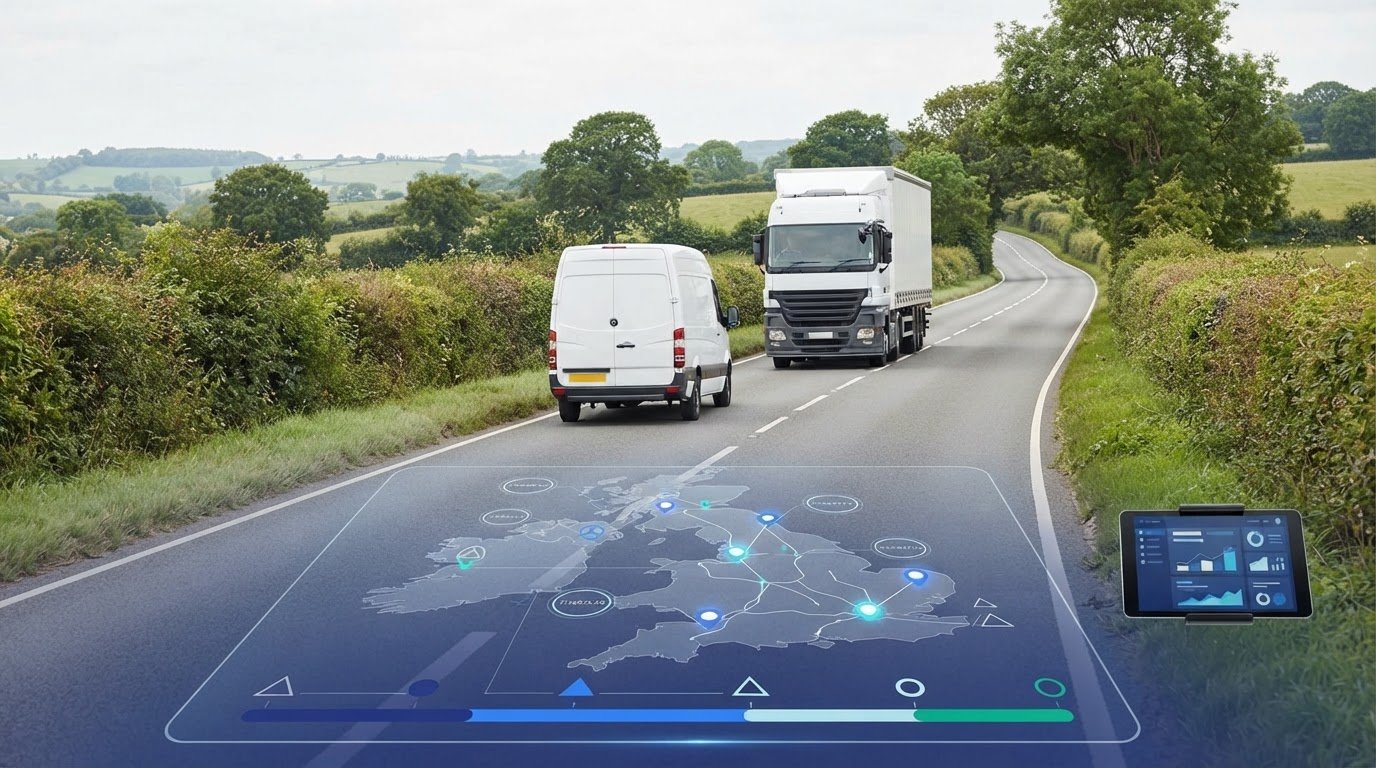
A repeatable review process helps your team answer delivery questions consistently and avoid conclusions based on a single location point. Start with the order, identify the relevant vehicle and set a time window wide enough to review the journey around the reported delivery. Then compare the GPS timeline with dispatch information and any available delivery documentation.
For each query, keep a concise record of the sources checked and what they support. If a timestamp is unclear or a record is missing, say so. The aim of proving delivery times with GPS data is to give a fair account of the evidence, not to make an uncertain timeline look complete.
A practical checklist for reviewing a disputed delivery
- Confirm the details: check the order reference, destination, assigned vehicle and planned delivery window.
- Review the journey: look at the vehicle’s recorded movements around the relevant period. Compare arrival and departure indicators with dispatch notes and available delivery records.
- Check the match: ensure each record relates to the same order and that timestamps can be compared consistently.
- Summarise the outcome: state what the records show, what they can’t confirm and any unresolved discrepancy.
For example, your summary might say that the vehicle record places it near the destination during a particular period, while the available delivery note records receipt at a different time. Report the difference and identify what needs checking rather than choosing one time without explanation. Share a short timeline with relevant context, not an unexplained location export that leaves the reader to interpret the data.
How should operators handle driver-location data?
Vehicle location records may relate to an identifiable driver, so consider privacy as part of the review process. The UK GDPR and Data Protection Act 2018 are relevant frameworks for handling personal data. Consider why the information is being reviewed, who needs access and how long records should be retained. These are general considerations, not legal advice; check current guidance and your organisation’s policies.
Limit access to people who need the records to investigate the query, and explain the purpose of tracking through appropriate internal information. For business-specific questions about lawful use, retention or disclosure, speak to your data-protection lead or a qualified adviser.
For operators looking to improve vehicle-location visibility as part of query reviews, explore Fleetalyse GPS fleet tracking.
How Fleetalyse GPS fleet tracking can support delivery visibility
For operators managing HGVs, vans, trailers or other mobile assets, Fleetalyse GPS fleet tracking provides real-time visibility of vehicle activity and asset locations. This can give dispatch teams useful context when a customer questions an arrival time or staff need to review a vehicle’s movements around a delivery.
Location visibility is one part of the record, not confirmation that goods were handed over. Teams still need to compare vehicle movements with dispatch information and the delivery records they collect. Used this way, tracking can help reduce time spent searching across separate sources and make it easier to understand what happened on a route.
What to assess in a GPS fleet tracking service
Start with your operation. Check that the vehicles and assets you need to monitor are covered, then consider how dispatch staff will use location information alongside existing order and delivery processes. Ask how users can review location history and timestamps, who can access the information, and how long records remain available. Confirm these details with the provider rather than assuming specific reporting, export or retention capabilities.
It’s also useful to map how a delivery query is handled today. Identify which records staff need, where they look for them and where delays or gaps arise. This gives you practical requirements to discuss when assessing GPS fleet tracking services.
Next steps for improving delivery-time visibility
Before selecting a solution, list the vehicles or assets that need coverage and the delivery-query tasks location information should support. Consider how tracking will fit with dispatch notes, driver updates and available delivery documentation. This helps keep expectations realistic: a tracking record can support a timeline, while other records may be needed to establish whether a handover took place.
Clear requirements make it easier to assess whether a service suits your working practices. If you’re considering Fleetalyse, explore Fleetalyse tracking options and discuss the coverage and operational needs you want to address.
Make delivery queries easier to resolve
A dependable answer starts with a clear timeline. GPS records can help show a vehicle’s movements, while dispatch information and available delivery records add context. Keep the distinction clear: location evidence may support when a vehicle arrived or left, but it doesn’t prove a handover on its own. Note gaps rather than filling them with assumptions.
Proving delivery times with GPS data is most useful when records are easy to review and tied to the right order, vehicle and time window. Consistent checks can help your team respond to customer queries with a clearer account and less manual searching.
Fleetalyse provides GPS tracking for HGVs, vans, trailers and other mobile assets, with real-time visibility into vehicle activity and asset locations. Its transport-focused services include fleet tracking and compliance monitoring. Use location visibility as operational context alongside your existing delivery records.
Ready to assess what suits your operation? Explore Fleetalyse GPS tracking options.
Frequently Asked Questions
Can GPS data prove that a delivery was completed?
GPS data can help show where a vehicle was and how it moved at recorded times, but being near an address doesn’t confirm that goods were unloaded or accepted by the customer. For a fuller account, compare relevant location records with the order reference and available delivery notes, customer communications or proof-of-delivery records. These sources may add handover context, although what they establish depends on their content and consistency.
How accurate are GPS delivery timestamps?
GPS timestamps are useful indicators, but their accuracy depends on the tracking device, satellite reception, surroundings, timestamp settings and records available. A recorded location may show a vehicle near a delivery site, not its exact position at a doorstep. Before treating a timeline as definitive, check for signal gaps, differences between system clocks and any configured location boundaries. Record uncertainties rather than presenting an estimate as an exact measurement.
What GPS records should I keep for a delivery query?
Keep the relevant location timestamps and journey context alongside the order reference, dispatch information and any available delivery documentation. Together, these records can help explain what happened without relying on an isolated point. Decide who needs access and how long to retain information according to the purpose for keeping it and applicable data-protection responsibilities. There isn’t a universal retention period for every business; check current guidance or consult a qualified adviser.
Can a geofence confirm a vehicle has arrived at a delivery address?
A geofence can indicate when a tracked vehicle enters or leaves a configured virtual boundary, if the tracking system supports that feature. It doesn’t necessarily confirm arrival at a specific door, unloading or customer acceptance. Interpret the event in context: boundary size, site layout and location accuracy can affect what an entry or exit record means. Check how the geofence is configured before using its event time in a delivery timeline.
What happens if GPS data has a gap during a delivery?
Record the gap rather than assuming what happened during it. Check available dispatch notes, driver updates, delivery documents and customer communications for additional context. Location points before and after the gap may still help establish part of the journey, but they can’t fill in the missing movements. If you share a timeline with a customer or colleague, state clearly where the data stops and what remains uncertain.
Can GPS fleet tracking help resolve late-delivery disputes?
Yes, location and timestamp records can help teams compare vehicle movements with the planned delivery window and investigate where a delay may have occurred. When proving delivery times with GPS data, match the relevant journey records to the correct order and review them alongside dispatch information and available delivery documents. Tracking provides operational context, not automatic proof of why a delay happened or whether a handover was completed.
Is vehicle GPS tracking subject to UK data-protection rules?
Organisations handling location information that identifies a driver should consider their data-protection responsibilities, including the UK GDPR and Data Protection Act 2018. The appropriate approach depends on the circumstances, purpose and processing involved. This overview isn’t legal advice. Check current guidance and your organisation’s policies, and speak to a data-protection lead or qualified professional about business-specific questions, such as access, retention and how tracking is explained to staff.
Frequently asked questions
What can GPS data confirm about a delivery visit?
Recorded coordinates can indicate a vehicle’s approximate location at a particular time. When several points are available, they can show a sequence: the vehicle approaches the destination, remains in the vicinity, then departs. For example, records may support that a van was near a customer’s premises during a particular period. Dispatch notes can then help establish whether this matched the planned delivery window. How precisely the records reflect a visit depends on the tracking device, satellite reception and the information available. A point near an address could relate to a nearby road, entrance or holding area rather than the delivery bay itself. Gaps or limited detail in the timeline can also affect what you can reasonably conclude.
Does a GPS timestamp prove that goods were delivered?
No. A vehicle’s presence doesn’t establish that unloading took place, that a customer received the goods or that anyone signed for them. The vehicle could have been waiting, unable to access the site or stopped nearby for another reason. Proving delivery times with GPS data means establishing a useful movement timeline, not treating a timestamp as conclusive proof of completion. Compare the location record with any relevant delivery note, dispatch log, driver report or customer message. A delivery note may record receipt; GPS can add context about the vehicle’s location and timing. Together, these records provide a fuller account, although no single record will resolve every dispute. Assess what the records support and be clear about any remaining uncertainty. A useful delivery timeline follows the vehicle through distinct stages: dispatch, journey, arrival, time on site and departure. GPS points add a record of movement to the planned delivery window. Dispatch notes and driver updates can help explain what was happening at each stage. A sequence of records tells a more useful story than one isolated location point. A point near a customer’s site may show that the vehicle was in the area. Movement before and after it can help indicate whether the vehicle arrived, stopped and later left. This still doesn’t confirm a handover, but it gives the team a clearer timeline to compare with other records.
Which GPS events help identify arrival and departure?
Review recorded locations and timestamps alongside changes in movement. A vehicle moving towards a site, slowing or stopping nearby, then continuing its journey can help identify a possible visit window. The detail available depends on the tracking system and its records, so don’t assume every system captures the same events. Some systems can use a geofence, a virtual boundary around a location, to flag entry or exit when the feature is supported and configured. Treat these events as indicators, not exact confirmation. Boundary settings, site layout and GPS reception can affect how an event should be interpreted.
How do dispatch records add context to GPS timestamps?
Compare the vehicle’s recorded journey with the planned schedule and dispatch notes. Match timestamps to the correct order, then check any available customer communication or driver update. If a delivery was expected in the morning but the vehicle appears to arrive later, these records may help establish whether the plan changed, access was delayed or the time needs further checking. Check that records use consistent time settings before comparing them. If a dispatch system, driver message and tracking record show different times, note the difference and establish how each timestamp was recorded. Consider any clock discrepancy before drawing a firm conclusion. These checks sit alongside wider transport management responsibilities. For background on the UK framework for commercial operators, see the UK goods vehicle operator licensing guide. Fleet operators seeking centralised vehicle-location visibility can also explore GPS fleet tracking as a source of movement context for delivery reviews. A delivery query is easier to assess when location records can be matched to other information about the same order. GPS may show where a vehicle was and when. Dispatch logs can show the planned schedule or a change to it, while a driver report or customer message may explain a delay or access issue. Use records your business actually holds. A delivery note may record what was delivered or received. A customer message may confirm a revised time. A driver report may describe waiting or an unsuccessful attempt. Before treating records as part of the same event, check that the order reference, vehicle and times align. For commercial operators, operational record-keeping sits within wider responsibilities outlined in the GOV.UK guide to Goods Vehicle Operator Licensing. That guidance does not make a GPS point proof of delivery.
What can weaken confidence in a delivery timeline?
Missing or conflicting information can leave uncertainty. GPS signal gaps, poor reception, an inaccurate device clock or imprecise address boundaries may make a recorded time or location harder to interpret. A brief stop near a destination could indicate a visit, but it could also reflect traffic, waiting or a nearby stopping place. Check surrounding records before deciding what it means. For each query, match the order reference across available sources and compare their timestamps. If the records don’t line up, note the discrepancy. If a GPS gap leaves part of the journey unclear, mark it as unknown rather than filling it with an assumption. A transparent account of what the evidence shows, and what it doesn’t, is more useful than a timeline that appears complete but isn’t supported by the records. A repeatable review process helps your team answer delivery questions consistently and avoid conclusions based on a single location point. Start with the order, identify the relevant vehicle and set a time window wide enough to review the journey around the reported delivery. Then compare the GPS timeline with dispatch information and any available delivery documentation. For each query, keep a concise record of the sources checked and what they support. If a timestamp is unclear or a record is missing, say so. The aim of proving delivery times with GPS data is to give a fair account of the evidence, not to make an uncertain timeline look complete.
How should operators handle driver-location data?
Vehicle location records may relate to an identifiable driver, so consider privacy as part of the review process. The UK GDPR and Data Protection Act 2018 are relevant frameworks for handling personal data. Consider why the information is being reviewed, who needs access and how long records should be retained. These are general considerations, not legal advice; check current guidance and your organisation’s policies. Limit access to people who need the records to investigate the query, and explain the purpose of tracking through appropriate internal information. For business-specific questions about lawful use, retention or disclosure, speak to your data-protection lead or a qualified adviser. For operators looking to improve vehicle-location visibility as part of query reviews, explore Fleetalyse GPS fleet tracking. For operators managing HGVs, vans, trailers or other mobile assets, Fleetalyse GPS fleet tracking provides real-time visibility of vehicle activity and asset locations. This can give dispatch teams useful context when a customer questions an arrival time or staff need to review a vehicle’s movements around a delivery. Location visibility is one part of the record, not confirmation that goods were handed over. Teams still need to compare vehicle movements with dispatch information and the delivery records they collect. Used this way, tracking can help reduce time spent searching across separate sources and make it easier to understand what happened on a route.
Can GPS data prove that a delivery was completed?
GPS data can help show where a vehicle was and how it moved at recorded times, but being near an address doesn’t confirm that goods were unloaded or accepted by the customer. For a fuller account, compare relevant location records with the order reference and available delivery notes, customer communications or proof-of-delivery records. These sources may add handover context, although what they establish depends on their content and consistency.
How accurate are GPS delivery timestamps?
GPS timestamps are useful indicators, but their accuracy depends on the tracking device, satellite reception, surroundings, timestamp settings and records available. A recorded location may show a vehicle near a delivery site, not its exact position at a doorstep. Before treating a timeline as definitive, check for signal gaps, differences between system clocks and any configured location boundaries. Record uncertainties rather than presenting an estimate as an exact measurement.
What GPS records should I keep for a delivery query?
Keep the relevant location timestamps and journey context alongside the order reference, dispatch information and any available delivery documentation. Together, these records can help explain what happened without relying on an isolated point. Decide who needs access and how long to retain information according to the purpose for keeping it and applicable data-protection responsibilities. There isn’t a universal retention period for every business; check current guidance or consult a qualified adviser.
Can a geofence confirm a vehicle has arrived at a delivery address?
A geofence can indicate when a tracked vehicle enters or leaves a configured virtual boundary, if the tracking system supports that feature. It doesn’t necessarily confirm arrival at a specific door, unloading or customer acceptance. Interpret the event in context: boundary size, site layout and location accuracy can affect what an entry or exit record means. Check how the geofence is configured before using its event time in a delivery timeline.
What happens if GPS data has a gap during a delivery?
Record the gap rather than assuming what happened during it. Check available dispatch notes, driver updates, delivery documents and customer communications for additional context. Location points before and after the gap may still help establish part of the journey, but they can’t fill in the missing movements. If you share a timeline with a customer or colleague, state clearly where the data stops and what remains uncertain.
Can GPS fleet tracking help resolve late-delivery disputes?
Yes, location and timestamp records can help teams compare vehicle movements with the planned delivery window and investigate where a delay may have occurred. When proving delivery times with GPS data, match the relevant journey records to the correct order and review them alongside dispatch information and available delivery documents. Tracking provides operational context, not automatic proof of why a delay happened or whether a handover was completed.
Is vehicle GPS tracking subject to UK data-protection rules?
Organisations handling location information that identifies a driver should consider their data-protection responsibilities, including the UK GDPR and Data Protection Act 2018. The appropriate approach depends on the circumstances, purpose and processing involved. This overview isn’t legal advice. Check current guidance and your organisation’s policies, and speak to a data-protection lead or qualified professional about business-specific questions, such as access, retention and how tracking is explained to staff.