
Stolen vehicle recovery telematics: what fleets need to know
Stolen vehicle recovery telematics gives commercial fleets live GPS tracking, geofencing and unauthorised-movement alerts, remote immobilisation, and time-stamped video and tachograph data that together cut recovery time and hand insurers and police the evidence they need. Fleetalyse builds this around the compliance frameworks fleet operators already answer to, including DVSA reporting standards, rather than treating security as a bolt-on feature.
For a transport manager, that translates into a handful of concrete outcomes:
- Faster vehicle recovery through live location data and geofence breach alerts
- Reduced downtime because remote immobilisation stops a vehicle before it leaves your operating area
- Insurer-ready evidence packages with GPS trails, immobilisation logs and video clips
- Fewer disputed claims thanks to audit-ready timelines that satisfy both police and underwriters
Key Takeaways
Fleet telematics that combines live tracking, geofencing, immobilisation and time-stamped evidence in one platform recovers stolen vehicles faster and satisfies insurers and police with less friction.
| Point | Details |
|---|---|
| Verify before you escalate | Check GPS, ignition and camera footage first to rule out false alarms before contacting police. |
| Choose integrated over standalone | Pick telematics that links tachograph compliance, tracking and immobilisation in one system. |
| Test immobilisation safely | Confirm speed interlocks work on a stationary vehicle before relying on it during a real theft. |
| Plan trailer visibility separately | Use dedicated trailer trackers with battery alerts, since trailers are the most overlooked blind spot. |
| Fleetalyse unifies the workflow | Fleetalyse combines tracking, immobilisation, tachograph downloads and reporting under UK-based support. |
Table of Contents
- How real-time vehicle tracking and recovery features work together
- What should a stolen vehicle recovery checklist include?
- How do you implement telematics across a mixed fleet?
- What happens between an alert and a police handover?
- Why does Fleetalyse fit this buying checklist?
- Sources
How real-time vehicle tracking and recovery features work together
Real-time vehicle tracking doesn’t mean instantaneous. Most commercial telematics units report position at frequent intervals depending on configuration, with accuracy typically within a few metres under open sky. That update rate is frequent enough to reconstruct a route to the minute, which matters far more than raw precision when you’re trying to tell a control room where a vehicle is heading.
Geofencing turns that location stream into an early warning system. Draw a virtual boundary around a depot, a client site or an approved route corridor, and the platform flags the moment a vehicle crosses it outside scheduled hours. Combine that with tamper sensors on the tracking unit itself, and you get a layered alert: unexpected movement plus unexpected disconnection is a much stronger signal than either alone.
The recovery sequence generally runs like this:
- An out-of-hours geofence breach or ignition event fires an alert to the operations team
- A duty controller checks the GPS trail and camera footage to confirm the movement isn’t a legitimate diversion
- If theft is confirmed, remote immobilisation can be triggered, but only once the vehicle has stopped or is at low speed
- Time-stamped video and telemetry are packaged for police and insurer handover
Immobilisation is where operators most often get nervous, and rightly so. Cutting engine power to a moving HGV on a live carriageway is a safety risk, not a security win. Reputable vehicle immobiliser telematics systems build in speed and status interlocks so the command only executes once the vehicle is stationary.
Pro Tip: Test your immobilisation feature on a static vehicle during onboarding, not during a live theft. Confirm the interlock actually blocks the command above walking pace before you trust it in production.
What should a stolen vehicle recovery checklist include?
Procurement teams evaluating suppliers need a checklist that covers hardware, compliance and evidence handling, not just tracking accuracy. Industry reporting shows operators increasingly judge telematics providers against how well they support standards such as DVSA, FORS and CLOCS, alongside pure theft-recovery performance.
Hardware and tracking:
- GPS update frequency with configurable rates, including faster polling during active alerts
- Battery backup that keeps reporting for several hours if a thief disconnects the main power feed
- Dedicated trailer trackers with tamper sensors, since trailers left on a yard are a common blind spot
- Multi-channel video (forward, rear, cabin) for incident context, not just dashcam footage of the road ahead
Compliance and integration:
- Native tachograph download and drivers’ hours integration so DVSA-ready reports come from the same platform, not a second system
- Automated compliance reporting that flags infringements before an audit does
- Clear data retention and GDPR notices that tell drivers exactly what’s monitored and why
Support and evidence:
- 24/7 monitoring or an on-call escalation path for out-of-hours alerts
- Standard export formats for police and insurers, ideally a single incident package rather than raw data dumps
- UK-based support with defined response SLAs, not an offshore helpdesk reading from a script
Insurers increasingly point to geofencing and out-of-hours alerts as a factor in reducing theft risk on commercial policies, which makes this checklist as much a cost lever as a security one.
How do you implement telematics across a mixed fleet?
Deployment order matters more than most operators expect. Roll out tracking before you roll out immobilisation policy, and you’ll spend weeks fielding driver questions you could have answered upfront.
- Choose the right hardware mix. Plug-and-play units suit vans and light commercials that need fast turnaround; hardwired units fit HGVs where you want deeper CAN-bus data. Trailers need their own mixed fleet tracking approach, often low-power tags rather than a full hardwired unit on every asset.
- Map the integration chain. Telematics needs to talk to your tachograph downloads, your fleet management dashboard and your insurer’s eFNOL channel. A platform that treats these as separate exports creates delay exactly when speed matters most.
- Pilot before full rollout. Run one depot or one vehicle type first, train drivers on what triggers an alert, and issue a GDPR notice explaining what’s tracked and why.
- Run verification tests. Simulate an unauthorised movement, test immobilisation on a stationary vehicle, and confirm footage retrieval actually works end to end before you rely on it during a real theft.
Pro Tip: Ask your provider for a sample police handover pack before you sign anything. If it takes more than a few minutes to assemble, that’s a workflow problem you’ll inherit during an actual incident.
What happens between an alert and a police handover?
The gap between “alert fires” and “vehicle recovered” is where most fleets either save the vehicle or lose it. Speed comes from having a fixed protocol, not from reacting fresh each time.
Verify first, escalate second:
- Confirm the GPS ping location and ignition status
- Check which geofence was breached and when
- Pull forward and rear camera clips covering the breach window
Escalate through defined channels:
- Internal duty controller or operations manager
- Local police liaison point, quoting the vehicle’s live location
- Insurer notification, ideally through an automated eFNOL trigger
Police and insurers typically want the same core package: a time-stamped GPS trail, the immobilisation log if one was triggered, video clips covering the incident window, and recent trip history for context. Nationwide fleet guidance confirms that telematics-driven eFNOL automation speeds up claims precisely because insurers no longer wait on manual statements.
Once the vehicle is recovered, the job isn’t done. Review what triggered the delay, if any, update your out-of-hours policy where it fell short, and close the loop with the insurer.
| Point | Details |
|---|---|
| Verification window | Confirm GPS, ignition and camera data before escalating to avoid false alarms. |
| Evidence package | Assemble GPS trail, immobilisation log and video clips as one bundle, not separate files. |
Why does Fleetalyse fit this buying checklist?
Fleetalyse builds its platform around the same workflow transport managers already run: tachograph downloads, DVSA-ready reporting and driver behaviour monitoring, with theft-recovery features sitting inside that same system rather than bolted on separately.
Plug-and-play telematics units and tachograph head units mean fleets can deploy without professional fitting, which matters when you’re trying to get twenty vans covered before a busy season rather than waiting weeks for a fitting bay slot. Vehicle immobiliser telematics, fuel theft detection, and automated driver hours monitoring all report through the same dashboard your compliance team already checks for tachograph infringements.
A fleet that runs tracking on one system and tachograph compliance on another loses time exactly when it can least afford to, because nobody wants to be cross-referencing two logins during a live theft.
UK-based support means the person answering your call understands DVSA requirements without you explaining them first. Fleet analysis software ties the whole picture together for audits and incident reviews alike.
Author perspective: prioritise integration over shiny features
The feature list matters less than whether it all talks to one system. Pick telematics that connects tracking, immobilisation and tachograph compliance under one roof, and bring drivers into the GDPR conversation early. A system nobody trusts gets switched off.
— Vytautas
How Fleetalyse maps to the checklist and next step
Everything on the checklist above, real-time tracking, geofencing, immobilisation, tachograph integration, and audit-ready reporting, sits inside one Fleetalyse platform rather than three separate logins. That’s the practical difference for a transport manager choosing between a patchwork of point solutions and a single system built around DVSA compliance from the start.
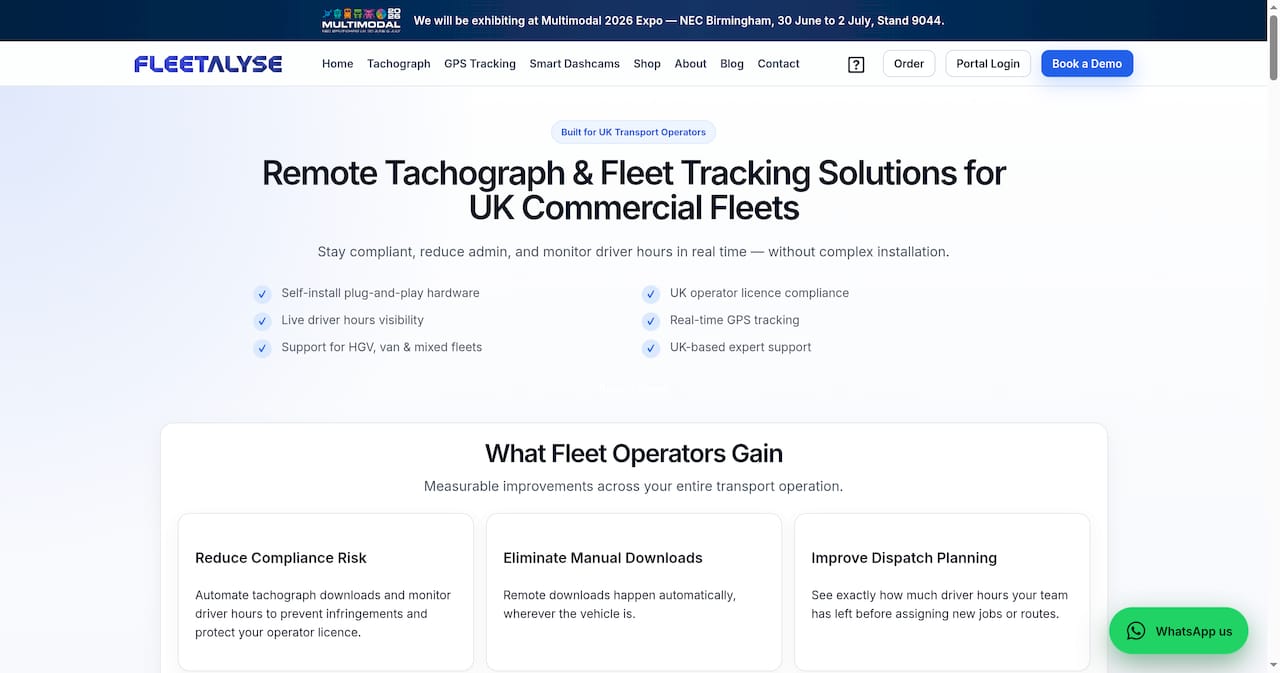
If hardware is your immediate gap, Fleetalyse’s unlocked GPS trackers are plug-and-play, no SIM lock, and ready to fit without a professional install. If you’re further along and want to see how driver behaviour data ties into your recovery and insurance evidence, book a walkthrough of driver behaviour monitoring and see how the alerts, logs and reports look on a live dashboard before you commit.
Sources
- Benefits of telematics for managing commercial vehicle fleets
- Top 10 benefits of telematics for fleets