
What is driving hours infringement and why it matters
A driving hours infringement is any breach of the driving time, break, rest or tachograph rules set out in Regulation (EC) No 561/2006 and enforced under UK domestic law. That covers everything from skipping a required break to falsifying a tachograph record.
The consequences arrive fast. An enforcement officer can issue a prohibition that stops your vehicle on the spot, hand out a fixed penalty, or refer the case for prosecution. Gov makes clear that prohibitions exist to protect road safety first, punishment second. For an operator, one infringement rarely stays isolated. It tends to expose a wider pattern that puts your operator licence at risk.
What typically triggers scrutiny:
- Driving beyond the 4.5 hour limit without a qualifying break
- Exceeding daily or weekly driving limits
- Taking insufficient daily or weekly rest
- Tachograph mode errors, missing driver card data, or overdue downloads
Fleetalyse exists precisely because most of these breaches are avoidable with the right monitoring in place, and this guide walks through what counts as an infringement, how enforcement treats it, and what you can do differently.
Key Takeaways
Preventing driving hours infringements depends on continuous hours monitoring, disciplined tachograph downloads, and rostering that respects legal limits rather than delivery pressure.
| Point | Details |
|---|---|
| Know the exact limits | 9 hours daily driving (10 twice weekly), 56 hours weekly, 90 hours per fortnight, 45-minute break after 4.5 hours. |
| Treat prohibitions as safety tools | A prohibition can stop a vehicle immediately and often triggers further investigation. |
| Document everything at the roadside | Timesheets, booking confirmations and tachograph extracts support any unforeseen-delay defence. |
| Automate hours monitoring | Alerts before drivers approach limits catch problems earlier than manual checks. |
| Keep download schedules strict | Driver cards every 28 days, vehicle units every 90 days, stored securely. |
Table of Contents
- Common types of driving hours infringements
- How enforcement works and the penalties you could face
- What to do if you’re stopped at a roadside check
- How operators prevent driving hours infringements before they happen
- What the research actually tells us about infringements
- Sources
Common types of driving hours infringements
Most infringements fall into four recognisable categories, and once you know what officers are actually checking for, spotting risk in your own operation gets much easier.
- Break violations. A driver must take a break of at least 45 minutes after around 4.5 hours of accumulated driving. That break can be split into 15 minutes followed by 30 minutes, but only in that order. Taking 30 minutes first and 15 minutes second does not satisfy the rule, and it is one of the most common mistakes tachograph analysis turns up.
- Daily driving limit breaches. The standard daily limit is generally about nine hours, extendable to around ten hours on no more than two days in a week. A driver who does this extended driving more than twice in a week has committed an infringement, even if each individual day looked fine in isolation.
- Weekly and fortnightly limit breaches. Weekly driving has an agreed maximum, and total driving across any two consecutive weeks also has a set upper limit. This second limit catches operators who plan week by week rather than looking at rolling fortnights.
- Rest period shortfalls. Regular daily rest periods have a typical minimum length, reducible under certain conditions up to a few times between weekly rests. Regular weekly rest periods also have defined minimum durations, some reducible under strict compensation rules. Confusing a reduced rest with a regular one, or forgetting to compensate it, is a frequent and largely preventable error.
- Tachograph misuse. This includes selecting the wrong duty mode, driving without a card inserted, failing to download data on schedule, or manipulating records. Regulation (EC) No 561/2006 treats deliberate falsification far more seriously than an accidental mode error, but both count as infringements.
Statistic callout: The regulation permits a daily driving extension to 10 hours on only two occasions per week, a limit small enough that a single scheduling oversight on a busy route can tip a driver over into a genuine breach.
Recognising these five patterns is most of the battle. The rest is discipline in rostering and recordkeeping, which later sections cover in detail.
How enforcement works and the penalties you could face
Enforcement in this area is graded, not binary. Officers assess severity case-by-case, and the TRACE enforcement guidance used across Member States explicitly builds in that judgement rather than a fixed tariff for every breach.
A prohibition is the sharpest tool available. It can stop a vehicle immediately, and depending on the circumstances, it may be specified or unspecified in length. GOV.UK’s guidance frames prohibitions as safety interventions rather than punishments, though a prohibition frequently opens the door to further investigation and does not necessarily end matters once corrected.
Enforcement officers may issue a prohibition to stop a vehicle until the cause of the infringement is corrected. Prohibitions are safety-first tools and often lead to further investigation rather than closing the case.
Below the prohibition threshold sit routine penalties:
- Fixed penalties, issued at the roadside for straightforward breaches, generally where the driver has a verifiable UK address.
- Deposits, required from drivers without a verifiable address, payable on the spot, with further driving barred until paid.
- Prosecution, reserved for repeated, serious or deliberately falsified breaches.
- Operator licence consequences, since operators carry co-liability where systemic failures in rostering or monitoring are found.
A lawful defence does exist for unforeseen, unavoidable delays that force a breach to reach a safe stopping point, but it relies entirely on contemporaneous evidence: timestamped logs, delivery confirmations, and tachograph extracts gathered at the time, not reconstructed afterwards. Operators who can show documented processes and training records tend to fare considerably better when a case escalates.
What to do if you’re stopped at a roadside check
A roadside stop is not the moment to argue the finer points of the regulation. It is the moment to cooperate, document, and protect your position for later.
- Present your documents promptly. Hand over your driver card, recent tachograph printouts, and any paper records without delay.
- Follow a prohibition’s exact terms. If issued, correct the stated cause where it is safe and practical to do so, and notify your operator immediately.
- Capture evidence on the spot. Photograph timesheets, job instructions, and booking confirmations that show why a delay happened, if a defence might apply.
- Escalate internally if prosecution is threatened. Contact your compliance team or legal support the same day, not after the paperwork lands on someone’s desk a week later.
Pro Tip: Keep a laminated card in the cab listing exactly what to hand over and in what order. Drivers under pressure at a roadside stop forget steps they’d normally never miss.
How operators prevent driving hours infringements before they happen
Prevention beats defence every time, and it starts with how you build the roster, not how you react once something has gone wrong.
Design shifts around the driving and rest limits rather than around delivery targets alone, and be wary of per-mile or per-drop incentive structures that quietly push drivers to skip breaks. Recordkeeping discipline matters just as much: download driver card data every 28 days and vehicle unit data every 90 days, then store it securely where it can be produced on demand. This schedule is standard industry practice for meeting recordkeeping obligations, even where exact timing can vary by fleet type.
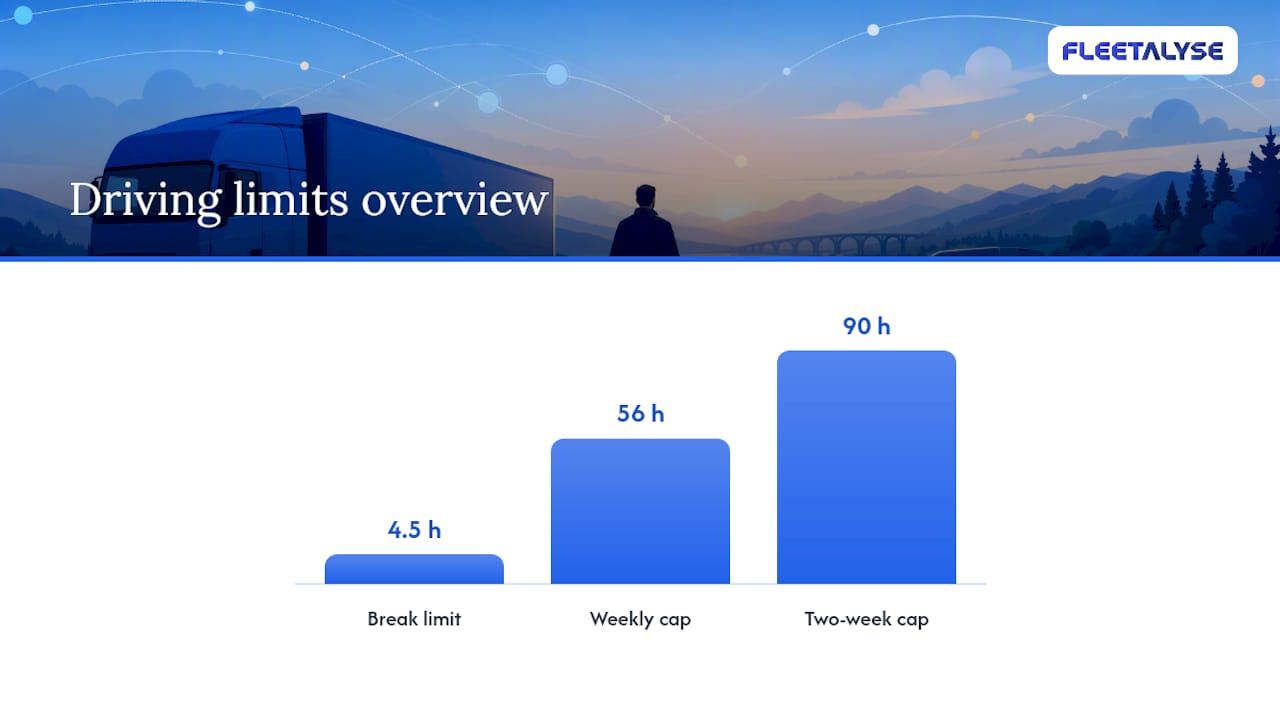
Statistic callout: Regulation (EC) No 561/2006 caps weekly driving at 56 hours and two-week driving at 90 hours, two limits that only stay visible to a fleet manager if hours are tracked continuously rather than checked retrospectively.
Manual checks catch problems after the fact. Automated hours monitoring and remote tachograph downloads flag an approaching 4.5-hour break limit, or a driver closing in on their weekly cap, while there’s still time to act. Plug-and-play telematics hardware removes the installation burden that used to make this kind of monitoring impractical for smaller fleets, and driver behaviour monitoring builds the audit trail that supports a credible defence if an infringement does slip through.
- Roster around rest and driving limits, not delivery deadlines
- Download driver card data every 28 days, vehicle unit data every 90 days
- Set automated alerts for approaching break, daily and weekly limits
- Keep training records and reports as documented proof of process
Pro Tip: An infringement that happened once despite a documented monitoring system in place is treated very differently to one arising from no monitoring at all. Build the paper trail before you need it.
What the research actually tells us about infringements
Most guidance on this subject treats infringements as a legal category to memorise: know the limits, know the penalties, move on. That misses the more useful lesson buried in the enforcement guidance itself, which is that severity judgements are discretionary, and documentation is what shapes that discretion in your favour.
The conventional advice, learn the rules, drive within them, tells operators almost nothing about what happens when a delay is genuinely unavoidable. A driver stuck behind an accident closure who breaches a limit to reach a safe stop has a lawful defence, but only if the evidence exists in writing from that day, not reconstructed a fortnight later when a fixed penalty notice arrives.
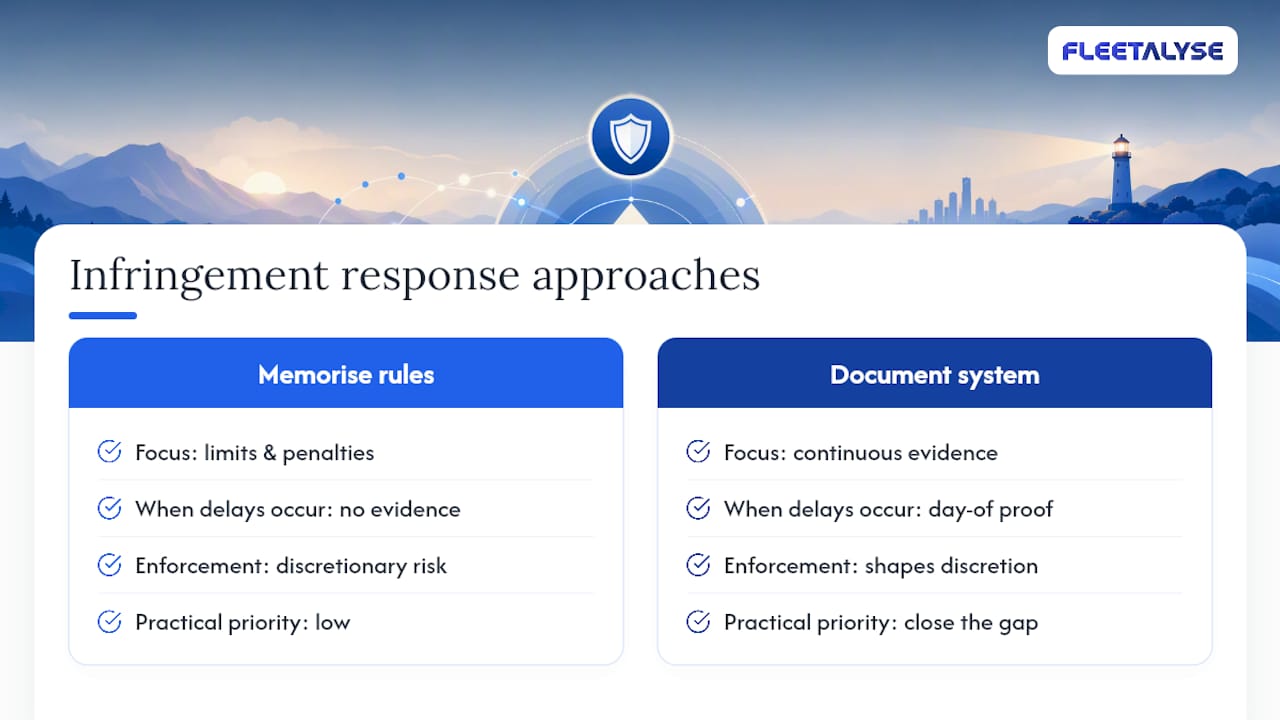
The priority, then, is not memorising every hour and minute in the regulation. It is building a system, rostering, tachograph downloads, automated alerts, that generates its own evidence continuously, so that when something does go wrong, you are not scrambling for proof. That is the gap most operators underestimate, and it is the one worth closing first.
Sources
- Gov
- Driving time and rest periods in the road transport sector | EUR-Lex
- TRACE_II Driving-Resting Times Enforcement Guidance