
For transport managers in Ipswich and across the UK, maintaining a clean Operator Licence is non-negotiable. Yet, the complexities of drivers' hours rules can feel like a constant battle against infringements. A single mistake, whether from a driver on the road or a manager in the office, can trigger a DVSA investigation, leading to significant fines, a Public Inquiry, or even the loss of your licence to operate.
The solution isn't just about avoiding penalties; it's about shifting from reactive problem-solving to proactive compliance management. This guide provides a clear framework for understanding the root causes of infringements, implementing robust systems to prevent them, and leveraging technology to gain total transparency over your fleet's operations.
Understanding Driver Hour Infringements and DVSA Standards
A driver hour infringement occurs whenever a commercial driver or their employer fails to comply with the regulations governing driving times, breaks, and rest periods. These rules are not arbitrary; they are a cornerstone of UK road safety law, designed to combat driver fatigue and reduce the risk of accidents. The Driver and Vehicle Standards Agency (DVSA) is the regulatory body responsible for enforcing these standards through roadside checks, site audits, and data analysis.
- What are infringements? Any deviation from the legal limits on driving, working, and resting, as recorded by a tachograph.
- Who enforces the rules? The DVSA monitors compliance and has the authority to issue fines, prohibitions, and report operators to the Traffic Commissioner.
- Why does it matter? A pattern of infringements is a direct threat to your Operator Licence, signalling to the DVSA that your company may not be fit to operate commercial vehicles.
The Legal Framework: EU vs GB Domestic Rules
Commercial vehicle operations in the UK are primarily governed by two sets of rules. The EU rules apply to most HGV drivers, covering limits on daily and weekly driving, mandatory breaks, and specified rest periods. The GB domestic rules apply to certain operations that are exempt from EU regulations, often including van drivers and specific types of HGV work. Understanding which rules apply to each vehicle and journey is fundamental. The 'Standard of Care' expected from a Transport Manager is to have robust, demonstrable systems in place to manage, record, and prevent violations of these complex legal requirements. (Drivers' working hours regulations)
Consequences of Non-Compliance for Fleet Operators
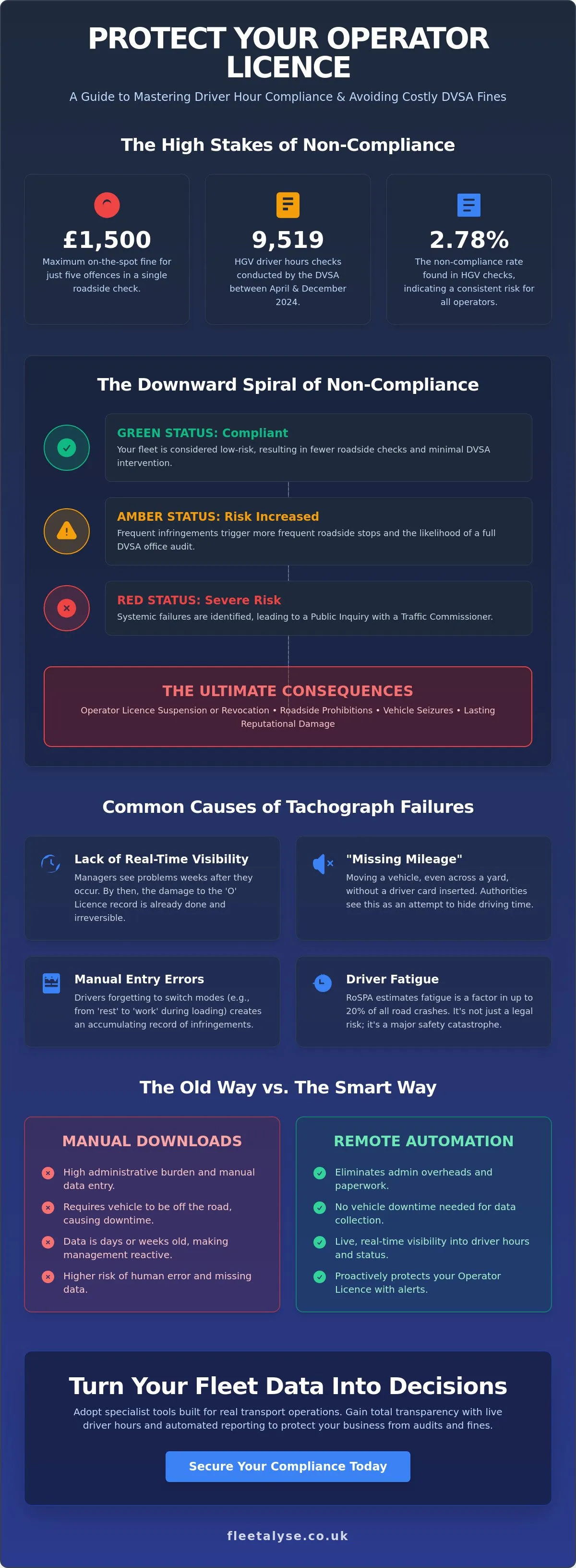
The consequences of failing to manage driver hours extend far beyond a simple fine. The DVSA uses an Operator Compliance Risk Score (OCRS) to grade fleets, and each infringement negatively impacts this score, increasing the likelihood of targeted inspections. Serious or repeated non-compliance can result in substantial financial penalties and a summons to a Public Inquiry before a Traffic Commissioner, who has the power to curtail, suspend, or revoke your 'O' Licence entirely. The reputational damage from vehicle prohibitions and seizures can be just as costly, undermining client confidence and your position in the market. For a detailed breakdown, see our guide to common tachograph infringements and penalties.
Identifying Common Causes of Tachograph Compliance Failures
Most infringements are not born from a deliberate attempt to break the law. More often, they are the result of systemic issues like poor planning, lack of training, or operational pressures. A key red flag for DVSA auditors is 'missing mileage'—unaccounted for vehicle movement that suggests driving without a card inserted. This, along with other common errors, points towards deeper issues within the operation.
- Poor Planning: Unrealistic schedules that don't account for traffic or delays.
- Unintentional Errors: Drivers forgetting to make manual entries or selecting the wrong mode on the tachograph.
- Missing Mileage: A critical compliance failure indicating a vehicle was moved without a driver card.
- Driver Fatigue: The primary safety risk that the hours regulations are designed to prevent.
Unintentional Errors and Manual Entry Failures
Many drivers struggle with the correct use of digital tachographs, particularly when it comes to switching between 'work', 'rest', and 'availability' modes. A common failure is not accurately recording 'other work'—such as vehicle checks or warehouse duties—which can lead to a false picture of their daily rest. Identifying patterns of these mistakes, such as repeated incorrect manual entries for the same driver, is a clear sign that targeted training is required to prevent future infringements. (UK government drivers' hours rules)
Operational Pressures and Route Planning Issues
When delivery windows are tight and routes are not planned with compliance in mind, drivers can feel pressured to make a 'calculated' infringement to meet a deadline. Unexpected traffic, accidents, or a lack of safe and legal HGV parking can quickly derail a well-intentioned plan. It is the operator's legal responsibility to prioritise compliance over the speed of delivery, creating schedules that have sufficient buffers for unforeseen delays and ensuring drivers are not put in a position where they have to choose between the rules and the job. Addressing these operational pressures is critical to managing driver fatigue effectively.

Remote Tachograph Downloads vs Manual Collection: Efficiency Comparison
The traditional method of manually downloading driver cards and vehicle units is time-consuming, inefficient, and prone to error. It requires vehicles to return to base and relies on staff to physically collect the data, often leading to missed deadlines and stale information. Modern remote download solutions automate this entire process. Data is transferred securely and automatically, giving managers live visibility of driver hours and ensuring compliance deadlines are never missed. This prevents infringements before they happen, rather than just reporting on them weeks later.
The Hidden Costs of Manual Compliance
The true cost of manual data collection goes beyond the time spent by an administrator. It includes vehicle downtime when an HGV has to return to the depot purely for a download, the fuel consumed, and the risk of human error. Forgetting to download a single driver card within the 28-day legal window is a serious offence. Manual systems often create a data 'lag', meaning by the time you analyse an infringement report, the information is too old to be used for effective coaching or intervention. This reactive approach is precisely what the DVSA penalises. Learn more about the consequences of missing a tacho download in our detailed guide. (Common HGV driver infringements)
Benefits of Live Driver Hour Monitoring
Live data provides a transformative advantage. With remote monitoring, transport managers receive real-time alerts for upcoming break requirements or potential driving time over-runs, allowing them to intervene proactively. This data integrates seamlessly with tachograph analysis software, generating instant reports without manual effort. This approach supports a culture of Total Transparency, where both drivers and managers have a clear, up-to-the-minute view of compliance status, eliminating guesswork and reducing administrative burdens.
Proactive Strategies to Organise and Reduce Infringement Risks
Effective compliance is built on a foundation of clear policies, regular checks, and open communication. Rather than waiting for a DVSA visit, operators should implement their own proactive strategies to identify and mitigate risks. This involves creating a structured framework for managing driver hours that is understood by everyone in the organisation, from the drivers to the directors.
- Internal Audits: Schedule regular, thorough checks of your tachograph data and procedures.
- Written Policy: Create a clear, concise 'Driver Hours Policy' that all drivers must read and sign.
- Positive Coaching: Use infringement reports as a tool for constructive training, not just disciplinary action.
- Data Validation: Use telematics and GPS data to cross-reference tachograph records and investigate anomalies like missing mileage.
Creating a Culture of Compliance
Compliance shouldn't be seen as a punishment. The most successful operators build a culture where safety and adherence to the rules are a shared responsibility. Consider incentivising infringement-free driving to reward professionalism. Hold regular, one-on-one debriefs with drivers to review their data together, discussing any issues in a supportive environment. When there is total transparency between management and drivers, friction is reduced, and everyone works towards the same goal: keeping the Operator Licence safe and the roads secure.
Utilising Telematics and GPS Insights
Modern GPS fleet tracking offers much more than a dot on a map. By analysing vehicle location data, you can identify recurring delay hotspots on certain routes and adjust schedules accordingly. Combining live driver hours with real-time asset location allows for smarter, compliance-led dispatching—you can see which driver has enough available time to handle an urgent job. Setting up geo-fences around customer sites or depots can also help you automatically monitor vehicle movements and validate them against driver logs, making it easier to spot and investigate potential issues.
Fleetalyse: Compliance Solutions for Real Transport Operations
Fleetalyse is a specialist UK partner dedicated to simplifying transport compliance. We provide robust, practical solutions built for the demands of real transport operations—not just generic tracking. Our hardware is 'Plug & Play' for a straightforward rollout across your HGV and van fleet, and our 'Clear Pricing' model means no hidden fees or complex lease agreements. We focus on turning your raw fleet data into clear, actionable decisions that protect your Operator Licence and improve efficiency.
Remote Tachograph Download and Integration
Our system automates the entire tachograph download process, ensuring you never miss the 28-day and 90-day deadlines. Fleetalyse guarantees your data is collected securely and on time, every time. It integrates with all leading tachograph analysis software, providing a complete and seamless overview of your fleet's compliance. Furthermore, Fleetalyse technology is engineered to support unattended asset monitoring, ensuring you maintain full visibility even when trailers or equipment are disconnected.
For an in-depth look at this technology, explore our Complete Guide to Remote Tacho Downloads.
Live Driver Hours for Better Decision Making
Stop planning routes based on old information. With Fleetalyse, you can view real-time driver availability across your entire fleet, allowing you to plan and dispatch more effectively. See exactly how much driving time each driver has left at a glance, enabling you to make smarter operational decisions on the fly. This eliminates the endless phone calls and administrative headaches of chasing drivers for their hours, freeing up your team to focus on running the business.
Ready to take control of your fleet compliance? Contact Fleetalyse today.
Frequently Asked Questions
What are the most common driver hour infringements in the UK?
The most frequent infringements include exceeding the 4.5-hour driving limit without a qualifying break, insufficient daily or weekly rest, and exceeding the daily driving limit of 9 or 10 hours. Inaccurate manual entries and failing to record 'other work' are also extremely common.
How much are the fines for HGV tachograph offences?
Fines can vary significantly. On-the-spot fines issued by the DVSA can be up to £300 per offence. If the case goes to court, fines can be much higher, reaching thousands of pounds for serious violations or for the operator failing in their duties. Falsifying records can even lead to imprisonment.
Can the DVSA revoke my Operator Licence for driver hour infringements?
Yes. While a few minor infringements may result in a warning, a pattern of persistent non-compliance or serious offences will be reported to the Traffic Commissioner. The Commissioner has the ultimate authority to curtail, suspend, or completely revoke your 'O' Licence if they deem you are no longer fit to operate.
Is remote tachograph downloading legally compliant with DVSA standards?
Absolutely. Remote downloading is a DVSA-compliant method for retrieving data from both the vehicle unit and the driver card. It is widely recognised as a more secure, accurate, and reliable method than manual downloads for maintaining compliance records.
How often must I download driver card and vehicle unit data?
By law in the UK, you must download data from the driver card at least every 28 days. Data from the vehicle unit (VU) must be downloaded at least every 90 days. It is best practice to download data more frequently to enable proactive management.
What happens if a driver forgets to insert their tachograph card?
Driving without a card inserted is a very serious offence known as 'missing mileage'. It creates a gap in the driver's activity record, which auditors will assume was illegal driving. The driver and the operator will be held responsible and face severe penalties, as it undermines the entire purpose of the tachograph system.
How can I monitor live driver hours without interrupting the driver?
The only effective way is through a telematics system that offers remote tachograph downloads. This technology automatically transmits live data from the tachograph to your management software without requiring any action from the driver, providing you with a real-time view of their remaining driving, break, and rest times.
Do van drivers have to follow the same driver hour rules as HGV drivers?
Not always. Many van drivers fall under the GB Domestic Rules, which are different and generally less strict than the EU rules that govern most HGV work. However, some van operations do fall under EU rules. It is the operator's responsibility to know which regulations apply to their specific fleet and ensure compliance accordingly.
Frequently asked questions
The Legal Framework: EU vs GB Domestic Rules
Commercial vehicle operations in the UK are primarily governed by two sets of rules. The EU rules apply to most HGV drivers, covering limits on daily and weekly driving, mandatory breaks, and specified rest periods. The GB domestic rules apply to certain operations that are exempt from EU regulations, often including van drivers and specific types of HGV work. Understanding which rules apply to each vehicle and journey is fundamental. The 'Standard of Care' expected from a Transport Manager is to have robust, demonstrable systems in place to manage, record, and prevent violations of these complex legal requirements. (Drivers' working hours regulations)
Consequences of Non-Compliance for Fleet Operators
The consequences of failing to manage driver hours extend far beyond a simple fine. The DVSA uses an Operator Compliance Risk Score (OCRS) to grade fleets, and each infringement negatively impacts this score, increasing the likelihood of targeted inspections. Serious or repeated non-compliance can result in substantial financial penalties and a summons to a Public Inquiry before a Traffic Commissioner, who has the power to curtail, suspend, or revoke your 'O' Licence entirely. The reputational damage from vehicle prohibitions and seizures can be just as costly, undermining client confidence and your position in the market. For a detailed breakdown, see our guide to common tachograph infringements and penalties. Most infringements are not born from a deliberate attempt to break the law. More often, they are the result of systemic issues like poor planning, lack of training, or operational pressures. A key red flag for DVSA auditors is 'missing mileage'—unaccounted for vehicle movement that suggests driving without a card inserted. This, along with other common errors, points towards deeper issues within the operation.
Unintentional Errors and Manual Entry Failures
Many drivers struggle with the correct use of digital tachographs, particularly when it comes to switching between 'work', 'rest', and 'availability' modes. A common failure is not accurately recording 'other work'—such as vehicle checks or warehouse duties—which can lead to a false picture of their daily rest. Identifying patterns of these mistakes, such as repeated incorrect manual entries for the same driver, is a clear sign that targeted training is required to prevent future infringements. (UK government drivers' hours rules)
Operational Pressures and Route Planning Issues
When delivery windows are tight and routes are not planned with compliance in mind, drivers can feel pressured to make a 'calculated' infringement to meet a deadline. Unexpected traffic, accidents, or a lack of safe and legal HGV parking can quickly derail a well-intentioned plan. It is the operator's legal responsibility to prioritise compliance over the speed of delivery, creating schedules that have sufficient buffers for unforeseen delays and ensuring drivers are not put in a position where they have to choose between the rules and the job. Addressing these operational pressures is critical to managing driver fatigue effectively. The traditional method of manually downloading driver cards and vehicle units is time-consuming, inefficient, and prone to error. It requires vehicles to return to base and relies on staff to physically collect the data, often leading to missed deadlines and stale information. Modern remote download solutions automate this entire process. Data is transferred securely and automatically, giving managers live visibility of driver hours and ensuring compliance deadlines are never missed. This prevents infringements before they happen, rather than just reporting on them weeks later.
The Hidden Costs of Manual Compliance
The true cost of manual data collection goes beyond the time spent by an administrator. It includes vehicle downtime when an HGV has to return to the depot purely for a download, the fuel consumed, and the risk of human error. Forgetting to download a single driver card within the 28-day legal window is a serious offence. Manual systems often create a data 'lag', meaning by the time you analyse an infringement report, the information is too old to be used for effective coaching or intervention. This reactive approach is precisely what the DVSA penalises. Learn more about the consequences of missing a tacho download in our detailed guide. (Common HGV driver infringements)
Benefits of Live Driver Hour Monitoring
Live data provides a transformative advantage. With remote monitoring, transport managers receive real-time alerts for upcoming break requirements or potential driving time over-runs, allowing them to intervene proactively. This data integrates seamlessly with tachograph analysis software, generating instant reports without manual effort. This approach supports a culture of Total Transparency, where both drivers and managers have a clear, up-to-the-minute view of compliance status, eliminating guesswork and reducing administrative burdens. Effective compliance is built on a foundation of clear policies, regular checks, and open communication. Rather than waiting for a DVSA visit, operators should implement their own proactive strategies to identify and mitigate risks. This involves creating a structured framework for managing driver hours that is understood by everyone in the organisation, from the drivers to the directors.
Creating a Culture of Compliance
Compliance shouldn't be seen as a punishment. The most successful operators build a culture where safety and adherence to the rules are a shared responsibility. Consider incentivising infringement-free driving to reward professionalism. Hold regular, one-on-one debriefs with drivers to review their data together, discussing any issues in a supportive environment. When there is total transparency between management and drivers, friction is reduced, and everyone works towards the same goal: keeping the Operator Licence safe and the roads secure.
Utilising Telematics and GPS Insights
Modern GPS fleet tracking offers much more than a dot on a map. By analysing vehicle location data, you can identify recurring delay hotspots on certain routes and adjust schedules accordingly. Combining live driver hours with real-time asset location allows for smarter, compliance-led dispatching—you can see which driver has enough available time to handle an urgent job. Setting up geo-fences around customer sites or depots can also help you automatically monitor vehicle movements and validate them against driver logs, making it easier to spot and investigate potential issues. Fleetalyse is a specialist UK partner dedicated to simplifying transport compliance. We provide robust, practical solutions built for the demands of real transport operations—not just generic tracking. Our hardware is 'Plug & Play' for a straightforward rollout across your HGV and van fleet, and our 'Clear Pricing' model means no hidden fees or complex lease agreements. We focus on turning your raw fleet data into clear, actionable decisions that protect your Operator Licence and improve efficiency.
Remote Tachograph Download and Integration
Our system automates the entire tachograph download process, ensuring you never miss the 28-day and 90-day deadlines. Fleetalyse guarantees your data is collected securely and on time, every time. It integrates with all leading tachograph analysis software, providing a complete and seamless overview of your fleet's compliance. Furthermore, Fleetalyse technology is engineered to support unattended asset monitoring, ensuring you maintain full visibility even when trailers or equipment are disconnected. For an in-depth look at this technology, explore our Complete Guide to Remote Tacho Downloads.
Live Driver Hours for Better Decision Making
Stop planning routes based on old information. With Fleetalyse, you can view real-time driver availability across your entire fleet, allowing you to plan and dispatch more effectively. See exactly how much driving time each driver has left at a glance, enabling you to make smarter operational decisions on the fly. This eliminates the endless phone calls and administrative headaches of chasing drivers for their hours, freeing up your team to focus on running the business. Ready to take control of your fleet compliance? Contact Fleetalyse today. What are the most common driver hour infringements in the UK?The most frequent infringements include exceeding the 4.5-hour driving limit without a qualifying break, insufficient daily or weekly rest, and exceeding the daily driving limit of 9 or 10 hours. Inaccurate manual entries and failing to record 'other work' are also extremely common. How much are the fines for HGV tachograph offences?Fines can vary significantly. On-the-spot fines issued by the DVSA can be up to £300 per offence. If the case goes to court, fines can be much higher, reaching thousands of pounds for serious violations or for the operator failing in their duties. Falsifying records can even lead to imprisonment. Can the DVSA revoke my Operator Licence for driver hour infringements?Yes. While a few minor infringements may result in a warning, a pattern of persistent non-compliance or serious offences will be reported to the Traffic Commissioner. The Commissioner has the ultimate authority to curtail, suspend, or completely revoke your 'O' Licence if they deem you are no longer fit to operate. Is remote tachograph downloading legally compliant with DVSA standards?Absolutely. Remote downloading is a DVSA-compliant method for retrieving data from both the vehicle unit and the driver card. It is widely recognised as a more secure, accurate, and reliable method than manual downloads for maintaining compliance records. How often must I download driver card and vehicle unit data?By law in the UK, you must download data from the driver card at least every 28 days. Data from the vehicle unit (VU) must be downloaded at least every 90 days. It is best practice to download data more frequently to enable proactive management. What happens if a driver forgets to insert their tachograph card?Driving without a card inserted is a very serious offence known as 'missing mileage'. It creates a gap in the driver's activity record, which auditors will assume was illegal driving. The driver and the operator will be held responsible and face severe penalties, as it undermines the entire purpose of the tachograph system. How can I monitor live driver hours without interrupting the driver?The only effective way is through a telematics system that offers remote tachograph downloads. This technology automatically transmits live data from the tachograph to your management software without requiring any action from the driver, providing you with a real-time view of their remaining driving, break, and rest times. Do van drivers have to follow the same driver hour rules as HGV drivers?Not always. Many van drivers fall under the GB Domestic Rules, which are different and generally less strict than the EU rules that govern most HGV work. However, some van operations do fall under EU rules. It is the operator's responsibility to know which regulations apply to their specific fleet and ensure compliance accordingly.