

What DVSA audit preparation actually requires in 2026

You pass a DVSA compliance audit by producing evidence, not by promising good intentions. The auditor wants to see at least 15 months of PMI and maintenance records, tachograph downloads with completed analyses, driver files with current licence checks and CPC records, a Vehicle Operator Licensing (VOL) record that matches your actual operation, KPI data and internal audit minutes, and a corrective action log showing closed items with dates and named owners. Miss any one of these and you’re relying on luck rather than preparation.
If you’re working towards Earned Recognition, the bar sits higher. You’ll need documented KPI reporting across multiple periods, a fleet sample that genuinely represents your operating centres and vehicle types, and at least one month’s worth of operator analysis included in the audit sample, as set out in the DVSA Earned Recognition HGV operator audit standards. Sampling isn’t random box-ticking. It’s designed to expose whether your systems work day to day, not just on the days you remember to check them.
Here’s what to do in the next hour, before you do anything else:
- Index everything you already have. Create a single folder structure mirroring the categories DVSA will ask for: maintenance, tachograph, driver files, licence documents, management records.
- Nominate one owner. Someone needs to be accountable for pulling evidence together, chasing gaps, and answering DVSA correspondence. Split ownership across three people and nothing gets done in time.
- Set deadlines on every open corrective action. An action with no date attached is an action that never closes, and an unclosed action log is one of the fastest routes to an unsatisfactory finding.
Get those three things moving today and the rest of your dvsa audit preparation becomes a matter of following a structured checklist rather than firefighting.
Key Takeaways
Passing a DVSA audit depends on producing organised, dated evidence across maintenance, tachograph, driver files, VOL accuracy and management oversight, sustained over time rather than assembled at the last minute.
| Point | Details |
|---|---|
| Build the core evidence bundle | Keep 12 to 15 months of PMI records, tachograph downloads with analyses, and driver files with current CPC and licence checks. |
| Reconcile VOL before anything else | A licence mismatch is an immediate trigger; fix it through the formal variation process, not by adjusting operations quietly. |
| Run mock audits regularly | Pull a random vehicle and driver file and walk it as an auditor would to expose gaps before DVSA does. |
| Respond to DBAs with an indexed pack | Mirror the request structure, cross-check dates, and acknowledge any gaps with a dated remediation plan. |
| Allow six weeks, not six days | Sustained fresh records matter more than a rushed fix commissioned just before a hearing or audit. |
Table of Contents
- Dvsa audit preparation: what auditors check and how they sample records
- How do you respond to a desk-based assessment quickly?
- A 6-week checklist to prepare for a DVSA audit
- What happens during an on-site DVSA audit visit?
- Common reasons DVSA audits come back unsatisfactory
- What are the possible outcomes of a DVSA audit?
- How Fleetalyse supports your dvsa audit preparation
- Essential GOV.UK documents and practical templates to download now
- An editorial take on what actually gets operators through a DVSA audit
- Sources
Dvsa audit preparation: what auditors check and how they sample records
DVSA auditors don’t examine every document you own. They sample, and the sampling method tells you exactly where to focus your dvsa compliance training and your own internal reviews.
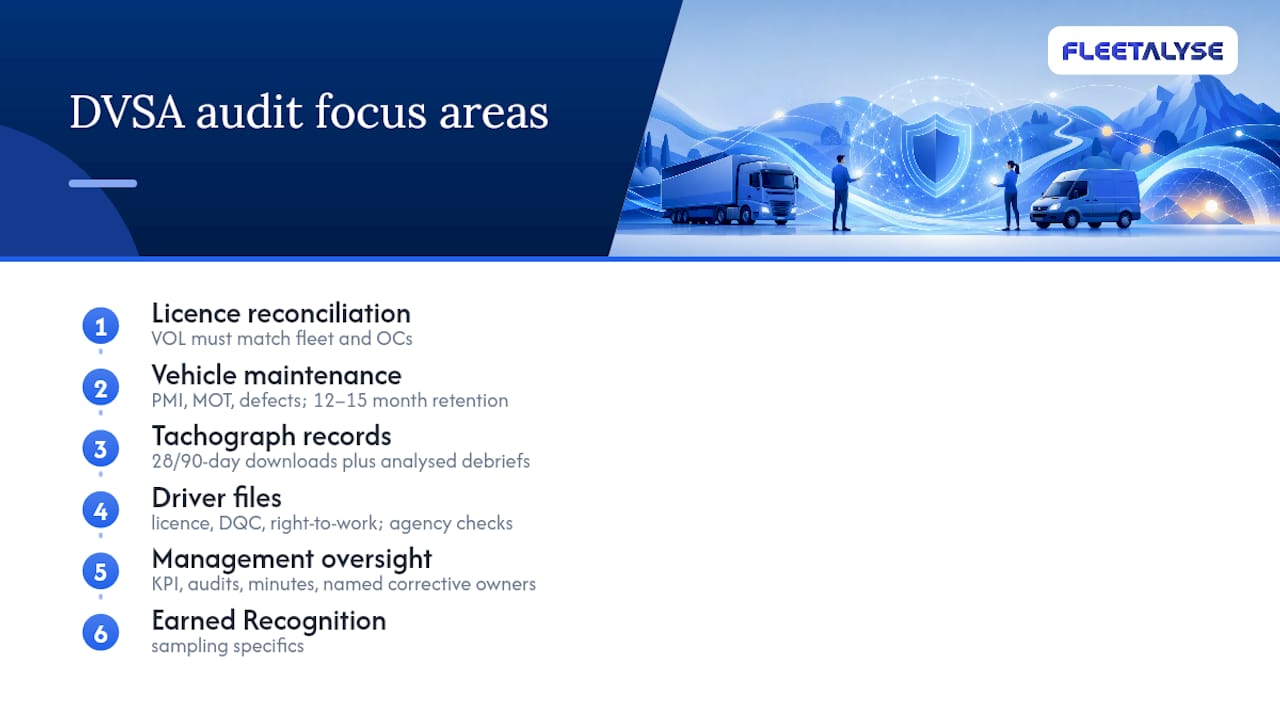
1. Operator licence and VOL reconciliation
Your VOL record has to match your actual fleet, operating centres and authorised vehicle numbers exactly. A mismatch, whether it’s an operating centre you’ve quietly stopped using or a vehicle you added without updating the licence, is one of the fastest ways to draw regulatory attention. If you spot a discrepancy, correct it through the formal licence variation process rather than adjusting your operation to fit an outdated record. Our guide on maintaining operator licence compliance walks through the variation process in detail.
2. Vehicle maintenance evidence
This is usually where audits succeed or fail. DVSA expects to see PMI sheets at the correct inspection intervals, brake test results, MOT history, and defect records with clear proof of rectification, not just a defect logged and forgotten. A recommended retention window is at least 12 to 15 months of PMI and maintenance records, sampled across different vehicle types, maintenance providers, and operating centres. If you use more than one maintenance contractor, keep records from each; auditors specifically look for consistency across providers.
3. Tachograph and drivers’ hours records
Downloads need to happen on schedule, typically every 28 days for vehicle units and 90 days for driver cards under most operator policies, with infringement reports generated and signed debriefs on file for every flagged event. A download with no analysis attached is barely better than no download at all, because it proves you collected data without proving you acted on it. Our detailed breakdown of DVSA tachograph rules covers the exact download intervals and what a compliant debrief record should contain.
4. Driver files
Each driver file should hold a current driving licence check, valid Driver CPC records, right-to-work documentation, and, where relevant, agency driver records showing the agency’s own compliance checks. Agency drivers are a common blind spot. Operators often assume the agency handles compliance, then discover during an audit that nobody actually verified it.
5. Management oversight
This is the category operators underestimate most. DVSA wants proof that your management systems function in practice, not just on paper. That means KPI reports, internal audit records, meeting minutes referencing compliance issues, and named owners attached to corrective actions. Official guidance points to independent audits and structured self-assessments as the clearest way to test these systems before DVSA does it for you.
6. Earned Recognition sampling specifics
If you’re audited under Earned Recognition, expect the sample to deliberately cover multiple operating centres and vehicle categories rather than the single easiest site to inspect. The standards require electronic or manual systems capable of reporting KPI triggers for both maintenance and driving activities, according to the Earned Recognition self-assessment checklist. A single month of strong data won’t cut it. Auditors expect at least one month of genuine operator analysis embedded in the sample, and they’ll ask questions if the trend looks suspiciously clean compared with the months either side.
Run through these six areas honestly and you’ll usually know within a day whether you’re audit-ready or whether you’ve got two weeks of backfilling ahead.
How do you respond to a desk-based assessment quickly?
A desk-based assessment (DBA) usually arrives by letter or email with a request for specific records and a deadline that feels tighter than you’d like, often ten working days or less. The good news is that a DBA rewards organisation far more than it rewards perfection. A well-structured, evidence-indexed response frequently closes the matter without further escalation.
Start by building an index that mirrors exactly what DVSA has asked for, in the same order, using the same terminology. If the letter asks for “maintenance records for vehicles X, Y and Z covering the last 12 months,” your index should have a section with that exact heading, not a folder called “Maintenance 2025” that the auditor has to dig through.
- Use a consistent PDF naming convention across every document: vehicle registration, document type, and date, in that order.
- Cross-reference every date against your maintenance planner and tachograph calendar before submitting anything, because a defect record dated after its supposed inspection date undermines the whole file.
- Where you find a genuine gap, don’t hide it. Note it in your covering letter with a clear remediation plan and a date it will be closed by.
- Keep the covering letter to one page where possible: a short summary of what’s enclosed, an acknowledgement of any gaps, and your named contact for follow-up questions.
The step operators skip most often is the quality check. A practical DBA workflow that starts with scoping the request, then gathering evidence, then a distinct quality-check stage before submission, catches the errors that would otherwise surface only when DVSA reads the file. Building your own evidence index from day one, rather than assembling it reactively when a DBA arrives, is exactly what our guide on proving transport compliance to the DVSA sets out in more depth.
Pro Tip: Draft your DBA cover letter before you’ve finished gathering every document. Writing the summary first forces you to define exactly what “complete” looks like, which makes it far easier to spot what’s still missing.
A covering letter that acknowledges a gap and shows a credible plan to close it is treated far more favourably than a submission that looks complete but doesn’t hold up under scrutiny once someone cross-checks the dates.
A 6-week checklist to prepare for a DVSA audit
Preparing for a DVSA audit works best as a short project with fixed milestones, not an open-ended task that drifts for months. A structured six-week audit readiness plan with weekly actions and a mock-audit stage gives you a realistic runway to fix problems and demonstrate sustained compliance, rather than a last-minute scramble.
Days 0 to 7: build the foundation
- Create your evidence index, structured around the six audit domains covered earlier.
- Pull a current VOL snapshot and reconcile it against your actual fleet and operating centres.
- Extract PMI records and tachograph downloads for the full required window, at least 12 to 15 months for maintenance evidence.
- Assign a named owner to each evidence category, with a clear deadline for gathering it.
Weeks 2 to 4: test and fix
- Run sample checks yourself. Pick a vehicle and a driver at random and walk the file exactly as an auditor would, because mock audits expose small gaps that look trivial individually but get judged harshly when they stack up.
- Commission or run an internal audit against DVSA’s own audit standards.
- Log every finding as a corrective action plan (CAP) item, each with an owner and a deadline.
- Start closing the straightforward items immediately. Missing signatures and unfiled MOT certificates are usually quick wins.
Weeks 4 to 6: prove sustained change
- Close remaining CAP items and file the evidence, not just a note saying the issue is “resolved.”
- Produce fresh records covering the weeks since your internal audit, showing the new process working consistently rather than a one-off fix.
- Prepare Transport Manager sign-off documents and meeting minutes that reference the audit findings and the actions taken.
One week before the audit
- Confirm which vehicles are most likely to be selected for physical inspection, and check them yourself first.
- Brief drivers and workshop staff on what to expect and who should speak to the auditor.
- Run an export and print test on every document type in your evidence pack. A file that won’t open on the day is as bad as a missing file.
- Do a final validation pass on the whole evidence pack against your original index.
Commissioning any part of this the week before a hearing is a mistake worth naming directly: an audit run at the last minute is often perceived as a superficial exercise, because there’s no time left to act on what it finds. Six weeks gives you room to fix things and prove the fix has held.
What happens during an on-site DVSA audit visit?
An on-site audit follows a fairly predictable sequence, and knowing that sequence in advance takes most of the anxiety out of it. It typically opens with introductions and a brief explanation of scope, moves into a document review, then interviews with the Transport Manager and often drivers, and finishes with a physical vehicle inspection.
The interview stage is where operators get caught out, not because they lack the records, but because they can’t explain their own systems under questioning. Expect direct questions like: “Walk me through what happens when a driver reports a defect.” “How do you know your PMI intervals are actually being met?” “Who reviews your infringement reports, and how often?” These aren’t trick questions. Auditors ask them because a system that only exists on paper falls apart the moment someone has to describe how it runs day to day.
Getting organised beforehand makes a visible difference to how the whole visit feels:
- Have your evidence bundle physically or digitally ready in the same structure DVSA has previously requested, so nobody’s hunting for files while the auditor waits.
- Decide in advance who accompanies the auditor. Usually this is the Transport Manager, supported by whoever manages maintenance records day to day.
- Brief your workshop and driver-facing staff beforehand so nobody’s caught off guard by a direct question about their role.
- Keep a blank CAP template on hand during the visit itself.
If something comes up during the visit that you weren’t expecting, don’t try to argue it away on the spot. Log it as a CAP item there and then, gather any interim evidence you can find immediately, and agree a realistic timescale with the auditor for closing it. Auditors respond far better to “we’ve identified this, here’s our plan” than to a defensive denial that later turns out to be wrong.
Common reasons DVSA audits come back unsatisfactory
Most unsatisfactory findings trace back to the same handful of causes, and nearly all of them are fixable if you catch them before the auditor does.
VOL mismatches. Your licence record shows vehicles, operating centres or authorised weights that don’t match reality. Run a full reconciliation and either amend your operation or apply to vary the licence, whichever actually reflects the truth on the ground.
Incomplete PMI or defect records. Gaps in your maintenance history, missing rectification proof, or defect reports with no follow-up. Backfill what you genuinely can, and where a process has changed, get supervisor sign-off documented so the change itself becomes evidence of improvement.
Tachograph and drivers’ hours gaps. Missed downloads or downloads with no analysis attached. Run retrospective downloads where the data still exists, produce infringement analyses covering the gap period, and get signed debriefs on file for anything flagged. Our guide to drivers’ hours infringements covers what a properly closed infringement file should contain.
No evidence of management oversight. This is the pitfall that surprises operators most, because they assume good intentions count. They don’t. Produce KPI reports, meeting minutes, and a corrective action log with closed items signed off by name and date.
Pro Tip: Keep a maintenance record template consistent across every workshop and contractor you use. Structured, comparable records, of the kind covered in this fleet maintenance documentation guide, make sampling faster for auditors and make gaps far easier for you to spot before they do.
None of these pitfalls require expensive fixes. They require someone with clear ownership checking the same things regularly enough that gaps don’t have time to accumulate.
What are the possible outcomes of a DVSA audit?
Every DVSA audit ends with one of four outcomes: satisfactory, mostly satisfactory with advice, unsatisfactory requiring action, or referral to the Traffic Commissioner. Understanding which bracket you’re likely to land in, and what each one demands next, shapes how you respond.
Satisfactory means your systems and records held up under sampling. Keep doing what you’re doing, and treat the audit itself as your new baseline for future internal reviews.
Mostly satisfactory with advice is the most common outcome for operators who are broadly compliant but have specific gaps. Take the advice seriously even though it isn’t a formal requirement to act. Advice ignored today often becomes an unsatisfactory finding at the next audit.
Unsatisfactory requires you to produce a formal corrective action plan and act on it within a defined period. Build a CAP that’s evidence-led: every item needs an owner, a deadline, and, once closed, the actual document proving closure, not just a tick against a task list.
Referral to the Traffic Commissioner is the most serious outcome and usually follows repeated or severe non-compliance. If you’re facing referral, sustained new records matter more than a rushed fix. Independent auditors advise commissioning an external compliance review or engaging an outside Transport Manager well ahead of any hearing date, because a report produced days before an inquiry looks defensive rather than proactive. Give yourself weeks, not days, to generate the evidence trail that shows genuine, sustained change.
Whichever outcome you receive, the response is the same in principle: document everything, assign ownership, and prove the fix has lasted longer than a single week.
How Fleetalyse supports your dvsa audit preparation
Most of what DVSA asks for during an audit is data you should already be generating as part of normal operations. The problem is rarely a lack of compliance activity. It’s that the evidence sits scattered across paper files, spreadsheets and someone’s memory, rather than in a format you can hand over in minutes.
Fleetalyse’s driver behaviour monitoring tools generate exactly the kind of ongoing, time-stamped record DVSA auditors look for when they ask how you monitor driver conduct between formal reviews. Combined with remote tachograph downloads, automated drivers’ hours monitoring, and maintenance scheduling with proof-of-repair logging, the platform builds the evidence trail continuously rather than leaving you to reconstruct it under deadline pressure.
- Remote tachograph downloads on a set schedule, with infringement flagging built in rather than discovered manually.
- Automated drivers’ hours monitoring that produces the analysis auditors expect alongside the raw download.
- Maintenance scheduling with time-stamped proof-of-repair records, addressing the PMI documentation gap that causes most unsatisfactory findings.
- KPI dashboards and exportable reports suited to Earned Recognition’s multi-period reporting requirement.
In practice, that means you can export a 28-day vehicle and tachograph pack in the exact structure a DBA letter asks for, generate a KPI period export ready for an Earned Recognition sample, or pull a time-stamped maintenance closure record the moment an auditor asks for proof of rectification.
Compliance evidence is only useful if you can retrieve it faster than the deadline DVSA gives you. Systems that generate the record automatically, rather than relying on someone remembering to file it, are what separate a stressful audit from a straightforward one.
If your fleet still relies on plug-and-play hardware to get telematics data flowing, Fleetalyse’s unlocked GPS trackers install without professional setup and start feeding maintenance and behaviour data into your compliance record from day one.
Essential GOV.UK documents and practical templates to download now
A handful of official documents cover almost everything you need to structure your own dvsa audit checklist, and it’s worth bookmarking each one rather than relying on secondhand summaries.
- Operator compliance audits guidance explains the audit process itself and why independent self-assessment is recommended before DVSA gets involved.
- The DVSA Earned Recognition HGV operator audit standards set out the exact sampling criteria and assessment areas for operators applying to the scheme.
- The Earned Recognition self-assessment checklist is the practical form to work through before you apply, covering KPI reporting capability in detail.
- The MIVR guidance explains how audit outcomes are categorised and what each finding means in practice.
For a structured, week-by-week template, our own guide on the operator licence audit checklist and the broader operator licence compliance guide both work well alongside these official sources.
An editorial take on what actually gets operators through a DVSA audit
The conventional advice on DVSA audit preparation leans heavily on documentation and lightly on rehearsal, and that balance is backwards. Most operators I’d expect to fail an audit don’t fail because they lack records. They fail because nobody in the business has actually walked a file the way an auditor will, so gaps that would take five minutes to spot in a mock audit surface for the first time under real scrutiny.
The Earned Recognition strand of this article matters more than most operators give it credit for, even if they have no plans to apply. Its sampling standards are simply a stricter version of what every DVSA audit tests. Building systems to that standard now means a standard compliance audit becomes routine rather than stressful.
If you take one thing from this: stop treating audit preparation as a document-gathering exercise and start treating it as a rehearsal. Pull a file at random this week and see if it survives the questions an auditor would ask.
— Vytautas
Sources
- Maintenance investigation visit report (MIVR) guidance
- Heavy goods vehicle (HGV) operator audit standards: DVSA earned recognition
- Operator compliance audits
- Transport compliance audits | DVSA readiness