
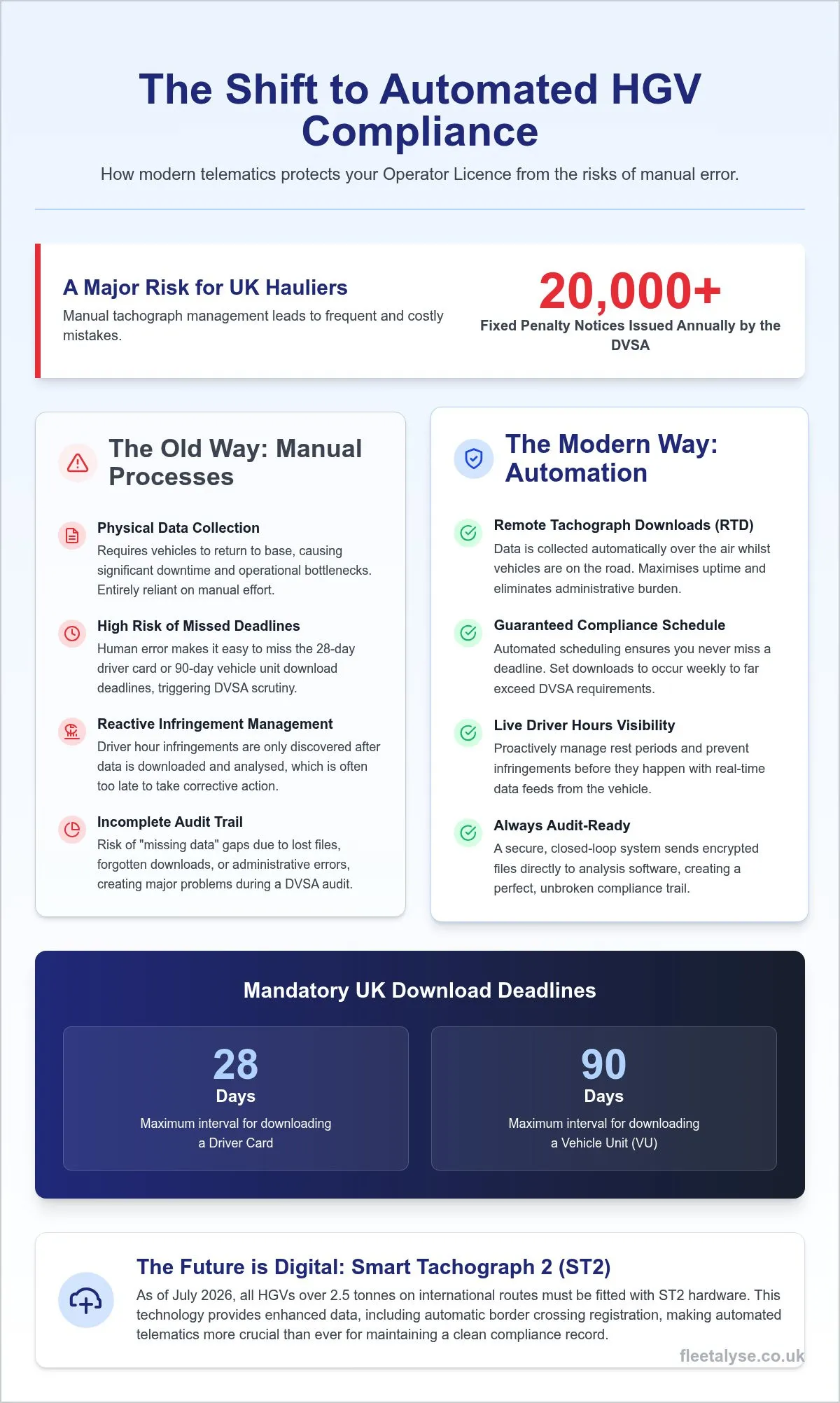
The DVSA issues over 20,000 fixed penalty notices for tachograph offences every year, a figure that highlights the constant pressure on UK hauliers to maintain perfect records. You already know that manual tachograph downloads are a drain on your resources. Taking a vehicle off the road just to retrieve data is inefficient, and the constant worry about missing a 28-day deadline or facing a surprise DVSA audit can keep even the most experienced transport manager awake at night. Relying on manual processes in 2026 isn't just slow; it's a significant risk to your Operator Licence.
Implementing modern telematics for HGV compliance transforms this administrative burden into a streamlined, automated process. This guide shows you how to secure your fleet with remote data collection and real-time visibility of driver hours, ensuring you're always audit-ready without lifting a finger. We'll explore the shift to Smart Tachograph 2, the practical benefits of automation, and how to build a robust compliance trail that protects your business from costly infringements.
Key Takeaways
- Automate data collection to meet DVSA standards and protect your Operator Licence from the risks of manual error.
- Understand how remote tachograph downloads eliminate the need to bring vehicles back to base just for data retrieval.
- Identify the hidden operational costs of manual administration and how telematics for HGV compliance provides a clear return on investment.
- Gain real-time visibility of live driver hours to prevent infringements and manage rest periods more effectively.
- Learn how to integrate telematics hardware with your tachograph analysis software for a seamless, audit-ready compliance trail.
The HGV Compliance Landscape: Why Telematics is Essential in 2026
For years, fleet managers viewed GPS tracking primarily as a security measure. It was a tool for recovering stolen assets or monitoring fuel usage. In 2026, the focus has shifted. Using telematics for HGV compliance is now a regulatory necessity rather than an optional extra. The DVSA has moved decisively towards digital record-keeping, and the margin for error has vanished. If you aren't using technology to manage your data, you're leaving your business vulnerable to unnecessary scrutiny. Whilst many providers focus on security, Fleetalyse prioritises the regulatory demands of regional hauliers.
Holding a UK Operator Licence carries heavy responsibilities. You must ensure driver cards are downloaded at least every 28 days and vehicle units every 90 days. Relying on drivers to remember these dates or bringing trucks back to the yard for a manual download creates a massive operational bottleneck. Human error is inevitable in manual systems. A single missed deadline or an unrecorded infringement can trigger a chain of events that threatens your right to operate. The DVSA now expects operators to have robust, proactive systems in place to catch these issues before they become systemic failures.
The Consequences of Non-Compliance
Driver hour infringements do more than just attract graduated fixed penalties. They damage your company's reputation with the Traffic Commissioner. If the DVSA identifies failures during an audit, you could be called to a Public Inquiry. This is a formal hearing where your professional competence is questioned. The HGV Operator Licence (O-Licence) is the lifeblood of a transport business. Losing it means your fleet stops moving, and your contracts disappear overnight. A poor compliance score also makes it harder to secure work with Tier 1 contractors who demand high safety standards.
Moving Beyond Manual Logbooks
Manual download systems are notoriously inefficient. They require physical access to the vehicle, taking it off the road and wasting valuable driving time. This creates constant "compliance anxiety" for fleet managers who must chase drivers for their cards. By July 2026, the regulatory landscape has tightened further. All vehicles over 2.5 tonnes used for international transport must be fitted with a Smart Tachograph Version 2 (ST2). This hardware provides more data than ever before, including automatic border crossing registration and enhanced position logging.
Understanding The Mechanics of a Tachograph helps you appreciate why automation is vital. Modern telematics for HGV compliance removes the manual element entirely. It pulls data directly from the ST2 unit and driver card whilst the vehicle is still on the road. This digital transformation ensures you never miss a download deadline. It provides a clean, transparent data trail that satisfies DVSA standards and allows you to focus on your core operations rather than chasing paperwork.
The Mechanics of Automation: Remote Tachograph Downloads and Live Data
Automation relies on a seamless link between the vehicle's digital tachograph head and your office. A small telematics device is installed behind the dashboard, connecting directly to the tachograph's data ports. This hardware doesn't just record GPS coordinates. It acts as a digital reader, pulling raw data files directly from the vehicle unit (VU) and the inserted driver card. The process is silent and happens in the background without any input from the driver.
Security and authentication are managed through a "remote company card" system. In a traditional setup, you'd need to physically insert your company card into the truck to authorise a download. With modern telematics for HGV compliance, your company card sits in a secure card reader at your office or a dedicated server centre. When a download is triggered, the server creates a secure bridge between your card and the vehicle via the GSM network. This ensures every data transfer is fully authenticated and legally compliant.
Remote Tachograph Download (RTD) Explained
The primary benefit of RTD is the elimination of vehicle downtime. Data is pulled over the mobile network whilst the vehicle is out on the road. You can automate the entire schedule to ensure you never miss a deadline. Most operators choose to download driver cards every week and vehicle units every month, far exceeding the mandatory 28-day and 90-day requirements. Once the encrypted files are retrieved, they are sent directly to your chosen analysis software for instant reporting. This closed-loop system removes the risk of "missing data" gaps that often plague manual collections.
Monitoring Live Driver Hours
There is a critical distinction between historical data and live visibility. Historical downloads show you infringements after they have already happened. Live data gives you the power to prevent them. By viewing real-time status updates, transport managers can see exactly how much driving time a driver has left before a break is required. This is essential for adhering to UK government drivers' hours rules, especially during busy periods or unforeseen traffic delays.
This level of insight transforms how you plan your routes. Instead of guessing, you can assign loads based on actual remaining hours. If a driver only has two hours of driving time left, you won't accidentally send them on a three-hour run. You can view our compliance solutions to see how live data can simplify your daily dispatching and keep your fleet within legal limits.
Analysing the ROI: Automated Telematics vs. Manual Administration
Investing in telematics for HGV compliance is often viewed as an overhead. In reality, it functions as a profit centre. Manual administration creates a massive, hidden drain on your balance sheet. Every time a driver stops to manually download a card, your earning potential drops. Automation shifts this dynamic by removing the human element from data retrieval, ensuring your fleet stays productive whilst your records remain perfect.
Manual data collection is inherently prone to gaps. Missing just one 28-day download deadline can lead to DVSA graduated fixed penalties ranging from £50 to £300 per offence. These costs accumulate quickly across a fleet of any size. Using telematics for HGV compliance ensures your records are always accurate and complete. By following European tachograph regulations, which now encompass lighter vehicles for international transport, the scope for administrative error has widened significantly. Automation removes this financial risk entirely.
The Cost of Vehicle Downtime
Returning to base for a 15-minute manual download is never just 15 minutes. It involves route deviation, fuel consumption, and wasted driver hours. When you factor in the opportunity cost of the vehicle not being under load, a single manual download can easily cost £50 in lost productivity. Remote downloads allow your assets to stay on the road, earning revenue whilst the data is pulled silently in the background. This shift also improves driver retention. Drivers want to drive. They don't want to spend their breaks or shift ends wrestling with card readers and office paperwork. Reducing this hassle makes your operation a more attractive place to work.
Audit-Readiness as a Business Asset
A robust, automated data trail is a powerful business asset. It simplifies the application for the DVSA Earned Recognition scheme, which marks you as an exemplary operator. This status often leads to fewer roadside stops and prioritisation for lucrative contracts. Insurance providers also favour fleets with clean compliance records, often offering lower premiums to operators who can prove their adherence to driver hours rules. You can find transparent pricing for these essential tools at Fleetalyse, where the focus is on providing value for regional hauliers without hidden complexities or unnecessary features.
Implementation Strategy: Integrating Telematics into Your Operation
Successful implementation starts with matching hardware to your specific fleet requirements. Heavy goods vehicles need units that interface directly with the digital tachograph head. Vans and trailers require dedicated asset tracking to ensure visibility across the entire operation. Effective use of telematics for HGV compliance depends on this initial hardware choice. It's not just about tracking a location; it's about capturing the right data streams for your analysis software.
Setting up automated alerts is the next logical step. These notifications act as an early warning system. They inform transport managers of upcoming download deadlines or potential driver hour infringements before they escalate. When your system is configured correctly, it moves from a passive recording device to an active management tool. This proactive approach is exactly what the DVSA looks for during a roadside stop or a full office audit.
Choosing the Right Compliance Partner
Hauliers should look for a specialist partner rather than a generic global provider. Generic GPS services often prioritise security and theft recovery, neglecting the granular detail required for a DVSA audit. A pragmatic partner focuses on the regulatory adherence of regional fleets. Transparency is vital. You need upfront costs and clear contractual terms without hidden clauses. Fleetalyse specialises in remote tachograph downloads and live driver hours, providing the specific tools needed for UK infrastructure and regulations.
The Integration Process
The transition to an automated system must be seamless. Your telematics data should bridge directly with your existing tachograph analysis software. This eliminates manual data entry and ensures your compliance trail is always current. Security is equally important. All driver records must be handled with strict GDPR compliance to protect sensitive personal data. Once installed, test the system across several cycles to ensure a 100% download success rate. This verification step is crucial for maintaining a robust, audit-ready record.
Training your staff is the final piece of the puzzle. When drivers understand that the system protects their licence as much as the company's, adoption becomes much smoother. Clear communication regarding how the data is used helps build trust and improves overall driving standards. You can get started with our compliance hardware today to begin your transition to an automated, audit-ready fleet.
Fleetalyse: Precision Compliance for the Modern UK Haulier
Fleetalyse is a UK-based specialist that understands the logistical realities of regional haulage. We don't provide generic, global software; we deliver a pragmatic telematics for HGV compliance solution built for the specific demands of the UK transport industry. Since 2020, our focus has remained on providing operational clarity and transparency. We help operators secure their O-Licence by removing the complexities of data management and replacing them with automated, reliable systems.
Our primary service, the Remote Tachograph Download, is designed to eliminate the administrative burden discussed in previous sections. It pulls data directly from the vehicle whilst it remains on the road, ensuring you never miss a 28-day or 90-day deadline. For dispatchers, our Live Driver Hours feature provides real-time visibility into remaining drive time. This allows for precise load planning and ensures that infringements are prevented before they occur, rather than being identified weeks later during analysis.
A Comprehensive Suite for Transport Operators
Managing a fleet requires visibility across all assets. Fleetalyse provides a single, unified platform for HGV, van, and trailer tracking. This consolidated approach allows you to monitor your entire operation from one dashboard, improving both compliance and asset security. Our hardware integrates directly with leading tachograph analysis tools. This ensures that once your data is downloaded, it moves seamlessly into your reporting system without manual intervention. Our trailer tracking and asset tracking solutions provide the same level of reliability, ensuring that every part of your fleet is accounted for and protected.
Why Fleetalyse is the Preferred Choice
We take a benefit-first approach to fleet management. We know that transport managers don't need flashy, unnecessary features; they need functional utility and honest pricing. Fleetalyse offers vehicle tracking from £5.99 per device per month (inc VAT) and trailer tracking on that same per-device pricing. This upfront transparency is a core part of our commitment to fairness. You get UK-based support and a partner that understands the rigours of the road. Using telematics for HGV compliance shouldn't be a source of stress. It should be a reliable tool that gives you back your time and protects your business's future.
See our published Fleetalyse pricing — from £5.99 per device per month inc VAT and see how we can simplify your compliance journey.
Secure Your Fleet's Future with Automated Compliance
The shift towards digital enforcement is no longer a future prediction; it's the current reality for every UK haulier. Moving away from manual tachograph downloads isn't just about saving administrative time. It's about building a robust, error-free compliance trail that stands up to intense DVSA scrutiny. By integrating telematics for HGV compliance, you eliminate the risk of missing critical 28-day deadlines and ensure your assets remain on the road earning revenue. This proactive approach turns compliance from a logistical headache into a competitive business advantage.
Fleetalyse provides the pragmatic, specialist tools needed to manage this transition with confidence. Our system offers automated remote tachograph downloads and live visibility of driver hours, backed by specialist UK-based compliance support. You gain the operational clarity required to protect your Operator Licence whilst reducing the daily pressure on your transport office. Take the first step towards a more efficient, audit-ready operation today. Your business deserves the reliability of a partner that understands the rigours of the British road network.
Optimise your fleet compliance with Fleetalyse
Frequently Asked Questions
What is the difference between fleet tracking and HGV compliance telematics?
Fleet tracking primarily monitors the GPS location and speed of a vehicle. In contrast, telematics for HGV compliance connects directly to the vehicle's tachograph head to retrieve legal data. Whilst tracking helps with logistics, compliance telematics focuses on regulatory adherence. It provides the specific files needed for DVSA audits and offers real-time visibility into driver hours, rest periods, and shift patterns.
How often do I need to download HGV tachograph data in 2026?
Legally, you must download driver card data at least every 28 days and vehicle unit data at least every 90 days. Many operators choose to automate this process to occur weekly. This ensures that any infringements are identified quickly and data gaps are avoided. As of July 2026, these requirements also apply to lighter commercial vehicles over 2.5 tonnes used for international transport.
Can telematics help me achieve DVSA Earned Recognition?
Yes, using automated telematics is a major advantage when applying for Earned Recognition. The scheme requires operators to prove they have robust systems for monitoring driver hours and vehicle maintenance. Telematics provides a transparent, digital data trail that replaces manual spreadsheets. This verifiable evidence demonstrates to the DVSA that you are consistently meeting the required safety standards without the need for frequent roadside stops.
Do remote tachograph downloads require the vehicle to be stationary?
No, remote downloads work whilst the vehicle is out on the road. The system uses the GSM network to transfer data silently in the background. This means your drivers don't need to stop or return to the depot specifically for data retrieval. It eliminates vehicle downtime and ensures that compliance data is collected regardless of where the vehicle is located within the UK or Europe.
Is live driver hours monitoring legal under UK GDPR?
Monitoring live driver hours is legal and is often a requirement for meeting your "legal obligation" as a transport operator. Under UK GDPR, you must process this data to ensure road safety and adherence to transport regulations. You should include this in your company's privacy policy. It's vital to explain to staff that the data is used specifically for regulatory compliance and operational safety.
What happens if a remote tachograph download fails?
If a download fails due to a poor mobile signal, the system will automatically retry the connection at the next available opportunity. Most professional platforms will trigger an alert for the transport manager if a download remains outstanding for more than a few days. This provides an early warning to investigate technical issues or perform a manual download before the legal deadline is missed.
Do I still need a physical company card for remote downloads?
You still require a physical company card, but it stays in your office rather than being taken to the vehicle. The card is placed in a secure card reader connected to your computer or a server. The telematics for HGV compliance hardware then creates a secure digital link between the truck and the card to authorise the download. This allows you to manage your entire fleet centrally.
How much does HGV compliance telematics typically cost per vehicle?
Pricing for compliance telematics is usually based on a monthly subscription per asset. Fleetalyse offers vehicle tracking from £5.99 per device per month inc VAT, with trailers priced on the same per-device basis. These rates provide a clear return on investment by reducing administrative labour and preventing costly DVSA fines. Choosing a specialist UK provider ensures you receive pragmatic support without paying for unnecessary, non-compliant features.
Frequently asked questions
What is the difference between fleet tracking and HGV compliance telematics?
Fleet tracking primarily monitors the GPS location and speed of a vehicle. In contrast, telematics for HGV compliance connects directly to the vehicle's tachograph head to retrieve legal data. Whilst tracking helps with logistics, compliance telematics focuses on regulatory adherence. It provides the specific files needed for DVSA audits and offers real-time visibility into driver hours, rest periods, and shift patterns.
How often do I need to download HGV tachograph data in 2026?
Legally, you must download driver card data at least every 28 days and vehicle unit data at least every 90 days. Many operators choose to automate this process to occur weekly. This ensures that any infringements are identified quickly and data gaps are avoided. As of July 2026, these requirements also apply to lighter commercial vehicles over 2.5 tonnes used for international transport.
Can telematics help me achieve DVSA Earned Recognition?
Yes, using automated telematics is a major advantage when applying for Earned Recognition. The scheme requires operators to prove they have robust systems for monitoring driver hours and vehicle maintenance. Telematics provides a transparent, digital data trail that replaces manual spreadsheets. This verifiable evidence demonstrates to the DVSA that you are consistently meeting the required safety standards without the need for frequent roadside stops.
Do remote tachograph downloads require the vehicle to be stationary?
No, remote downloads work whilst the vehicle is out on the road. The system uses the GSM network to transfer data silently in the background. This means your drivers don't need to stop or return to the depot specifically for data retrieval. It eliminates vehicle downtime and ensures that compliance data is collected regardless of where the vehicle is located within the UK or Europe.
Is live driver hours monitoring legal under UK GDPR?
Monitoring live driver hours is legal and is often a requirement for meeting your "legal obligation" as a transport operator. Under UK GDPR, you must process this data to ensure road safety and adherence to transport regulations. You should include this in your company's privacy policy. It's vital to explain to staff that the data is used specifically for regulatory compliance and operational safety.
What happens if a remote tachograph download fails?
If a download fails due to a poor mobile signal, the system will automatically retry the connection at the next available opportunity. Most professional platforms will trigger an alert for the transport manager if a download remains outstanding for more than a few days. This provides an early warning to investigate technical issues or perform a manual download before the legal deadline is missed.
Do I still need a physical company card for remote downloads?
You still require a physical company card, but it stays in your office rather than being taken to the vehicle. The card is placed in a secure card reader connected to your computer or a server. The telematics for HGV compliance hardware then creates a secure digital link between the truck and the card to authorise the download. This allows you to manage your entire fleet centrally.
How much does HGV compliance telematics typically cost per vehicle?
Pricing for compliance telematics is usually based on a monthly subscription per asset. Fleetalyse offers vehicle tracking from £5.99 per device per month inc VAT, with trailers priced on the same per-device basis. These rates provide a clear return on investment by reducing administrative labour and preventing costly DVSA fines. Choosing a specialist UK provider ensures you receive pragmatic support without paying for unnecessary, non-compliant features.