

What is a fleet audit trail? A guide for operators

A fleet audit trail is a chronological, tamper-evident record of every operational and compliance event affecting your vehicles, drivers, and maintenance activities. It documents what happened, who performed each action, and precisely when it occurred. For UK fleet operators and compliance managers, this record is not optional paperwork. It is the primary evidence you present to the DVSA, Traffic Commissioners, and insurers when your operations come under scrutiny. Without a complete, defensible audit trail, even a mechanically sound and well-run fleet can face penalties, out-of-service orders, and licence jeopardy.
What is a fleet audit trail and what does it contain?
A fleet audit trail is defined as a complete, time-stamped, tamper-evident record spanning every inspection, defect, repair, and credential verification across your fleet. The word “trail” is deliberate. Each record links to the next, forming a chain of evidence rather than a pile of disconnected documents. This distinction matters enormously when a DVSA examiner or Traffic Commissioner asks you to reconstruct a sequence of events.
The core records that form a defensible audit trail include:
- Pre and post-trip Driver Vehicle Inspection Reports (DVIRs): These must capture the driver’s signature, any defects identified, and the mechanic’s certification that defects were resolved. The DVIR signature chain from driver to mechanic must be retained in full to prevent audit trail breaks.
- Maintenance and repair records: Every scheduled service, unscheduled repair, and parts replacement, each linked to the defect that triggered it.
- Hours of service and tachograph data: In the UK, digital tachograph records must be downloaded on time, stored securely for a minimum of 12 months, and retrievable for DVSA audits on demand.
- Driver credentials and qualification records: Licence checks, CPC certificates, and medical declarations, each with their own retention timelines.
- Drug and alcohol testing results, vehicle defect reports, and roadworthiness certificates: All with specific minimum retention periods defined by FMCSA and UK transport regulations.
Retention requirements vary by record type. Operators must organise driver qualifications, maintenance logs, hours of service records, and testing results separately, each held for its mandated period. Mixing these into a single unstructured folder is a common and costly mistake.
Pro Tip: Set calendar reminders or automated alerts for each record category’s retention deadline. Deleting records too early is treated the same as never having them.

How does a fleet audit trail differ from audit logs?
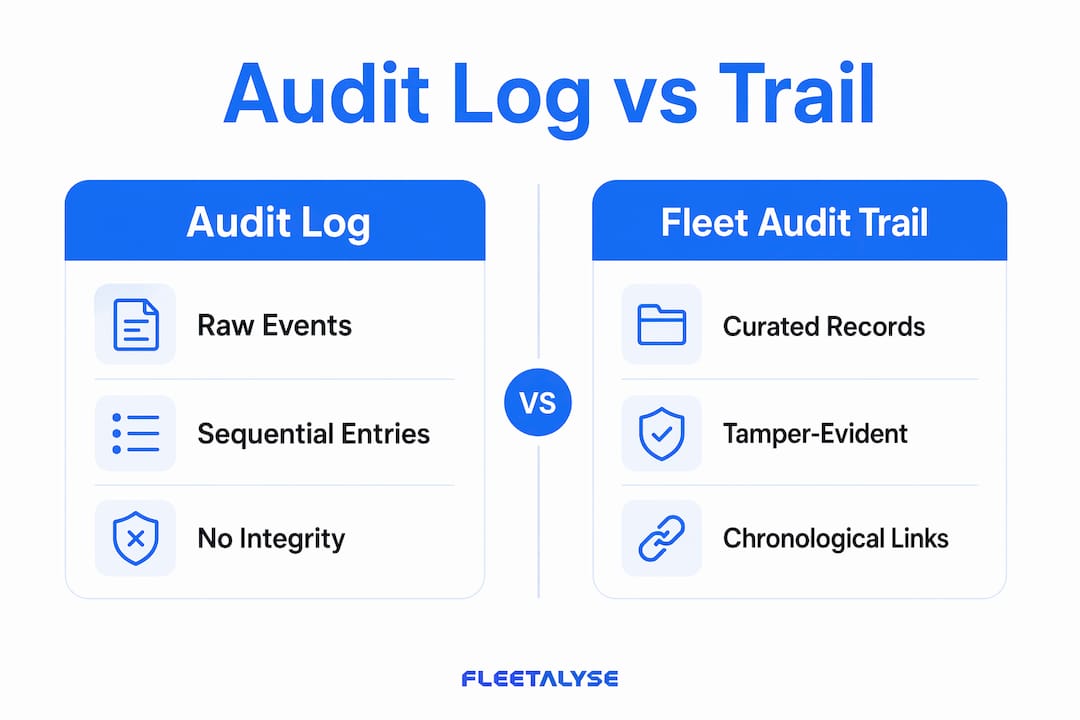
The terms “audit log” and “audit trail” are used interchangeably in many organisations, but they carry very different compliance weight. Understanding the distinction protects you from a false sense of security.
| Feature | Audit log | Fleet audit trail |
|---|---|---|
| Structure | Raw, sequential event entries | Curated, chronologically linked chain |
| Tamper evidence | Typically absent | Mandatory integrity controls |
| Regulatory acceptance | Not sufficient alone | Accepted as legal evidence |
| Completeness requirement | Captures system events | Must capture decisions and sign-offs |
| Audit defensibility | Low without additional controls | High when properly maintained |
An audit log records that something happened. An audit trail proves it happened, who authorised it, and that the record has not been altered since. Audit trails are end-to-end reconstructions with integrity controls, and this is precisely what regulators expect. Frameworks including HIPAA, SOX, and FDA regulations mandate audit trails with specific integrity characteristics that raw logs simply cannot satisfy.
For fleet compliance managers, this means your telematics platform or fleet management system must do more than store data. It must lock records against modification, timestamp entries at the point of creation, and link each event to the next in a verifiable sequence. Auditors expect a reconstructable record with integrity, not just internal system logs without tamper evidence.
Pro Tip: When evaluating fleet management software, ask the vendor specifically whether records are tamper-evident and whether the system produces a reconstructable event chain. A “yes” to data storage alone is not enough.
Why digital fleet audit trails matter more than ever
Paper-based record-keeping has three failure points that digital systems eliminate entirely. Records get lost in transit between depots. Signatures are missed under time pressure. And when a DVSA examiner arrives unannounced, locating the correct documents across filing cabinets can take hours you do not have.
Missing or incomplete maintenance records can trigger severe violations and penalties regardless of the vehicle’s actual mechanical condition. This is a critical point. The DVSA does not only judge whether your vehicles are roadworthy. It judges whether you can prove they were maintained correctly. A vehicle in perfect condition with no paperwork trail is a compliance failure.
Digital audit trail systems address this directly through several capabilities:
- Automatic record chaining: Each inspection, defect report, and repair sign-off is linked automatically, with no manual filing required.
- GPS timestamping and photo evidence: Location data and images are attached at the point of capture, making records far harder to dispute.
- Cloud synchronisation: Records sync instantly, meaning depot managers and compliance officers see the same data in real time.
- Audit-ready reporting: Digital platforms generate audit-ready reports within minutes, compared to hours of manual document retrieval.
- Automated tachograph download workflows: Treating digital tachograph downloads as controlled workflows prevents the backlogs that consistently cause compliance failures during DVSA audits.
For HGV operators in particular, the integration of tachograph data with broader fleet audit records is where digital systems deliver the greatest compliance advantage. Fleetalyse’s HGV GPS trackers combine tachograph support with real-time tracking, giving compliance managers a single source of truth for driver hours, location history, and vehicle activity.
How to implement an effective fleet audit trail process
Building an audit-ready fleet is a process, not a one-time project. The following steps reflect best practice for UK operators managing mixed fleets under DVSA and Operator Licence requirements.
-
Define your record categories and retention periods. List every record type your fleet generates: DVIRs, maintenance logs, tachograph data, driver credentials, and defect reports. Assign each a retention period based on current UK transport regulations and FMCSA guidance where applicable.
-
Implement a structured inspection workflow. Every pre and post-trip inspection must follow a consistent format. DVIRs require the full signature chain from driver to mechanic. A missed signature breaks the audit trail at that point, and the entire chain must be intact to withstand regulatory scrutiny.
-
Link defects to resolution actions. Storing a defect report and a repair invoice as separate documents is not sufficient. Compliance depends on demonstrating the full repair and defect resolution workflow with sign-offs. Your system must connect the defect identification to the repair action and the subsequent clearance sign-off as a single process chain.
-
Automate tachograph downloads and storage. In the UK, tachograph data must be downloaded at defined intervals and stored securely. Manual download processes create gaps. Automated systems connected to your vehicles remove the human error factor entirely.
-
Conduct internal audit reviews quarterly. Do not wait for a DVSA visit to discover gaps. A quarterly internal review of record completeness, retention compliance, and signature chain integrity gives you time to correct issues before they become enforcement actions.
-
Centralise storage with access controls. Records stored across multiple systems, email inboxes, and physical folders cannot be retrieved quickly under audit pressure. A centralised digital platform with role-based access means the right people can retrieve any record within minutes.
-
Train drivers and depot staff on their role in the audit trail. The most sophisticated system fails if drivers skip DVIR signatures or mechanics close defects without proper sign-off. Regular, brief training sessions on why each step matters reduce compliance gaps at the human level.
The Fleetalyse compliance platform supports each of these steps through automated telematics data capture, remote tachograph downloads, and centralised record management designed specifically for UK transport operators.
Key takeaways
A fleet audit trail is only as strong as its weakest link. One unsigned DVIR or a missed tachograph download can unravel an otherwise compliant record.
| Point | Details |
|---|---|
| Definition matters | A fleet audit trail is a tamper-evident, chronologically linked record chain, not a document collection. |
| Logs are not trails | Raw audit logs lack the integrity controls regulators require; only verified audit trails serve as legal evidence. |
| Digital systems are necessary | Paper records fail under audit pressure; digital platforms automate chaining, timestamping, and retrieval. |
| Defect resolution must be linked | Storing defect reports and repairs separately breaks the process chain and weakens compliance defensibility. |
| Retention is non-negotiable | Each record category carries a specific minimum retention period; early deletion is treated as non-compliance. |
The audit trail gap most operators don’t see coming
I have worked with fleet operators who genuinely believed their compliance was solid. They had maintenance records. They had tachograph downloads. They had signed DVIRs. What they did not have was a connected chain. The defect report from Tuesday referenced a vehicle registration. The repair invoice from Thursday referenced a job number. The DVSA examiner could not link the two without a manual cross-reference that took the operator two hours to produce under pressure.
That is the gap most operators miss. It is not about having records. It is about having records that speak to each other. The moment you have to manually explain the connection between two documents, you have already weakened your audit position.
The other pattern I see consistently is tachograph download backlogs. Operators know downloads are required. They intend to do them. Then a busy period hits, a driver changes vehicles, and suddenly there are six weeks of missing data. The DVSA does not accept “we were busy” as a defence. Automated download workflows are not a luxury for large fleets. They are the only reliable way to prevent this specific failure mode.
My honest advice: treat your audit trail as a live operational asset, not an administrative task. Review it monthly, not annually. The operators who do this rarely face enforcement surprises.
— Vytautas
How Fleetalyse helps you maintain a complete audit trail
Fleetalyse is built for UK fleet operators who need more than dots on a map. The platform combines GPS vehicle tracking, smart dashcams, and remote tachograph downloads into a single compliance-focused system. Every vehicle event is automatically timestamped, location-tagged, and stored in a tamper-evident record that is retrievable within minutes. For HGV operators, the asset and trailer GPS trackers extend audit trail coverage to every asset in your fleet, not just powered vehicles. Whether you are preparing for a DVSA visit or managing day-to-day Operator Licence requirements, Fleetalyse gives your compliance team the audit-ready records they need, without the administrative burden of manual filing.
FAQ
What is a fleet audit trail in simple terms?
A fleet audit trail is a chronological, tamper-evident record of every compliance and operational event in your fleet, including inspections, repairs, driver hours, and credentials. It proves what happened, who did it, and when, in a format regulators accept as legal evidence.
How long must fleet audit trail records be kept in the UK?
Retention periods vary by record type. Digital tachograph records must be stored for a minimum of 12 months and be retrievable for DVSA audits on demand. Driver qualification and maintenance records carry their own specific retention requirements under UK transport regulations.
What is the difference between an audit log and an audit trail?
An audit log records raw system events without integrity controls. An audit trail is a curated, tamper-evident reconstruction that links events in a verifiable chain, which is the standard regulators and courts require as legal evidence.
Can paper records satisfy a fleet audit trail requirement?
Paper records are legally permissible in some contexts, but they carry significant practical risk. They are easily lost, difficult to retrieve under audit pressure, and cannot provide the automatic chaining and timestamping that digital systems offer. Most UK compliance advisers recommend digital records as the only reliable approach for modern fleet operations.
What happens if your fleet audit trail has gaps?
Incomplete or missing records can trigger DVSA enforcement actions including fines, out-of-service orders, and elevated risk scores, regardless of the vehicle’s actual mechanical condition. A gap in the DVIR signature chain or a missed tachograph download is treated as a compliance failure in its own right.