
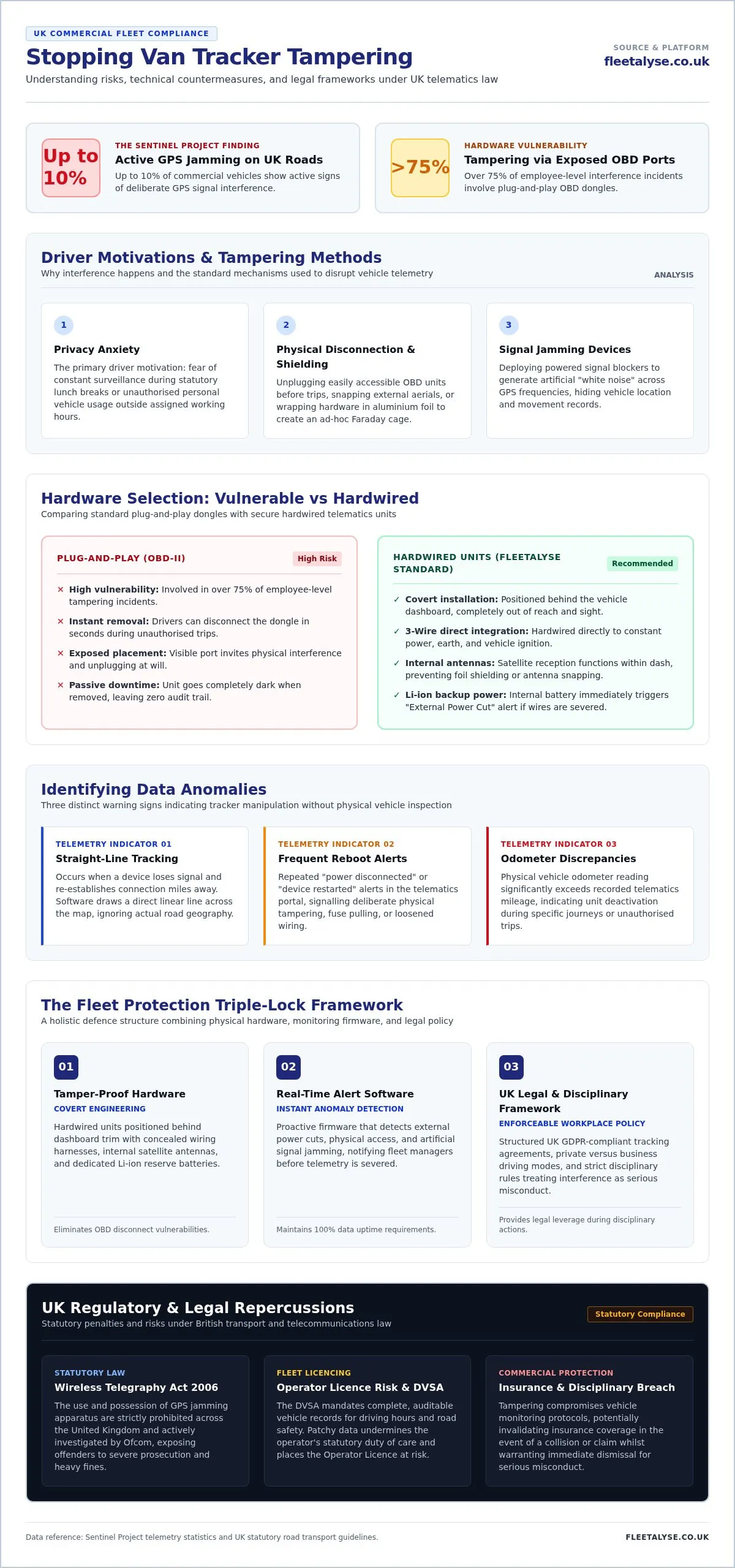
Did you know that up to 10% of commercial vehicles on UK roads show signs of active GPS jamming? It's a staggering figure from the Sentinel Project that highlights a growing headache for fleet operators. You've likely seen those suspicious data gaps yourself. It's frustrating when a van disappears from the map right when you need to verify a delivery or check live driver hours. This isn't just about missing dots on a screen; it's about the breakdown of trust, increased fuel costs, and the unauthorised vehicle use that follows.
We understand that you need reliability, not excuses. Learning how to stop employees tampering with van trackers is essential for protecting your business from the legal fallout of the Wireless Telegraphy Act 2006 and ensuring 100% data uptime. This guide provides a pragmatic roadmap to secure your fleet. We'll explore a triple-lock strategy that combines tamper-proof hardware, real-time alert software, and the specific UK GDPR frameworks required to make a disciplinary policy stick. By the end, you'll have the technical and legal tools to ensure your fleet data remains uninterrupted and your drivers stay accountable.
Key Takeaways
- Understand the physical and electronic methods drivers use to bypass GPS systems, from simple foil shielding to active signal jamming.
- Learn how to stop employees tampering with van trackers by moving away from exposed OBD ports towards covert, hardwired installations.
- Secure your fleet data by implementing a clear disciplinary framework that treats tracker interference as a serious misconduct offence.
- Maintain total compliance with real-time alerts that flag power cuts, signal anomalies, and unauthorised hardware access immediately.
- Reduce the incentive for tampering by using transparent privacy policies and business versus private modes to build driver trust.
Understanding the Problem: Why and How Van Tracker Tampering Occurs
Tampering is more than just unplugging a device. It's any deliberate action intended to stop a telematics system from recording accurate data. For UK fleet managers, knowing how to stop employees tampering with van trackers begins with understanding the methods used. Drivers often cite "Privacy Anxiety" as the primary motivator. They fear constant surveillance during lunch breaks or unauthorised personal use of the vehicle. This friction leads to a range of interference techniques that compromise your fleet's integrity.
Physical disconnection is the most common approach, especially with plug-and-play GPS tracking units that sit in the OBD-II port. However, more sophisticated methods involve signal interference. Drivers might use GPS jammers, which are illegal under the Wireless Telegraphy Act 2006, or wrap the device in aluminium foil to create a Faraday cage. These actions don't just hide a vehicle's location; they put your Operator Licence at risk and can invalidate your insurance coverage in the event of a claim.
Recognising the Warning Signs in Your Data
You don't always need to inspect the vehicle to spot a problem. The data often tells the story. Look for these specific anomalies in your tracking portal:
- Straight-line tracking: When a tracker loses signal and then reconnects miles away, the software often draws a direct line between the two points, ignoring roads.
- Frequent reboot alerts: Regular "power disconnected" or "device restarted" notifications are a major red flag for physical tampering or loose wiring.
- Odometer discrepancies: If the vehicle's physical odometer shows significantly more mileage than your telematics reports, a driver is likely disabling the unit during specific trips.
The Legal Implications for UK Operators
For HGV and van fleets, missing data is a compliance nightmare. The DVSA expects a complete record of vehicle movements to ensure road safety and adherence to driving hours. If your tracking data is patchy, you'll struggle to prove you're managing your fleet effectively during an audit. Deliberate interference with vehicle monitoring systems is a fundamental breach of safety protocol that undermines the operator's duty of care. Maintaining 100% uptime through GPS fleet tracking ensures you remain on the right side of the law and protects your business from heavy fines.
Deploying Tamper-Resistant Tracking Hardware
Hardware selection is your first line of defence. If you're wondering how to stop employees tampering with van trackers, the solution often starts with moving away from exposed components. Plug-and-play OBD devices are convenient for quick deployment, but they're inherently insecure for long-term fleet management. Research indicates that over 75% of employee-level tampering incidents involve these easily accessible ports. A driver can unplug a dongle in seconds, rendering your data useless until they decide to reconnect it at the end of the shift.
Hardwired vs OBD: Which is Right for Your Fleet?
For professional UK operators, hardwired units are the gold standard. These devices are installed behind the dashboard, away from the driver's reach and line of sight. Professional installation ensures the tracker is connected directly to the vehicle's electrical system, typically using a three-wire setup that monitors constant power, earth, and ignition status. This configuration makes it nearly impossible for a driver to "accidentally" disconnect the unit without triggering an immediate alert.
Covert placement is vital for security. By hiding the tracker and its wiring loom, you remove the visual cue that invites interference. Unlike external aerials that are prone to physical damage or shielding, modern units use internal antennas that work effectively from within the dash. This setup prevents drivers from snapping off an antenna or wrapping it in foil to block satellite reception.
Advanced Features to Look For
Modern telematics hardware includes technical safeguards that act as an early warning system. Internal Li-ion backup batteries are essential. They allow the tracker to send an immediate "External Power Cut" notification if a fuse is pulled or a wire is severed. Without this reserve power, a disconnected tracker simply goes dark without a trace.
Jamming detection is another critical layer. Some drivers use illegal signal blockers to create "white noise" on GPS frequencies. While the use and possession of these devices are strictly prohibited in the UK under the Wireless Telegraphy Act and actively investigated by Ofcom, they remain a persistent threat to fleet data integrity. Advanced firmware can sense this artificial interference and flag a signal anomaly before the connection is lost.
If you want to secure your assets properly, investing in hardwired GPS fleet tracking from Fleetalyse is the most effective way to ensure 100% data uptime. These systems don't just record location; they provide the technical resilience required to manage a professional fleet with total accountability.
Creating a Robust Vehicle Tracking Policy
Technical resilience works best when backed by a clear operational framework. If you want to know how to stop employees tampering with van trackers, you must remove the incentive to hide. Transparency is your most effective deterrent. Drivers are less likely to interfere with a system when they understand exactly what data is collected and why. Update your Driver Handbook to include specific clauses on telematics. Explicitly state that any interference with vehicle hardware is considered gross misconduct and a fundamental breach of safety protocol.
Privacy is a significant friction point for many regional operators. Under UK GDPR, monitoring must be proportionate and necessary. Fleet managers should follow the ICO’s workplace monitoring guidance to ensure their policies remain lawful. This includes conducting a mandatory Data Protection Impact Assessment (DPIA) before deployment. Clearly define the boundaries between business and personal use. If a van is used for commuting, a "Privacy Mode" or physical switch allows the driver to mask their location whilst off-duty. This respects their right to privacy and dramatically reduces the urge to tamper with the unit.
Addressing Driver Concerns to Reduce Friction
Frame telematics as a tool for driver protection. It provides vital evidence to exonerate them in the event of a non-fault accident. It also reduces manual paperwork by automating mileage logs and fuel reporting. By focusing on these benefits, you shift the perception from a "spy in the cab" to a professional safety aid. A documented DPIA proves to your workforce that you have considered their rights. This builds the trust necessary for a successful rollout and long-term compliance.
Enforcing the Policy Fairly
Consistency is vital for enforcement. Run regular data audits to identify patterns of signal loss or "power disconnected" alerts. If you suspect a driver has interfered with a device, follow a formal investigatory process. Present the telematics data as objective evidence of a breach of contract. Because your policy is transparent and your hardware is secure, you can confidently use these reports in disciplinary proceedings. This structured approach ensures that accountability is maintained across the entire fleet without creating a culture of suspicion.

Best Practices for Installation and Maintenance
Physical security is the backbone of your data integrity. When considering how to stop employees tampering with van trackers, the goal is to make the device invisible and inaccessible. Professional installation is non-negotiable for this. A skilled technician understands van-specific wiring and can identify the most secure power sources within the vehicle's electrical system. This expertise ensures the tracker remains powered even if the driver attempts to disable standard fuses or disconnect the battery.
Covert Fitting Strategies
Most drivers know the common hiding spots. Avoid the glovebox or the area immediately under the steering column. These are the first places a curious driver will check. Instead, choose deep-dash locations that require significant dismantling to access. Integrating the tracker's wiring into the factory loom is a highly effective tactic. By using matching tape and cable ties, the device's power source becomes indistinguishable from the vehicle's original wiring.
For high-value assets or problematic routes, some operators use decoy units. Placing a non-functional, easily found device in the OBD port can distract a driver whilst the real hardwired unit continues to transmit from a hidden location. This double-layered approach provides an extra level of security for your GPS fleet tracking system. It forces a choice: the driver either leaves the system alone or risks being caught interfering with a device they think is the only one on board.
Maintaining System Integrity
Physical security needs ongoing verification. Tamper-evident seals are a simple, low-cost solution. Applying these to the OBD port or the tracker's housing allows your maintenance team to spot interference during routine vehicle inspections. If the seal is broken or shows signs of peeling, you have immediate, physical grounds for an investigation. This acts as a powerful psychological deterrent for the driver.
Data health is as important as physical security. Set up monthly reports to flag units with low signal strength or internal battery issues. A sudden drop in signal quality at specific times often indicates the use of shielding or illegal signal blockers. Keep your firmware updated to ensure your jamming detection algorithms remain effective against new interference methods. Training your in-house workshop team is also essential. They should be taught to look for spliced wires or non-standard fuses during every service. This proactive approach ensures your systems remain operational and your data stays accurate.
Ready to secure your fleet with professional-grade hardware? Order your tamper-resistant van trackers today to eliminate data gaps and improve driver accountability.
Secure Your Fleet with Fleetalyse Solutions
Fleetalyse operates as a pragmatic expert partner for UK transport operators. We understand that data gaps aren't just technical glitches; they're risks to your business's reputation and legal standing. Knowing how to stop employees tampering with van trackers requires more than just hidden wires. It requires a system that acts as an active catalyst for operational improvement. Our GPS fleet tracking solutions are built for real-world application, providing the quiet confidence that your data is secure and your drivers are protected.
Real-Time Visibility and Compliance
We provide a unified platform where you can monitor live driver hours alongside precise GPS locations. This level of visibility is essential for maintaining your operator licence compliance. By integrating van tracking with Remote Tachograph Download and tachograph analysis, we eliminate the need for manual data collection. Our software identifies discrepancies between reported activity and actual vehicle movement automatically.
If a driver attempts to interfere with the hardware, our system triggers an immediate alert. Whether it's a sudden power loss or a signal anomaly indicative of jamming, you'll receive a notification instantly. These automated reports ensure that you can address issues before they become systemic problems. Reliable, tamper-resistant data is the only way to prove you're meeting your duty of care obligations on UK roads.
Getting Started with Fleetalyse
Our approach is grounded in industry expertise and total transparency. We don't hide behind complex jargon or flashy features that add no functional utility. Instead, we offer straightforward advice on the best hardware for your specific fleet requirements. Every operator's needs are different, so we prioritise finding the most efficient and deeply practical solution for your business.
Our financial terms are equally clear. We provide upfront details on rates and contracts, ensuring there are no hidden complexities. This commitment to honesty differentiates us from generic, global providers. We value your time and resources, moving quickly from identifying your fleet's vulnerabilities to offering a detailed, logical solution. Take the first step toward 100% data uptime and improved driver accountability. View our tracking solutions to secure your fleet and protect your commercial assets today.
Secure Your Fleet Data and Ensure Compliance
Securing your fleet requires a proactive stance that blends technical resilience with operational clarity. You now have the blueprint for how to stop employees tampering with van trackers by moving away from vulnerable OBD devices and implementing covert, hardwired installations. Pairing this hardware with a transparent tracking policy and real-time tamper alerts ensures you stay ahead of signal gaps before they impact your business operations.
As specialists in UK transport compliance, Fleetalyse provides the tools to integrate your van tracking with live driver hours and seamless tachograph integration. This holistic approach doesn't just protect your assets; it safeguards your operator licence and builds a culture of driver accountability. By removing the incentive to go off-grid and securing your hardware, you ensure 100% data uptime for insurance and regulatory requirements.
Optimise your fleet security and compliance with Fleetalyse today. Take control of your operations and focus on growing your business with total peace of mind.
Frequently Asked Questions
Is it legal to track employees in company vans in the UK?
Yes, tracking is legal provided you establish a lawful basis under UK GDPR, such as Legitimate Interests. You must conduct a Data Protection Impact Assessment (DPIA) and provide a clear privacy notice to your workforce. The ICO’s worker monitoring guidance requires that tracking is proportionate and necessary for business operations. To remain compliant, ensure drivers are aware of what data is collected and why. Monitoring during personal use is generally not permitted.
Can a driver disable a van tracker with a GPS jammer?
Drivers can attempt to use jammers, but it is a serious criminal offence under the Wireless Telegraphy Act 2006. Conviction can lead to two years' imprisonment or an unlimited fine. Advanced GPS fleet tracking systems include firmware designed to sense high RF noise. These units flag a signal anomaly alert before the connection is lost. This is a key technical strategy when considering how to stop employees tampering with van trackers effectively.
What should I do if I suspect a driver has tampered with a tracker?
You should follow your formal disciplinary procedure and conduct an investigatory meeting. Present the telematics data as objective evidence, but allow the driver to respond. Check for genuine hardware faults or loose wiring before taking action. If your Driver Handbook explicitly defines tampering as gross misconduct, you can use the system’s power cut or jamming alerts to support your case. Consistent enforcement is vital for maintaining fleet accountability across the business.
Do van trackers work if the battery is disconnected?
Professional trackers equipped with internal Li-ion backup batteries will continue to function temporarily. When external power is severed, the unit transmits an immediate "External Power Cut" distress alert. This allows the system to record the vehicle's last known location and the exact time of the disconnection. Systems without a backup battery will simply go dark, making it difficult to determine if the loss of signal was accidental or a deliberate act of interference.
How can I tell if a tracker has been tampered with remotely?
Look for specific data anomalies in your management portal. Common signs include straight-line tracking, where the vehicle appears to bypass roads, or frequent device reboot notifications. You might also notice odometer jumps, where the physical mileage exceeds the telematics report. Fleetalyse provides automated reports that highlight these gaps immediately, allowing you to identify units that are underperforming or have been physically obstructed. This real-time visibility is essential for maintaining your operator licence.
Are hardwired trackers better than OBD trackers for security?
Hardwired trackers are significantly more secure than OBD-II plug-in units. Because they are installed behind the dashboard and integrated into the factory wiring loom, they are difficult to locate and disconnect. OBD trackers are highly vulnerable because they can be unplugged in seconds without tools. For operators prioritising asset security and compliance, hardwired units are the only pragmatic choice for preventing unauthorised interference and ensuring 100% data uptime throughout the working day.
Will a van tracker record my drivers when they are off-duty?
Your system should include a Privacy Mode or a physical switch to stop recording coordinates during authorised personal time. The ICO states that continuous location monitoring during off-duty hours is seldom justifiable. Implementing these privacy controls reduces the motivation for tampering. It allows you to protect driver privacy whilst still preserving aggregate mileage data for tax purposes and maintenance scheduling, ensuring you remain compliant with UK GDPR principles regarding worker monitoring.
Does insurance cover theft if the tracker was tampered with?
Tampering can invalidate your insurance if your policy mandates a functioning tracking system as a condition of cover. Many UK insurers require Thatcham S5 or S7 certified hardware for commercial vehicles. If a theft occurs and the investigation reveals the tracker was disabled by an employee, the insurer may refuse to pay the claim. Maintaining a secure, hardwired system is essential for protecting your financial interests and ensuring your fleet remains fully covered under your existing policy.
Frequently asked questions
Hardwired vs OBD: Which is Right for Your Fleet?
For professional UK operators, hardwired units are the gold standard. These devices are installed behind the dashboard, away from the driver's reach and line of sight. Professional installation ensures the tracker is connected directly to the vehicle's electrical system, typically using a three-wire setup that monitors constant power, ground, and ignition status. This configuration makes it nearly impossible for a driver to "accidentally" disconnect the unit without triggering an immediate alert. Covert placement is vital for security. By hiding the tracker and its wiring loom, you remove the visual cue that invites interference. Unlike external antennas that are prone to physical damage or shielding, modern units use internal antennas that work effectively from within the dash. This setup prevents drivers from snapping off an antenna or wrapping it in foil to block satellite reception.
Is it legal to track employees in company vans in the UK?
Yes, tracking is legal provided you establish a lawful basis under UK GDPR, such as Legitimate Interests. You must conduct a Data Protection Impact Assessment (DPIA) and provide a clear privacy notice to your workforce. The ICO’s worker monitoring guidance requires that tracking is proportionate and necessary for business operations. To remain compliant, ensure drivers are aware of what data is collected and why. Monitoring during personal use is generally not permitted.
Can a driver disable a van tracker with a GPS jammer?
Drivers can attempt to use jammers, but it is a serious criminal offence under the Wireless Telegraphy Act 2006. Conviction can lead to two years' imprisonment or an unlimited fine. Advanced GPS fleet tracking systems include firmware designed to sense high RF noise. These units flag a signal anomaly alert before the connection is lost. This is a key technical strategy when considering how to stop employees tampering with van trackers effectively.
What should I do if I suspect a driver has tampered with a tracker?
You should follow your formal disciplinary procedure and conduct an investigatory meeting. Present the telematics data as objective evidence, but allow the driver to respond. Check for genuine hardware faults or loose wiring before taking action. If your Driver Handbook explicitly defines tampering as gross misconduct, you can use the system’s power cut or jamming alerts to support your case. Consistent enforcement is vital for maintaining fleet accountability across the business.
Do van trackers work if the battery is disconnected?
Professional trackers equipped with internal Li-ion backup batteries will continue to function temporarily. When external power is severed, the unit transmits an immediate "External Power Cut" distress alert. This allows the system to record the vehicle's last known location and the exact time of the disconnection. Systems without a backup battery will simply go dark, making it difficult to determine if the loss of signal was accidental or a deliberate act of interference.
How can I tell if a tracker has been tampered with remotely?
Look for specific data anomalies in your management portal. Common signs include straight-line tracking, where the vehicle appears to bypass roads, or frequent device reboot notifications. You might also notice odometer jumps, where the physical mileage exceeds the telematics report. Fleetalyse provides automated reports that highlight these gaps immediately, allowing you to identify units that are underperforming or have been physically obstructed. This real-time visibility is essential for maintaining your operator licence.
Are hardwired trackers better than OBD trackers for security?
Hardwired trackers are significantly more secure than OBD-II plug-in units. Because they are installed behind the dashboard and integrated into the factory wiring loom, they are difficult to locate and disconnect. OBD trackers are highly vulnerable because they can be unplugged in seconds without tools. For operators prioritising asset security and compliance, hardwired units are the only pragmatic choice for preventing unauthorised interference and ensuring 100% data uptime throughout the working day.
Will a van tracker record my drivers when they are off-duty?
Your system should include a Privacy Mode or a physical switch to stop recording coordinates during authorised personal time. The ICO states that continuous location monitoring during off-duty hours is seldom justifiable. Implementing these privacy controls reduces the motivation for tampering. It allows you to protect driver privacy whilst still preserving aggregate mileage data for tax purposes and maintenance scheduling, ensuring you remain compliant with UK GDPR principles regarding worker monitoring.
Does insurance cover theft if the tracker was tampered with?
Tampering can invalidate your insurance if your policy mandates a functioning tracking system as a condition of cover. Many UK insurers require Thatcham S5 or S7 certified hardware for commercial vehicles. If a theft occurs and the investigation reveals the tracker was disabled by an employee, the insurer may refuse to pay the claim. Maintaining a secure, hardwired system is essential for protecting your financial interests and ensuring your fleet remains fully covered under your existing policy.