
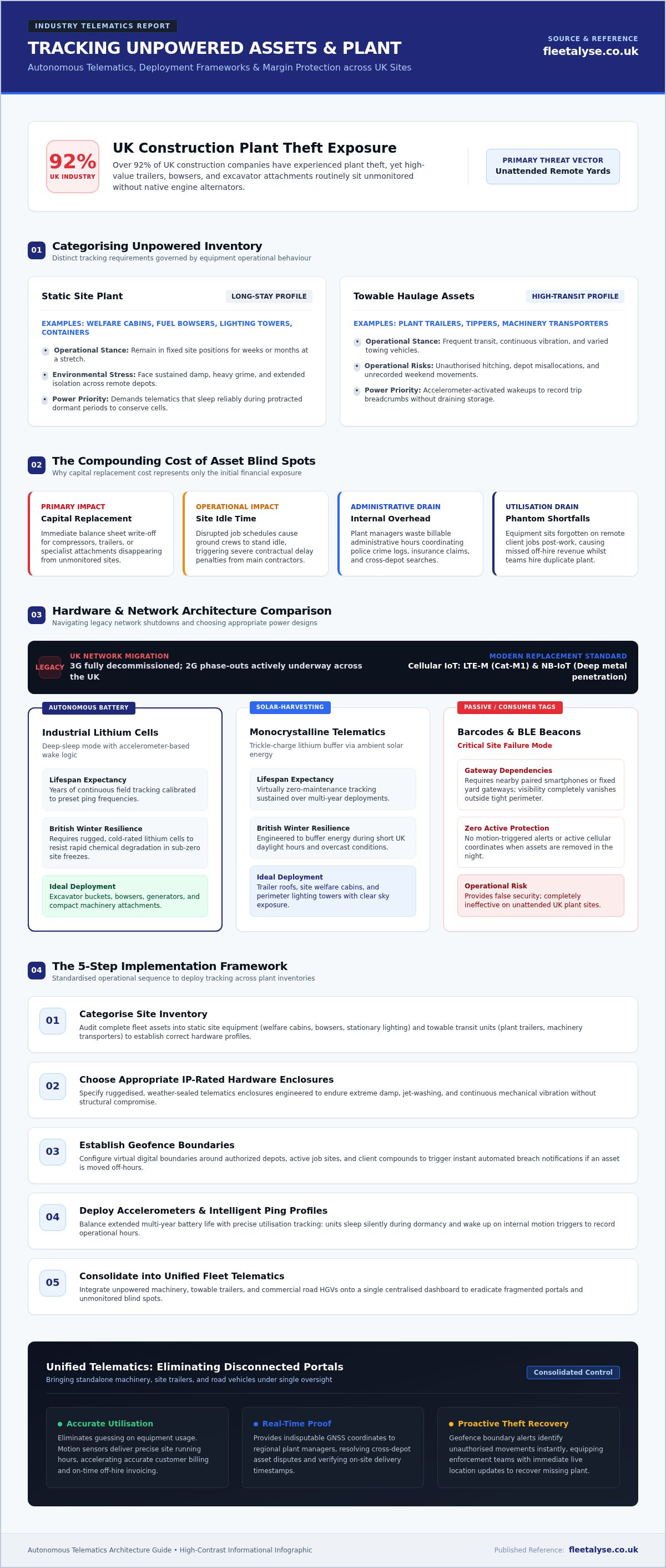
Over 92% of UK construction companies have experienced plant theft, yet high-value trailers, bowsers, and excavator attachments routinely sit unmonitored across remote yards. Cable-tied consumer beacons and passive tags will not stop equipment from disappearing in the night. Mastering how to track unpowered assets and plant demands rugged, purpose-built telematics engineered to survive brutal British weather without relying on an engine alternator.
You already know the headache of chasing idle flatbeds across depot locations, calling yard managers to confirm equipment drops, or discovering that a tracker battery died months ago. Juggling disconnected portals for powered vehicles and standalone machinery only compounds the problem. In this guide, you will discover how to monitor, protect, and manage unpowered site plant and trailers effectively across the UK. We break down autonomous power management, geofence security triggers, and unified fleet telematics to help you secure real-time visibility and accurate utilisation data across every operational site.
Key Takeaways
- Master how to track unpowered assets and plant using autonomous telematics hardware engineered specifically for machinery without an alternator or continuous power supply.
- Compare long-life lithium battery systems with solar-harvesting trackers to determine the ideal power architecture for your trailers, site bowsers, and welfare cabins.
- Follow a practical five-step rollout plan to categorise your site inventory, choose suitable IP-rated enclosures, and establish reliable geofence boundaries.
- Deploy accelerometer-based motion sensors and intelligent ping profiles to capture accurate utilisation hours whilst extending field battery life for years.
- Consolidate standalone site equipment, trailers, and commercial road vehicles into a unified telematics dashboard to eliminate disconnected software systems.
Understanding the Operational Demands of Unpowered Asset Tracking
Commercial road vehicles carry high-output alternators to keep telematics devices charged around the clock. Unpowered plant and site equipment enjoy no such luxury. From welfare units and towable generators to hydraulic breakers, excavator attachments, and flatbed trailers, these vital tools operate without a native electrical supply. Understanding how to track unpowered assets and plant begins with addressing this distinct operational reality. Barcodes and passive inspection labels fail completely here; they offer zero physical security once machinery sits isolated on an unattended UK job site or unmonitored yard.
Categorising Heavy Plant vs Towable Assets
Tracking requirements differ significantly depending on how equipment moves through your daily operations:
- Static site plant: Welfare cabins, fuel bowsers, lighting towers, and secure storage containers often remain in one position for weeks or months. These assets face sustained damp, heavy grime, and extended isolation, demanding hardware that sleeps reliably during long dormant periods.
- Towable haulage assets: Plant trailers, tippers, and machinery transporters experience frequent road transit, intense mechanical vibration, and changing towing vehicles across depot networks.
Deploying standalone machinery without purpose-built telematics asset tracking technologies leaves transport managers blind to unauthorised hitching, depot misallocations, and weekend site movements.
The Real Financial Cost of Asset Blind Spots
Asset blind spots rapidly erode operating margins. When an unpowered compressor, trailer, or specialist attachment disappears, the capital replacement cost is only the initial hit. Plant managers face idle ground crews, contractual delay penalties, and painful administrative hours handling police crime logs and insurance claims.
Asset under-utilisation presents an equally persistent drain on capital. Without central oversight, unpowered machinery sits forgotten on remote client jobs long after active work finishes. Plant hire desks miss out on billable off-hire revenue, whilst contractors needlessly hire duplicate units to fill imagined shortfalls. Gaining accurate oversight shows regional managers how to track unpowered assets and plant systematically, protecting margins through rugged asset tracking that delivers indisputable location proof.
Comparing Telematics Technologies for Assets Without Internal Power
Selecting the right hardware architecture determines whether an installation succeeds or fails. With UK mobile networks having fully decommissioned 3G and progressing through 2G phase-outs, modern standalone tracking relies on low-power cellular IoT: LTE-M (Cat-M1) and NB-IoT. These narrow-band protocols penetrate dense metal containers and transit yards whilst consuming a fraction of the power drawn by legacy cellular modems. Deciding how to track unpowered assets and plant effectively comes down to matching autonomous battery units or solar-harvesting devices to your operational cycles.
Autonomous Battery-Powered GPS vs Solar Telematics
Autonomous battery devices rely on high-capacity industrial lithium cells coupled with deep-sleep power modes. An internal accelerometer detects movement. The unit wakes up, broadcasts its coordinates via GNSS and cellular IoT, and immediately powers down. This design delivers years of reliable field tracking on preset ping intervals. Harsh British winters present real chemical challenges, however. Prolonged freezing temperatures degrade standard batteries rapidly, making rugged, cold-rated lithium cells essential to prevent seasonal power failures on remote sites.
Solar-harvesting telematics suit machinery with clear skyward exposure, such as trailer roofs, lighting towers, and site cabins. Monocrystalline solar panels continuously trickle-charge an internal lithium buffer, providing virtually zero-maintenance tracking across extended multi-year plant deployments.
Why Passive Barcodes and BLE Tags Fall Short
Some operators attempt to manage remote site machinery using Bluetooth Low Energy (BLE) tags or laminated QR codes. These methods fail under demanding field conditions:
- Gateway dependencies: BLE beacons require a nearby paired smartphone or a fixed yard gateway to relay their location. Once a flatbed leaves that restricted radius, location visibility vanishes.
- Zero active security: Passive barcodes cannot generate alerts during weekend yard breaches, leaving equipment vulnerable to quick removal.
- Statutory alignment: Regulatory standards such as the Equipment Theft (Prevention) Act 2023 underline the national priority on traceable security, rendering manual labels inadequate for capital equipment.
Protecting high-value machinery demands autonomous GPS and cellular transceivers. When planning how to track unpowered assets and plant across distributed sites, specify dedicated telematics designed to withstand rough treatment. If you need to equip your fleet immediately, you can order standalone tracking hardware built to secure remote machinery without continuous power.
How to Implement Unpowered Asset Tracking: A 5-Step Process
Deploying standalone telematics across a mixed equipment yard requires more than sticking devices onto body panels with industrial tape. It demands a systematic rollout that safeguards both physical hardware and operational data flow. Mastering how to track unpowered assets and plant successfully means balancing battery conservation against timely location recovery across five structured deployment phases.
Step 1 & 2: Audit Assets and Select Hardware Enclosures
Begin by dividing your machinery inventory into distinct security and movement categories:
- High-theft static plant: Compressors, fuel bowsers, and welfare units require covert installations inside non-metallic housings where opportunistic thieves cannot easily spot or sever antennas.
- Heavy haulage trailers: Flatbeds and machinery transporters need overt or chassis-recessed enclosures rated to IP67 or IP69K standards to survive high-pressure jet washing and corrosive road spray.
- Maintenance intervals: Calculate expected battery duration against planned six-week trailer inspections or annual plant maintenance regimes to avoid unscheduled swap-outs.
Step 3 & 4: Optimal Physical Installation and Ping Calibration
Metal surfaces act as Faraday shields. Positioning an internal GNSS antenna directly beneath thick cast iron or folded steel blocks satellite signals and cellular handshakes. Secure housings using structural welded brackets, heavy-duty through-bolts, or high-pull magnetic mounts on upper composite cowlings, fibreglass covers, or outer trailer rails.
Calibrating transmission profiles preserves internal power:
- Static assets: Configure devices for a single daily "heartbeat" ping to confirm location and battery health whilst machinery remains parked.
- Towable assets: Programme accelerometer sensors to trigger rapid location pings the moment movement begins, switching back to sleep mode thirty minutes after transit stops.
Step 5: Geofencing, Alert Routing, and Staff Training
Your hardware installation is only as sharp as the alert rules behind it. Draw tight virtual geofences around operating depots, active customer work zones, and regional compounds. Route SMS or email alerts to site foremen and transport planners for any movement outside agreed working hours, such as unauthorised weekend towing.
Train operational desks to review live status dashboards at the start of every shift. Incorporating rugged asset tracking into daily yard checks ensures transport controllers resolve depot misallocations immediately, transforming how to track unpowered assets and plant from a reactive security headache into an automated, profitable operational control system.
Essential Hardware and Software Features for Heavy Equipment
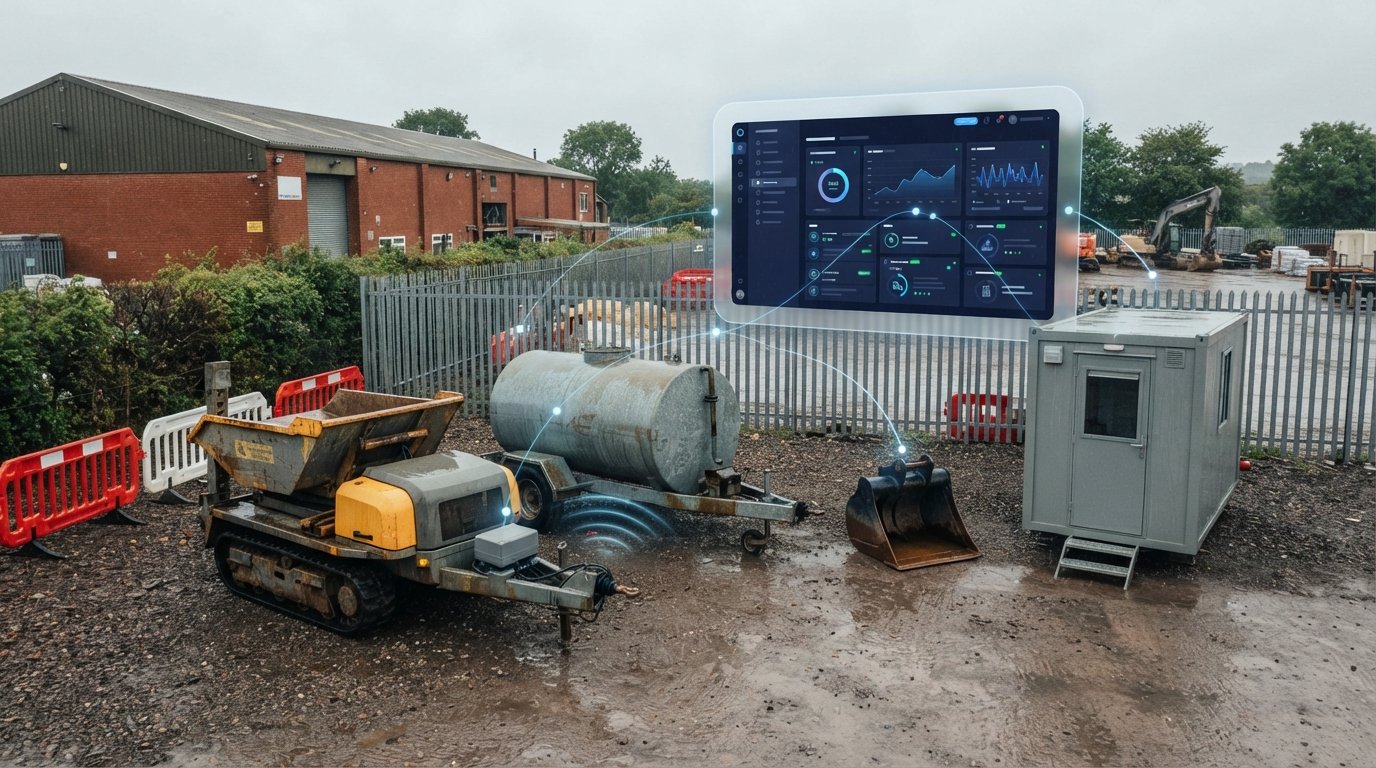
Fittings engineered for light vans fail quickly when bolted to a steel tipper or civil engineering plant. Between relentless ground vibration, flying ballast, and industrial pressure washers, site machinery destroys consumer-grade electronics within weeks. When evaluating how to track unpowered assets and plant effectively, physical enclosure resilience matters just as much as cloud reporting algorithms. You need purpose-built hardware capable of enduring tough British site environments without missing a single location heartbeat.
Durability, Battery Longevity, and Tamper Detection
Field reliability hinges on three non-negotiable hardware standards:
- Industrial battery chemistry: Standard alkaline or basic consumer lithium packs drop voltage rapidly during freezing UK winters. High-capacity lithium-thionyl chloride (Li-SOCl2) cells maintain stable current across severe thermal swings, preventing premature tracker failure.
- Internalised antenna arrays: External wiring harnesses and magnetic antennas invite trouble. Criminals easily snip exposed wires before hitching a trailer. Keep GNSS and cellular antennas fully enclosed inside reinforced polycarbonate housings.
- Optical tamper detection: Choose devices fitted with base-mounted light sensors or mechanical micro-switches. If a unit is pried away from an excavator chassis, the sudden light exposure triggers an immediate emergency breach alert.
Software Visibility: Geofences, Utilisation, and Service Logs
A rugged physical shell must be paired with intelligent telematics software. Raw GPS breadcrumbs alone will not solve daily management headaches. Your tracking platform must translate raw sensor pings into actionable commercial insights.
Intelligent software features include:
- Vibration-based run logs: Tri-axial accelerometers detect mechanical operation on unpowered kit, such as hydraulic pumps or diesel generators. This logs true operating hours to streamline preventative maintenance schedules.
- Custom polygonal geofences: Draw complex, boundary-accurate perimeters around irregular compound fences and access roads rather than simple circular radii, eliminating false alarms when equipment parks near boundary lines.
- Automated off-hire auditing: Generate indisputable arrival and departure logs to verify exactly when a customer returned hired plant, eliminating invoice disputes.
- Emergency recovery mode: Over-the-air commands force dormant trackers into continuous high-frequency ping modes the moment unauthorised movement occurs, giving recovery teams live turn-by-turn tracking coordinates.
Consolidating these capabilities gives fleet operators absolute control over high-risk machinery. You can secure your plant tracking hardware today to eliminate site blind spots across all your remote assets.
Unifying Plant Tracking with Your Broader Commercial Fleet
Operating separate portals for powered vehicles and standalone machinery breeds communication gaps across dispatch desks. Transport planners end up checking one system for tractor units, another for plant trailers, and a manual whiteboard for site bowsers. Understanding how to track unpowered assets and plant efficiently requires removing these operational silos. True logistical visibility happens when HGVs, vans, towable flatbeds, and heavy site attachments sit side by side on one dynamic map.
Consolidating Powered Vehicles and Static Plant
Merging your entire asset footprint onto a single screen simplifies fleet dispatch and operational oversight:
- Towing verification: Link an unpowered trailer's historical movements directly to the telematics data of the towing tractor unit or service van to confirm responsible drivers.
- Unified maintenance planning: Track mandatory six-week trailer inspections alongside vehicle servicing and statutory tachograph compliance schedules without switching platforms.
- Administrative clarity: Eliminate subscription fatigue by consolidating billing and SIM connectivity under one operational roof.
Centralising telematics across your entire transport footprint becomes straightforward when you integrate with a comprehensive GPS fleet tracking platform built for mixed commercial operations.
Securing Your Assets with Proven UK Tracking Specialists
Protecting high-value field investments demands hardware engineered specifically for domestic transport conditions and heavy civil plant environments. Generic imported consumer trackers often fail to withstand local site grime, salt-laden winter roads, and relentless pressure washing. Purpose-built industrial units keep working where consumer electronics fail.
A unified telematics strategy delivers immediate commercial dividends across your entire operation:
- Indisputable proof of delivery: Confirm exact drops for trailers and welfare units with timestamped geofence logs, eliminating client arrival disputes.
- Rapid theft intervention: Coordinate with regional recovery services using live high-frequency location pings the moment an unauthorised tow begins.
- Auditable site compliance: Export automated plant movement histories to prove strict adherence to corporate insurance policies and jobsite risk assessments.
Managing site machinery alongside your commercial road fleet should not involve guesswork or fragmented software. Once you master how to track unpowered assets and plant using dedicated hardware, your operations gain continuous security and audit-ready utilisation records. Review professional tracking hardware and take command of your fleet operations at the Fleetalyse checkout.
Take Full Control of Your Remote Plant and Trailer Operations
Unpowered machinery no longer needs to represent an operational blind spot on your balance sheet. Implementing autonomous, IP-rated telematics paired with motion-activated sleep profiles ensures your trailers, site bowsers, and heavy attachments stay visible without draining internal batteries. Consolidating these standalone units onto a unified dashboard alongside your commercial road vehicles eliminates software silos and streamlines preventative maintenance schedules.
As dedicated UK fleet telematics and asset management specialists, Fleetalyse provides ruggedised hardware engineered to endure demanding British plant environments. Bringing HGVs, vans, trailers, and mobile plant onto a single screen gives your team complete location visibility and audit-ready utilisation logs. Mastering how to track unpowered assets and plant protects your capital investments from remote site theft whilst eliminating client billing disputes. Equip your fleet with reliable asset tracking at Fleetalyse and secure every asset across your regional footprint today.
Frequently Asked Questions
How do asset trackers work on equipment without an internal battery or engine?
Asset trackers operate on self-contained power architectures, utilizing high-capacity industrial lithium batteries or integrated solar-harvesting panels. These units spend most of their time in an ultra-low-power sleep state to conserve energy. When an internal sensor detects motion, or when a scheduled reporting interval arrives, the unit wakes up, acquires its satellite coordinates, transmits the location via cellular networks, and returns to sleep.
How long does the battery last on an unpowered asset tracking device?
Battery life spans anywhere from several years up to a decade, depending entirely on reporting frequency and ambient conditions. A static unit transmitting one daily location update uses negligible power, lasting many years in the field. Higher ping rates during motion consume stored power faster. Solar-hybrid units continuously replenish their internal buffers during daylight, delivering virtually indefinite operation on exposed plant equipment.
Can unpowered asset trackers help recover stolen plant and trailers in the UK?
Yes, purpose-built asset trackers dramatically increase theft recovery rates across the UK. Knowing how to track unpowered assets and plant with automated geofences means transport managers receive instant SMS or email alerts if equipment moves outside authorised working hours. Operators can remotely switch the hardware into emergency high-frequency tracking modes, providing police and recovery teams with live turn-by-turn coordinates.
What happens to the tracking signal if equipment is stored inside a metal shipping container?
Solid steel containers create a Faraday cage effect that blocks standard GNSS satellite signals. Modern tracking hardware mitigates this by transmitting location estimates using cellular tower triangulation and low-power IoT networks like LTE-M and NB-IoT, which penetrate dense structures far better than legacy frequencies. Mounting external antennas or securing trackers on non-metallic access panels ensures reliable signal transmission.
Is it difficult to install GPS trackers on heavy construction machinery?
No, installing standalone tracking hardware is simple and usually takes under fifteen minutes per asset. Because these units require no integration into vehicle wiring looms or alternators, mechanics don't need complex electrical schematics. Units are firmly mounted to equipment frames using high-pull magnetic bases, heavy-duty through-bolts, or welded steel security brackets, positioning the internal antenna towards the sky.
How do trackers detect equipment usage if the machine has no electrical system?
Trackers measure equipment activity using sensitive internal tri-axial accelerometers that register specific vibration patterns. When a diesel generator, compressor, or hydraulic attachment begins operating, the sensor detects that mechanical vibration and logs active run-hours. This data uploads during scheduled pings, allowing fleet desks to schedule preventative maintenance based on true operating hours rather than rough guesswork.
Can I monitor both my road vehicles and unpowered site plant on the same software?
Yes, modern telematics dashboards unify powered road fleets and standalone equipment on a single interactive screen. Consolidating how to track unpowered assets and plant alongside your HGVs and vans eliminates disconnected management tools. Dispatchers can monitor towing vehicles and assigned trailers simultaneously, streamlining compliance inspections, asset allocation, and customer delivery proof across one centralised platform.
Frequently asked questions
How do asset trackers work on equipment without an internal battery or engine?
Asset trackers operate on self-contained power architectures, utilizing high-capacity industrial lithium batteries or integrated solar-harvesting panels. These units spend most of their time in an ultra-low-power sleep state to conserve energy. When an internal sensor detects motion, or when a scheduled reporting interval arrives, the unit wakes up, acquires its satellite coordinates, transmits the location via cellular networks, and returns to sleep.
How long does the battery last on an unpowered asset tracking device?
Battery life spans anywhere from several years up to a decade, depending entirely on reporting frequency and ambient conditions. A static unit transmitting one daily location update uses negligible power, lasting many years in the field. Higher ping rates during motion consume stored power faster. Solar-hybrid units continuously replenish their internal buffers during daylight, delivering virtually indefinite operation on exposed plant equipment.
Can unpowered asset trackers help recover stolen plant and trailers in the UK?
Yes, purpose-built asset trackers dramatically increase theft recovery rates across the UK. Knowing how to track unpowered assets and plant with automated geofences means transport managers receive instant SMS or email alerts if equipment moves outside authorised working hours. Operators can remotely switch the hardware into emergency high-frequency tracking modes, providing police and recovery teams with live turn-by-turn coordinates.
What happens to the tracking signal if equipment is stored inside a metal shipping container?
Solid steel containers create a Faraday cage effect that blocks standard GNSS satellite signals. Modern tracking hardware mitigates this by transmitting location estimates using cellular tower triangulation and low-power IoT networks like LTE-M and NB-IoT, which penetrate dense structures far better than legacy frequencies. Mounting external antennas or securing trackers on non-metallic access panels ensures reliable signal transmission.
Is it difficult to install GPS trackers on heavy construction machinery?
No, installing standalone tracking hardware is simple and usually takes under fifteen minutes per asset. Because these units require no integration into vehicle wiring looms or alternators, mechanics don't need complex electrical schematics. Units are firmly mounted to equipment frames using high-pull magnetic bases, heavy-duty through-bolts, or welded steel security brackets, positioning the internal antenna towards the sky.
How do trackers detect equipment usage if the machine has no electrical system?
Trackers measure equipment activity using sensitive internal tri-axial accelerometers that register specific vibration patterns. When a diesel generator, compressor, or hydraulic attachment begins operating, the sensor detects that mechanical vibration and logs active run-hours. This data uploads during scheduled pings, allowing fleet desks to schedule preventative maintenance based on true operating hours rather than rough guesswork.
Can I monitor both my road vehicles and unpowered site plant on the same software?
Yes, modern telematics dashboards unify powered road fleets and standalone equipment on a single interactive screen. Consolidating how to track unpowered assets and plant alongside your HGVs and vans eliminates disconnected management tools. Dispatchers can monitor towing vehicles and assigned trailers simultaneously, streamlining compliance inspections, asset allocation, and customer delivery proof across one centralised platform.