

Satellite GPS tracking for UK fleets: compliance-first guide
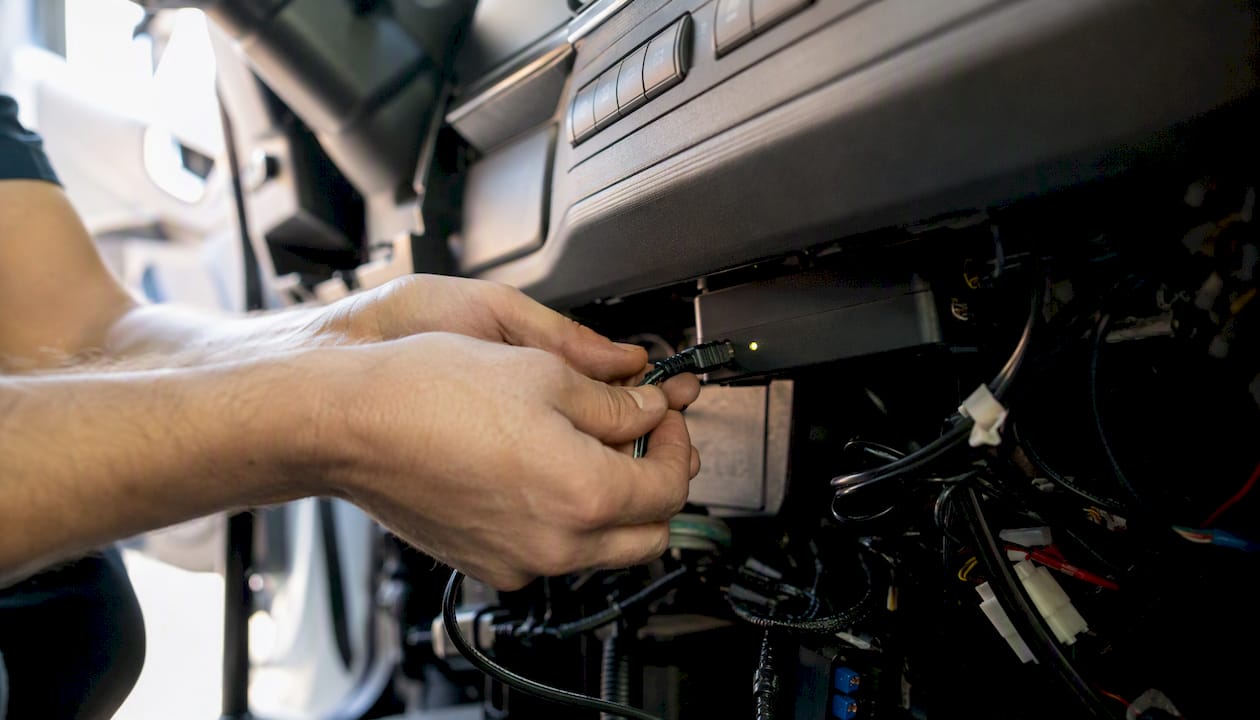
For UK commercial fleet operators, satellite GPS tracking means far more than dots on a map. The right system integrates GNSS telematics with tachograph support and GDPR-safe driver data handling, giving you real-time vehicle visibility alongside the compliance infrastructure the DVSA expects. The recommended approach is a compliance-first platform that delivers remote tachograph downloads, secure UK data storage, and multi-network SIM connectivity from day one.
Before you evaluate any vendor, confirm these non-negotiables are present:
- Remote vehicle unit (VU) and driver card downloads, with company-card workflows locked to your operator licence
- Automated drivers’ hours alerts and remaining drive-time visibility
- Secure DDD file retention with role-based access and an audit trail
- Multi-network or roaming SIM for UK rural coverage continuity
- UK-based support with demonstrable DVSA compliance credentials
- A documented data protection policy covering lawful basis and driver notification
Table of Contents
- What does “satellite GPS tracking” mean for commercial fleets?
- What capabilities must a UK telematics system provide?
- UK drivers’ hours and tachograph rules: what must you do?
- How does UK GDPR apply to driver tracking and in-cab cameras?
- How to set up operations so telematics supports compliance
- How Fleetalyse delivers compliant satellite GPS tracking for UK fleets
- 90-day pilot roadmap and deployment checklist
- Key takeaways
- Why compliance-first telematics is the only sensible starting point
- Fleetalyse: your next step toward compliant fleet telematics
- Authoritative sources for deeper reading
What does “satellite GPS tracking” mean for commercial fleets?
In this guide, “satellite GPS tracking” refers to GNSS telematics for commercial fleets: hardware units that report vehicle location, driver behaviour, and tachograph data to a fleet management platform. The industry term is fleet telematics, and the two phrases are used interchangeably here.
This article covers HGVs, vans, trailers, and mixed assets operating under UK transport regulations. It does not cover consumer satellite messengers, personal SOS devices, or asset trackers for lone workers. If you are evaluating those categories, this guide is not for you.
Later sections address tachograph download rules and timelines, UK GDPR obligations for driver-facing technology, hardware selection and installation, and a 90-day deployment roadmap.
What capabilities must a UK telematics system provide?
Generic GPS tracking systems report location. Enterprise fleet telematics must go further, and the gap matters during a DVSA desk-based assessment.
- Remote tachograph downloads: VU data every 90 days and driver card data every 28 days, as required by GOV.UK tachograph rules. Automated scheduling and company-card workflows prevent missed cycles.
- Secure data storage: — Original DDD files retained with role-based access, full audit trail, and export capability. Retention schedules must meet operator licence requirements.
- Connectivity resilience: Telematics systems combine GNSS multi-constellation receivers with multi-network SIMs and local buffering to maintain data continuity across UK rural routes where single-network coverage fails.
A modern lorry-tracking system also needs CAZ/ULEZ awareness, GVMS/GMR status, and ePOD integration to meet shipper-grade visibility expectations. Specialist HGV telematics deliver this regulatory depth; consumer-grade trackers do not.
UK drivers’ hours and tachograph rules: what must you do?
The legal framework is clear, but operators regularly underestimate the administrative burden. Here is what the regulations actually require.
Download intervals and retention
| Requirement | Legal maximum | Recommended practice |
|---|---|---|
| Vehicle unit download | Every 90 days | Monthly |
| Driver card download | Every 28 days | Weekly |
| Debrief evidence | Required | Logged with date and outcome |
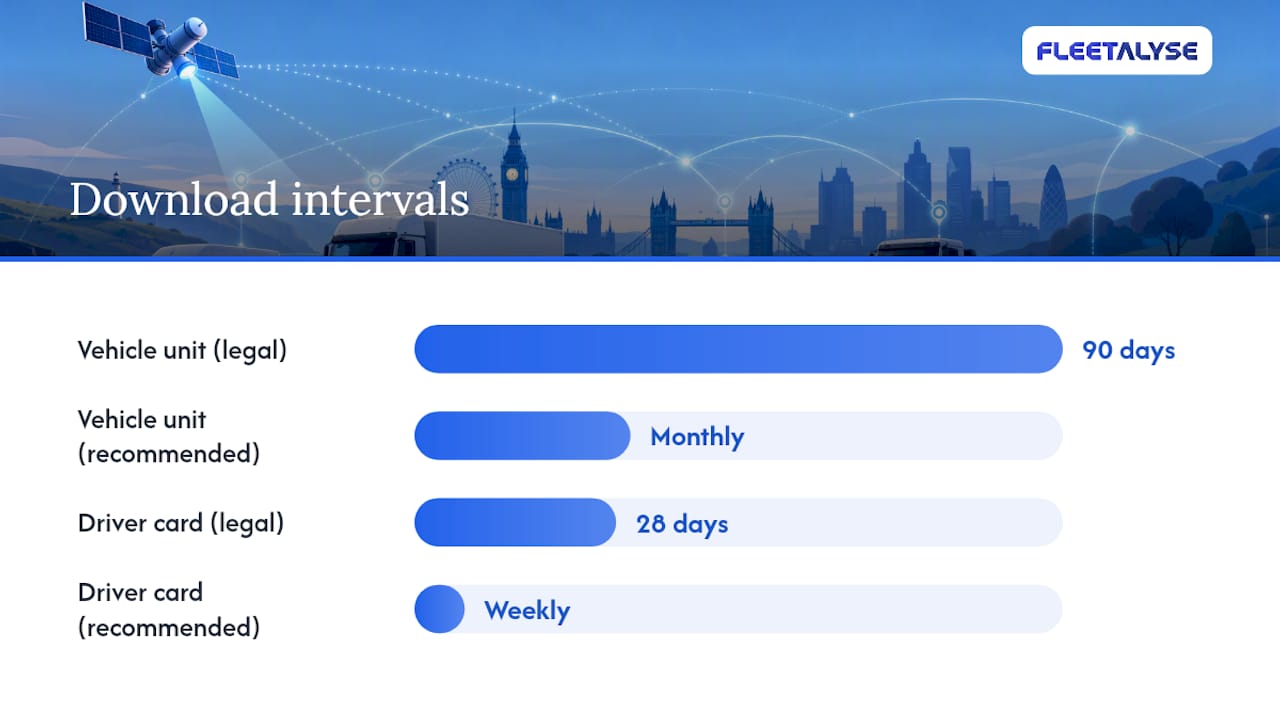
The 90-day VU interval was extended from 56 days by domestic amendment regulations to align with the EU maximum. Treat it as a ceiling, not a target. Operators who run shorter internal cycles, such as weekly card downloads and monthly VU downloads, greatly reduce the risk of a missed cycle caused by driver absence or vehicle downtime.
Smart tachograph transition and 2026 changes
Smart 1 tachographs are fitted to vehicles first registered from June 2019. Smart 2 units are required for newly registered vehicles from August 2023 and must be retrofitted to vehicles making international journeys. 2026 regulatory amendments updated scope and transitional arrangements for certain vehicle classes, so review your fleet register against current requirements.
Operator compliance checklist
According to GOV.UK operator responsibilities, you must:
- Arrange calibration every two years and inspection every six years at an approved centre
- Issue and manage company cards; use them for every VU download
- Maintain a written download schedule with a named responsible person
- Analyse downloaded files, log driver debriefs, and retain evidence
- Train drivers on tachograph use and record that training
Pro Tip: If a VU is unreadable or a download fails, document the fault immediately, arrange repair at an approved workshop, and retain the manual records covering the gap. A DVSA officer will check last-download dates at the roadside; an unexplained gap is an infringement regardless of the reason.
For a deeper breakdown of DVSA expectations, the DVSA tachograph rules explained guide covers desk-based assessment evidence in detail. You can also review the consequences of missing a tacho download to understand enforcement risk.
How does UK GDPR apply to driver tracking and in-cab cameras?
Driver-facing cameras and GPS tracking generate personal data. UK GDPR applies from the moment you fit the hardware, not from when you first review footage.
- Write a data protection policy that covers telematics and camera use specifically. Generic policies that do not mention vehicle surveillance will not satisfy an ICO audit.
- Record your lawful basis. Legitimate interest is the most common basis for operational telematics; consent is rarely appropriate for employee monitoring because it is not freely given. Where smart tachograph ITS interfaces are used to release personal tachograph data, explicit driver consent is required by the interface specification.
- Conduct a DPIA where processing is intrusive, for example continuous in-cab video with audio.
- Display clear signage in every vehicle and provide a privacy notice to drivers before deployment. The ICO vehicle surveillance guidance requires employers to document lawful basis, provide signage, and publish controller contact details so drivers can exercise access rights.
- Minimise data collection. Limit GNSS fields to operational necessity; anonymise data used for aggregate analytics.
- Establish access request procedures. Drivers have the right to request their own data; you need a process to respond within one month.
Pro Tip: Legitimate interest and consent can coexist in the same deployment. Use legitimate interest for operational location tracking and tachograph downloads; use explicit consent for any optional data sharing through the ITS interface. Document both bases separately in your records of processing activities.
How to set up operations so telematics supports compliance
Appoint a named responsible person for download management before the first unit goes live. Without ownership, download schedules drift.
- Set a written download timetable: weekly for driver cards, monthly for VUs as a minimum.
- Configure automated remote downloads where the platform supports it; manual downloads are a fallback, not a primary method.
- Retain original DDD files in secure storage immediately after download; do not rely on the telematics platform as your sole archive.
- Schedule file analysis within 48 hours of download; log the outcome and any driver debrief with date, name, and action taken.
- Set escalation thresholds: alert the transport manager when a driver approaches 80% of their weekly hours limit, not at 100%.
- For faulty VUs, document the fault, arrange approved workshop repair, and retain manual records covering the gap period.
Multi-depot operations need delegated depot responsibility with a central dashboard for oversight. Each depot manager should hold download authority for their vehicles and report exceptions upward weekly. A DVSA desk-based assessment will ask for evidence of this structure, so keep the delegation documented. Guidance on documenting transport procedures offers a practical framework for formalising these records.
How Fleetalyse delivers compliant satellite GPS tracking for UK fleets
Fleetalyse is built as a compliance-first telematics platform for UK commercial operators. Its architecture addresses the requirements above directly rather than treating compliance as an add-on.

| Requirement | Fleetalyse capability |
|---|---|
| Remote tachograph download | VU and driver card, automated scheduling, company-card workflow |
| Drivers’ hours monitoring | Live remaining drive-time, infringement alerts, exportable reports |
| Secure DDD retention | UK-hosted storage, role-based access, full audit trail |
| Multi-network connectivity | Multi-IMSI SIM, GNSS multi-constellation, offline buffering |
| GDPR compliance | Written data policy, lawful basis documentation, driver notification support |
| UK-based support | Local team for setup, troubleshooting, and DVSA query handling |
| API integrations | TMS/ERP connections, CAZ/ULEZ awareness, ePOD support |
A typical Fleetalyse deployment follows a pilot-then-scale model: fit 5–10 vehicles, verify remote downloads and coverage, train the transport team, then roll out across the fleet. The commercial model combines a hardware cost, a per-vehicle monthly subscription, and a SIM data fee, with no long-term lock-in on pilot vehicles.
For remote tachograph download specifics, including company-card setup and download scheduling, the Fleetalyse product page covers the workflow in full.
90-day pilot roadmap and deployment checklist
A structured pilot removes the guesswork from full fleet commitment.
- Days 1–10 (selection and procurement): Confirm hardware specification per vehicle type; order units and SIMs; verify calibration status of target vehicles.
- Days 11–20 (installation): Fit units; complete ITS interface installation at approved workshop for tachograph-equipped vehicles; verify calibration plaques and sealing.
- Days 21–30 (coverage testing): Run target routes; confirm buffering behaviour in low-signal areas; validate remote download success rate.
- Days 31–45 (driver training): Brief drivers on data collection, their rights, and the privacy notice; obtain acknowledgement records.
- Days 46–60 (KPI baseline): Establish baseline for download compliance rate, infringement frequency, and fuel consumption.
- Days 61–90 (validation and sign-off): Confirm successful remote downloads for all units, accurate hours alerts, secure DDD retention, and manager reporting. Document acceptance criteria met.
Common pitfalls to avoid:
- Skipping route-based SIM coverage testing before full roll-out
- Failing to verify calibration plaques after ITS interface installation
- Running debrief processes informally without logged outcomes
- Treating the 90-day VU interval as a target rather than a maximum
For smaller operations, the tachograph compliance for small fleets guide provides a simplified checklist that maps directly to this roadmap.
Key takeaways
Compliance-first satellite GPS tracking for UK fleets requires remote tachograph downloads, GDPR-safe driver data handling, multi-network connectivity, and a structured 90-day pilot before full roll-out.
| Point | Details |
|---|---|
| Download intervals are legal maximums | VU every 90 days, driver card every 28 days; run shorter internal cycles to avoid missed downloads. |
| GDPR applies from hardware fitment | Document lawful basis, display signage, and provide driver privacy notices before any unit goes live. |
| Hardware must match vehicle type | Plug-and-play OBD for vans, wired CAN-bus for HGVs, ITS interface for smart tachograph integration. |
| Multi-network SIM is non-optional | Single-network SIMs fail on rural UK routes; multi-IMSI roaming maintains data continuity. |
| Fleetalyse as recommended platform | Fleetalyse delivers remote tachograph downloads, UK-hosted DDD retention, and UK-based support for compliant fleet deployment. |
Why compliance-first telematics is the only sensible starting point
The instinct many fleet managers have is to start with location tracking and add compliance features later. That sequence creates problems that are expensive to unpick. Tachograph interfaces require calibration-seal-preserving installation; retrofitting them after a generic tracker is already fitted means a second workshop visit and a second set of calibration costs. GDPR documentation written after deployment, rather than before, is a liability rather than a safeguard.
The operators I see managing DVSA desk-based assessments with the least friction are those who treated the compliance infrastructure as the foundation, not the finishing touch. Real-time GPS tracking is genuinely useful for routing and customer visibility. But the value that protects your operator licence comes from the download records, the debrief logs, and the audit trail. Those are the documents a Traffic Commissioner asks for, and they are what a compliance-first platform is designed to produce automatically.
Fleetalyse: your next step toward compliant fleet telematics
Fewer infringements, cleaner DVSA assessments, and a download process that runs without manual chasing: that is what a properly configured Fleetalyse deployment delivers for UK fleet operators.
Fleetalyse offers a structured pilot for UK commercial fleets, covering hardware fitment, remote download verification, driver training support, and KPI baselining across your chosen vehicles. During the pilot, Fleetalyse will validate remote tachograph download success, confirm multi-network SIM coverage on your routes, and configure your download schedule and alert thresholds.
- Explore driver behaviour monitoring to see how Fleetalyse scores and coaches drivers alongside compliance tracking.
- Browse unlocked GPS trackers to select the right hardware for your vehicle mix before the pilot begins.
Contact Fleetalyse at fleetalyse.co.uk to book a demo and discuss your fleet’s specific compliance requirements.
Authoritative sources for deeper reading
These are the primary sources cited in this guide. Keep them accessible when preparing evidence for a DVSA desk-based assessment.
- Guidance on video surveillance (including CCTV) – additional considerations for technologies other than CCTV: surveillance in vehicles – ICO
- Drivers’ hours and tachographs: goods vehicles - Tachograph rules – GOV.UK
- Drivers’ hours and tachographs: goods vehicles - Responsibilities of vehicle operators – GOV.UK
- Explanatory memorandum: The Drivers’ Hours and Tachographs (Amendment) Regulations – legislation.gov.uk
- Appendix 13 — specification for the interface with Intelligent Transport Systems — EUR-Lex / legislation.gov.uk
- Amendments to drivers’ hours and tachograph regulations 2026 – legislation.gov.uk
- Fleet telematics explained in simple terms – EasyNT
- Lorry tracking systems 2026: UK haulier’s practical guide – TrucksOnTheMap
For DVSA desk-based assessments, extract the download interval evidence from the GOV.UK tachograph rules page and the operator responsibilities page; these are the two documents an assessor will reference directly. The ICO vehicle surveillance guidance supports your GDPR documentation if your data protection policy is challenged.
This article provides general information about UK fleet telematics and compliance requirements. It is not legal advice. Confirm current regulatory requirements with GOV.UK, the ICO, or a qualified transport compliance professional.