

Types of enterprise fleet management solutions: 2026 guide

Enterprise fleet management solutions are specialised digital platforms designed to optimise vehicle tracking, maintenance, safety, dispatch, and compliance across commercial transport operations. The fleet management market is projected to grow from $24.3 billion in 2024 to $52.5 billion by 2034, with software commanding 49% market share by early 2026. That growth reflects a fundamental shift: operators are moving away from spreadsheets and disconnected tools toward purpose-built platforms. But not every platform solves the same problem, and choosing the wrong type of enterprise fleet management solution is a costly mistake that many UK fleets make every year.
1. What are the main types of enterprise fleet management solutions?
Fleet management software solutions fall into six distinct categories, each built around a different operational priority. Understanding these categories is the starting point for any sound purchasing decision.
- Telematics and GPS tracking platforms focus on real-time vehicle location, route history, speed monitoring, and idle time. They are the most widely deployed category and form the foundation of most enterprise vehicle tracking systems.
- Maintenance-first CMMS platforms prioritise scheduled servicing, parts inventory management, work orders, and total cost of ownership analytics. They are built for fleets where unplanned breakdowns are the primary cost driver.
- Safety and compliance telematics platforms integrate AI dashcams, driver behaviour scoring, and regulatory compliance tools. They are particularly relevant for UK operators managing DVSA requirements and Operator Licence obligations.
- Dispatch and transport management system (TMS) platforms handle route optimisation, load planning, and carrier management. They are the operational backbone for fleets running complex delivery or haulage schedules.
- AI-powered predictive platforms use machine learning and sensor data to forecast component failures, optimise fuel consumption, and dynamically reroute vehicles before problems occur.
- Enterprise Fleet Operations OS platforms function as unified ecosystems combining tracking, maintenance, safety, and dispatch into a single connected hub, replacing multiple siloed point solutions.
Each category addresses a different set of operational pain points. The right choice depends entirely on where your fleet is losing money or time.
2. How telematics and GPS platforms differ from maintenance-first solutions

The distinction between these two platform types is more significant than most operators realise, and confusing them leads to expensive mismatches.
Telematics platforms such as Samsara and Verizon Connect are built around live vehicle data: GPS coordinates, speed, geofencing alerts, driver behaviour scores, and fuel consumption pulled from OBD-II or CAN-bus ports. Samsara averages £27 to £60 per vehicle per month and excels in AI dashcam technology and intuitive reporting. Verizon Connect sits at roughly £25 to £40 per vehicle per month plus hardware, making it a strong fit for large fleets that need deep integration with existing enterprise systems.
Maintenance-first platforms such as Fleetio and OxMaint take a different approach entirely. Maintenance-first systems focus on work orders, parts inventory, and total cost of ownership analytics, making them ideal for fleets where unplanned breakdown costs are the primary financial drain. Fleetio starts from as little as £4 to £8 per vehicle per month for maintenance modules, though it does not include GPS hardware.
| Feature | Telematics platforms | Maintenance-first platforms |
|---|---|---|
| Primary focus | Live location, driver behaviour | Work orders, parts, servicing |
| Hardware required | Yes (GPS unit, dashcam) | No (software only) |
| Best for | Route visibility, compliance | Reducing unplanned downtime |
| Entry-level cost | £25 to £60/vehicle/month | £4 to £8/vehicle/month |
| Examples | Samsara, Verizon Connect | Fleetio, OxMaint |
Pro Tip: If your fleet’s biggest cost is unplanned breakdowns rather than route inefficiency, start with a maintenance-first platform. You can layer telematics on top once your servicing data is under control.
3. What safety, dispatch, and AI predictive platforms solve
These three platform types address operational problems that neither pure telematics nor maintenance-first tools are designed to handle.
Safety and compliance platforms are built around driver behaviour and regulatory adherence. Platforms in this category integrate AI dashcams that detect harsh braking, lane departure, mobile phone use, and fatigue indicators in real time. For UK operators, this category is particularly relevant given DVSA enforcement activity and the requirements of the Operator Licence framework. The data these platforms generate also supports insurance claims and driver coaching programmes.
Dispatch and TMS platforms solve a different problem: the complexity of coordinating loads, routes, and carriers at scale. These tools calculate optimal delivery sequences, manage proof of delivery, and provide real-time ETAs to customers. For haulage operators running multi-drop routes across the UK, a TMS platform reduces both fuel spend and missed delivery windows without requiring a GPS hardware investment.
AI-powered predictive platforms represent the most technically advanced category. They ingest sensor data from vehicles, cross-reference it with historical failure patterns, and flag components likely to fail before they do. The practical result is fewer roadside breakdowns and more accurate maintenance scheduling. These platforms are most valuable for fleets with high-value assets such as HGVs, refrigerated trailers, or specialist vehicles where a single breakdown carries significant financial consequences.
- Safety platforms: best for fleets with driver behaviour incidents, insurance cost pressure, or DVSA compliance risk
- Dispatch and TMS platforms: best for multi-drop haulage, courier operations, or fleets managing third-party carriers
- AI predictive platforms: best for high-value asset fleets where breakdown costs outweigh platform investment
Pro Tip: When evaluating fleet fuel efficiency tools within AI platforms, check whether the system uses CAN-bus data or simply estimates consumption from GPS speed data. CAN-bus readings are significantly more accurate and worth the additional hardware cost.
4. What enterprise fleet operations OS platforms are and when to choose them
Enterprise Fleet Operations OS platforms are unified ecosystems that replace the need for separate telematics, maintenance, safety, and dispatch tools by connecting all of these functions within a single platform and data model.
Samsara Connected Operations, Verizon Connect Fleet, and OxMaint each offer varying degrees of this unified approach. The defining characteristic of a true enterprise OS is open API connectivity, which allows the platform to exchange data with ERP systems such as SAP or Oracle, business intelligence tools such as Power BI, and HR or payroll systems. Decision-makers should prioritise vendors offering open API connectivity for integration with ERP and BI tools, as this determines long-term scalability.
The case for an enterprise OS platform is strongest when:
- Your fleet operates across multiple regions or depots and needs a single source of operational truth.
- You are currently running three or more separate tools that do not share data with each other.
- Your compliance reporting requires data from both vehicle tracking and driver hours in the same report.
- You are planning to scale the fleet significantly within the next two to three years.
- Your finance team needs total cost of ownership data that currently requires manual consolidation from multiple systems.
The trade-off is cost and implementation complexity. Enterprise OS platforms carry higher per-vehicle costs and typically require a structured onboarding process. For smaller fleets or those with a single operational focus, a purpose-built point solution will almost always deliver better value.
5. How to choose the right fleet management solution for your UK fleet
Selecting the best fleet management solution starts with one question: what is your fleet’s single largest operational cost or compliance risk right now?
The most common selection mistake is choosing a platform with the most features instead of addressing the highest operational cost. A fleet losing £50,000 per year to unplanned breakdowns gains almost nothing from a platform with superior GPS ping rates. The platform that solves your primary problem is the right platform, regardless of how its feature list compares to competitors.
A practical selection process follows this sequence:
- Identify your top three cost drivers. Unplanned downtime, fuel waste, driver incidents, compliance penalties, and route inefficiency are the most common. Rank them honestly.
- Match cost drivers to solution types. Unplanned downtime points to maintenance-first or AI predictive platforms. Fuel waste and route inefficiency point to telematics or TMS platforms. Driver incidents and compliance risk point to safety platforms.
- Assess your integration requirements. If you run SAP, Oracle, or a bespoke transport management system, confirm that any shortlisted platform offers a documented API before progressing to a demo.
- Evaluate hardware compatibility. Integration complexity is frequently underestimated, particularly in mixed-OEM fleets where vehicles from different manufacturers may require different telematics hardware. Ask vendors directly which vehicle makes and models they natively support.
- Request a structured trial. Most reputable platforms offer a 14 to 30-day trial period. Use it with real vehicles on real routes, not a controlled demo environment.
“The best platform solves the fleet’s specific operational bottleneck rather than having the most features.” This principle should govern every stage of your evaluation process.
Budget is a genuine constraint, but it should inform your shortlist rather than dictate it. A platform at £8 per vehicle per month that solves your primary problem delivers more value than a £45 per vehicle per month platform that does not. For logistics market context and pricing benchmarks relevant to UK operators, independent industry analysis can help calibrate expectations before entering vendor negotiations.
Key takeaways
The right enterprise fleet management solution is determined by your fleet’s primary cost driver, not by feature count or market reputation.
| Point | Details |
|---|---|
| Match solution to problem | Identify your top cost driver first, then select the platform category that directly addresses it. |
| Telematics vs maintenance | Telematics platforms suit route visibility needs; maintenance-first platforms suit fleets with high breakdown costs. |
| Enterprise OS for scale | Unified OS platforms are worth the investment only when you operate multiple depots or run three or more disconnected tools. |
| Hardware compatibility matters | Always confirm native support for your vehicle makes before committing to a telematics or AI predictive platform. |
| Trial with real conditions | A 14 to 30-day trial on live routes reveals integration gaps that a vendor demo never will. |
Why most fleets choose the wrong platform type
I have seen this pattern repeat itself more times than I care to count. A fleet operator attends a trade show, gets a polished demo from a well-known telematics vendor, and signs a three-year contract. Six months later, the platform is tracking vehicles perfectly, but the breakdown costs that were destroying the P&L are exactly where they were before. The GPS data is there. The maintenance insight is not.
The uncomfortable truth is that most fleet purchasing decisions are driven by what is easiest to demonstrate, not what is hardest to fix. GPS tracking produces a satisfying map with dots moving in real time. Maintenance analytics require you to sit with your workshop data for a week before the value becomes visible. One sells itself in a 20-minute demo. The other requires patience and honesty about where your fleet is actually losing money.
My strong preference for mixed-asset UK fleets, particularly those running HGVs alongside vans and trailers, is to combine a telematics platform for compliance and location visibility with a dedicated maintenance module for servicing and parts. The two functions serve different audiences within your organisation: transport managers need the tracking data, and workshop managers need the maintenance data. Forcing both into a single platform that does neither particularly well is a false economy.
The integration question is where I see the most underestimated risk. Syncing raw vehicle data via OBD-II or CAN-bus into maintenance workflows is genuinely complex in mixed-OEM fleets, and vendors rarely volunteer this information during the sales process. Ask for a reference customer running the same vehicle mix as yours before you sign anything.
— Vytautas
Explore Fleetalyse’s fleet tracking and compliance solutions
If you are a UK fleet operator weighing up which platform type fits your operation, Fleetalyse offers a practical starting point. The platform combines GPS fleet tracking and smart dashcams with tachograph compliance tools built specifically for UK transport regulations, covering HGVs, vans, trailers, and mixed-asset fleets.
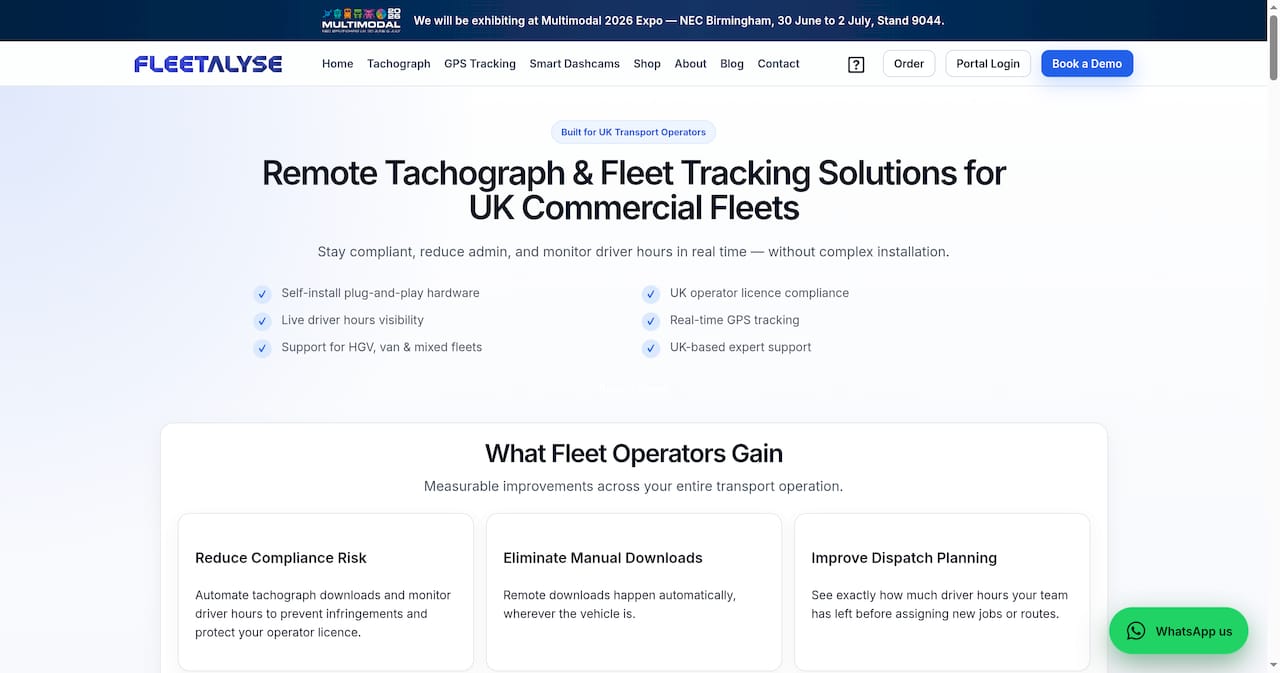
Fleetalyse’s plug-and-play telematics hardware removes the installation barrier that puts many operators off enterprise-grade systems. For fleets that need asset and trailer visibility alongside vehicle tracking, the asset and trailer GPS trackers range covers everything from refrigerated trailers to plant equipment. UK-based support means you are speaking to someone who understands DVSA requirements, not a generic helpdesk. Explore the full range or request a demo to see how it fits your fleet’s specific operational priorities.
FAQ
What are the main types of enterprise fleet management solutions?
The six main types are telematics and GPS tracking platforms, maintenance-first CMMS platforms, safety and compliance platforms, dispatch and TMS platforms, AI-powered predictive platforms, and enterprise fleet operations OS platforms. Each category addresses a different operational priority, from vehicle location to unplanned breakdown prevention.
How do I choose between telematics and maintenance-first platforms?
Identify your primary cost driver first. If unplanned breakdowns are your biggest expense, a maintenance-first platform such as Fleetio or OxMaint is the correct starting point. If route visibility, driver behaviour, or DVSA compliance is the priority, a telematics platform is the better fit.
What does an enterprise fleet operations OS platform do differently?
An enterprise OS platform consolidates tracking, maintenance, safety, and dispatch into a single data environment with open API connectivity to ERP and BI tools. It replaces multiple disconnected point solutions and is most valuable for fleets operating across multiple depots or regions.
How much do enterprise fleet management solutions cost in the UK?
Costs vary significantly by category. Maintenance-first platforms start from approximately £4 to £8 per vehicle per month, while telematics platforms such as Samsara range from £27 to £60 per vehicle per month including hardware. Enterprise OS platforms typically sit at the higher end of this range with additional implementation costs.
What is the most common mistake when selecting fleet management software?
The most common mistake is choosing by feature count rather than by operational fit. A platform with superior GPS ping rates adds no value to a fleet whose primary problem is unplanned downtime. Always match the platform category to your highest-cost operational problem first.