

Consignment tracking explained for UK fleet operators

Consignment tracking is the process of monitoring a shipment from the moment it is booked until delivery confirmation is recorded, giving UK fleet operators real-time visibility, accurate ETAs, and auditable proof of delivery at every stage. For operators managing DVSA compliance and HMRC customs dependencies, that visibility is not a convenience — it is an operational requirement. Fleetalyse integrates GPS telemetry, driver app confirmations, and automated event capture to make that record defensible.
A fleet manager should expect every consignment tracking system to deliver:
- A unique consignment number assigned at booking and carried through every handover
- Timestamped GPS fixes and scan events at each checkpoint
- A POD record combining digital signature, photo, or OTP verification
Table of Contents
- What does consignment tracking cover across the delivery lifecycle?
- How consignment tracking works technically for your fleet
- Why consignment tracking matters for UK commercial fleets
- What counts as legally defensible proof of delivery?
- How do you solve the carrier-to-WMS synchronisation problem?
- Common operational errors and how to prevent them
- Which KPIs tell you your consignment tracking is working?
- Practical rollout checklist and cost considerations for UK fleets
- How Fleetalyse implements consignment tracking for UK fleets
- Key takeaways
- Why consignment tracking deserves more than a software tick-box
- Fleetalyse gives your fleet audit-ready consignment records
- Useful sources and further reading
What does consignment tracking cover across the delivery lifecycle?
Event-driven updates at each stage form the backbone of any tracking system. The table below maps the full lifecycle so you can use it as a checklist when evaluating your own setup.
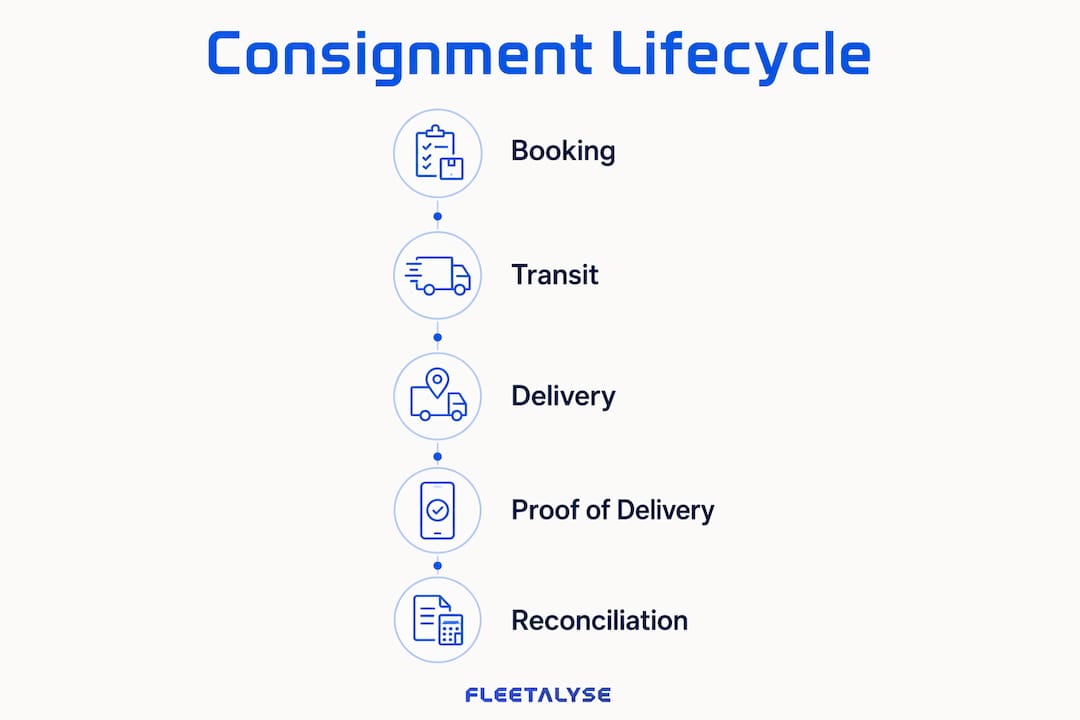
| Lifecycle stage | Typical event | Required data fields |
|---|---|---|
| Booking | Consignment ID generated | Consignment number, sender, receiver, dimensions, ETA |
| Pickup | Driver collects load | Consignment ID, driver ID, GPS fix, timestamp |
| Depot arrival | Barcode/QR scan at gate | Scan ID, depot code, timestamp, vehicle ID |
| Customs/checkpoint | Clearance or transfer event | Consignment ID, customs reference, timestamp, handler ID |
| Out for delivery | Status update pushed to consignee | GPS fix, ETA, driver ID, consignment ID |
| Delivery confirmation | POD captured | Digital signature/OTP/photo, GPS fix, timestamp, consignment ID |
The consignment number is the single most important reference across this chain. Failure to log it consistently at every handover causes disputes and, critically, DVSA audit failures. Consignor, consignee, and carrier all need access to the same reference — which is why a shared, consistent ID across your TMS, WMS, and telematics platform matters far more than any individual scan.
It is also worth distinguishing transit tracking from consignment stock management. The latter involves ownership states, cycle locking, and digital reconciliation rather than vehicle telemetry. This guide focuses on transit tracking for commercial fleets.
How consignment tracking works technically for your fleet
The signal chain starts with the vehicle. A GPS tracker generates a geofence hit when a vehicle enters a depot or delivery zone; the driver app records a barcode or QR scan at the checkpoint; and the fleet platform stitches those events into a single consignment record. That record then flows outward via API or EDI to the carrier portal and the consignee’s WMS.
The typical architecture looks like this:
- Vehicle telematics (GPS tracker, CAN-bus data) feeds live position and ignition events
- Driver mobile app captures consignment ID scans, digital signatures, and photos at delivery
- Fleet platform (such as Fleetalyse) correlates GPS geofence events with scan data and stores the audit trail
- API webhooks or EDI push real-time state changes to carrier portals, WMS, and TMS systems
For commercial vehicle tracking, the integration between telematics and the wider supply chain system is where most operators fall short. Consignment ID propagation — ensuring the same reference travels from the driver app through to the WMS acknowledgement — is the single most common failure point.
Why consignment tracking matters for UK commercial fleets

Improved ETA accuracy is the most visible gain, but the compliance benefits run deeper. When DVSA inspectors or HMRC customs teams request delivery evidence, a timestamped, GPS-correlated POD record is far stronger than a paper delivery note.
Key operational benefits for UK fleets:
- Detention costs can decrease by avoiding missed delivery windows
- Reduced admin time chasing status updates across carrier portals
- Proactive delay mitigation — real-time exceptions allow rerouting before a missed slot becomes a penalty
- Clearer liability boundaries at each handover point
- Customs dependency handling for cross-border consignments under HMRC requirements
For time-sensitive or customs-dependent shipments, tracking is not a luxury. Cascading delays from a single missed checkpoint can affect multiple downstream consignments, driver hours compliance, and operator licence standing simultaneously. Centralised dashboards that consolidate telemetry, scan events, and status updates let operations teams act on exceptions immediately rather than discovering them after the fact.
What counts as legally defensible proof of delivery?
Delivery confirmation records provide the shipment documentation necessary for operational record-keeping and audit readiness. Not all POD formats carry equal weight, though.
Acceptable POD formats, ranked by evidential strength:
- Timestamped GPS fix + digital signature — the strongest combination; location and identity are both recorded
- OTP verification — confirms the correct recipient acknowledged delivery
- Timestamped photo — useful corroboration, particularly for condition disputes
- EDI/ASN records — essential for automated reconciliation with consignee WMS
Every POD record should include, at minimum: timestamp, GPS coordinates, consignment ID, driver or handler ID, and the proof type used. Consistency of the consignment number across all POD artefacts is what makes dispute resolution tractable — without it, matching a delivery photo to a specific load becomes a manual exercise.
Pro Tip: Combine a GPS geofence confirmation with a signed mobile app confirmation at the point of delivery. The geofence provides non-repudiable location evidence; the signature provides identity. Together they satisfy both DVSA record-keeping expectations and commercial dispute requirements.
For UK pallet network operators, pallet network tracking follows the same principle — each pallet scan at a hub creates a timestamped checkpoint record that feeds the central audit trail.
How do you solve the carrier-to-WMS synchronisation problem?
Without integration between carrier transit data and the consignee’s WMS or TMS, consignment tracking becomes little more than a package location tool rather than a strategic operational asset. The most common sync failure modes are:
- Missing or mismatched consignment IDs between carrier portal and WMS
- Delayed scans that arrive after the WMS has already closed the receipt window
- Independent data silos where telematics, carrier portal, and warehouse system never reconcile
Integration priorities for IT and operations teams:
- Agree a single consignment ID format at contract stage with every carrier
- Implement API webhooks so state changes (pickup, in-transit, delivered) push to the WMS in real time
- Schedule daily reconciliation jobs to catch any events that missed the webhook
- Use EDI where legacy carrier partners cannot support REST APIs
- Validate consignment ID at the driver app level — reject scans that do not match the expected format
A webhook-plus-WMS-acknowledgement flow reduces manual reconciliation significantly. When the WMS sends an acknowledgement back to the fleet platform on receipt of a delivered event, both systems stay in sync without human intervention. For UK freight documentation requirements, that automated audit trail is increasingly expected by customers and auditors alike.
Common operational errors and how to prevent them
The most frequent tracking failures are not technical — they are procedural. Drivers skipping scans, depot staff entering consignment IDs manually into spreadsheets, and late status updates from sub-contractors all degrade the audit trail in ways that only surface during a dispute or inspection.
Common problems and their fixes:
- Inconsistent scanning — enforce mandatory QR/barcode scans at every checkpoint via the driver app; the system should not allow a status update without a valid scan
- Lost consignment IDs — pre-print barcode labels at booking and attach them to the load before dispatch
- Manual re-entry — eliminate spreadsheet workarounds by connecting the driver app directly to the fleet platform via API
- Late sub-contractor updates — require EDI or API access as a contract condition for any carrier handling your consignments
Pro Tip: Run monthly pulse audits on a random sample of consignments — check that every lifecycle event has a corresponding GPS fix and scan record. Build an exception queue in your fleet platform for any consignment missing an event at a required checkpoint, and review it weekly.
Driver compliance is the hardest variable to control. Driver behaviour monitoring tools that flag missed scan events alongside other compliance metrics give operations managers a single view of both safety and process adherence.
Which KPIs tell you your consignment tracking is working?
| KPI | How to measure | Data source | Target |
|---|---|---|---|
| Full POD capture rate | PODs with all required fields / total deliveries | Fleet platform, driver app | A high capture rate aimed to satisfy DVSA audit requirements |
| Average ETA deviation | Actual delivery time minus predicted ETA | Telematics, TMS | Targeted to maintain minimal deviation to improve service |
| Checkpoint event capture rate | Events recorded / expected events | Fleet platform scan logs | Aiming for most events to be recorded to ensure audit completeness |
| Exception reconciliation time | Hours from exception flagged to resolved | Fleet platform exception queue | Goal to resolve exceptions promptly to maintain operational efficiency |
These metrics align directly to compliance and efficiency. A high POD capture rate satisfies DVSA audit requirements; a low ETA deviation reduces detention costs and improves customer SLAs. Fleet analysis software that surfaces these KPIs in a single dashboard removes the need to pull data from multiple systems manually.
Practical rollout checklist and cost considerations for UK fleets
| Phase | Steps | Typical duration |
|---|---|---|
| Planning | Define consignment ID format, map carrier integrations, agree POD requirements | Typically ranges from a short to moderate duration |
| Hardware procurement | GPS trackers per vehicle, mobile devices for drivers | Usually takes a few weeks |
| Driver app rollout | Install, configure, train drivers on scan workflows | Typically lasts a few weeks |
| API/EDI integration | Connect fleet platform to WMS/TMS and carrier portals | This phase generally requires several weeks |
| Pilot | Run on a subset of routes; validate KPIs and exception handling | May last multiple weeks to ensure readiness |
| Staged rollout | Expand to full fleet in batches | The rollout spans several weeks for full adoption |
Cost factors to budget for: GPS hardware per vehicle, platform subscription fees, integration engineering time (particularly for legacy EDI partners), and driver training. The pilot phase is the most important investment — define clear success criteria (POD capture rate, ETA deviation, exception resolution time) before expanding, so you have objective evidence to justify the full rollout to finance and operations leadership.
How Fleetalyse implements consignment tracking for UK fleets
Fleetalyse brings together the hardware and software components that consignment tracking requires into a single platform built for UK compliance requirements.
Relevant Fleetalyse capabilities:
- Plug-and-play GPS trackers for HGVs, vans, and trailers — no professional installation required
- Real-time GPS geofence events correlated with consignment IDs at depot arrival and delivery
- Driver mobile app for barcode/QR scan capture, digital signatures, and photo POD
- Automated event generation — system-level events rather than manual entries
- Remote tachograph downloads and driver hours monitoring for DVSA compliance
- API webhooks for integration with WMS, TMS, and carrier portals
- Fleet data analysis and KPI dashboards for POD capture rate and ETA deviation
A typical Fleetalyse implementation flow:
- Consignment ID assigned at booking and loaded into the driver app job list
- Driver departs; GPS geofence hit at depot exit creates a timestamped pickup event
- Barcode scan at each checkpoint updates the consignment record automatically
- On delivery, driver captures digital signature and photo via the app; GPS fix is recorded simultaneously
- Completed POD record — with consignment ID, driver ID, GPS coordinates, timestamp, and signature — is stored in the Fleetalyse platform and available for audit or dispute resolution
For mixed fleets running HGVs alongside vans, Fleetalyse handles both asset types within the same platform, so consignment records are consistent regardless of which vehicle type completed the delivery.
Key takeaways
Consignment tracking requires a consistent consignment ID, automated event capture at every checkpoint, and a GPS-correlated POD record to satisfy both operational efficiency and UK regulatory audit requirements.
| Point | Details |
|---|---|
| Consignment ID consistency | The same reference must travel from booking through every handover to avoid disputes and DVSA audit failures. |
| Automated events beat manual entry | System-generated GPS and scan events cannot be backdated, making them inherently more defensible than manual records. |
| POD format matters | GPS fix combined with digital signature is the strongest POD combination for commercial disputes and DVSA checks. |
| Integration is the hard part | Carrier transit data must sync with your WMS/TMS via API webhooks or EDI to turn tracking into operational intelligence. |
| Fleetalyse for UK fleets | Fleetalyse combines GPS trackers, driver app POD capture, and API integrations in a single UK-compliance-ready platform. |
Why consignment tracking deserves more than a software tick-box
Most operators I speak with treat consignment tracking as something they already have — because their carrier sends a tracking link. That is not consignment tracking for a fleet operator. That is a customer-facing status page. The real question is whether your own platform is capturing GPS-correlated events, storing them against a consistent consignment ID, and producing a POD record that would hold up if DVSA or a commercial counterparty challenged a delivery.
The gap between “we have tracking” and “we have audit-ready consignment records” is where disputes are lost and operator licence reviews get complicated. Fleetalyse was built to close that gap — not by adding another portal to check, but by making the event capture automatic and the audit trail a by-product of normal operations. If your highest-risk consignment flows (time-sensitive, customs-dependent, high-value) are not generating that kind of record today, that is the place to start a pilot.
Fleetalyse gives your fleet audit-ready consignment records
Real-time GPS tracking, automated POD capture, and driver behaviour monitoring in one platform — built specifically for UK commercial fleets managing DVSA compliance and operator licence requirements.
Fleetalyse connects plug-and-play GPS hardware with a driver app and fleet analytics dashboard, so every consignment generates a timestamped, GPS-correlated audit trail without additional admin. Whether you operate HGVs, vans, or a mixed fleet, the platform handles consignment event capture, driver compliance monitoring, and KPI reporting in one place. To see how Fleetalyse supports consignment tracking for your fleet, visit the fleet analysis platform or browse GPS trackers for your vehicles.
Useful sources and further reading
- What is consignment tracking and how does it work? — step-by-step explanation of the tracking lifecycle and POD formats
- Consignment in logistics: how shipments work and benefits — event-driven tracking model, consignment ID importance, and integration priorities
- Why businesses must track consignment to reduce delays and operational risks — operational risk reduction and centralised dashboard benefits
- What is consignment stock management? — distinguishes transit tracking from inventory consignment workflows
- UK freight shipping guide — practical UK freight documentation and compliance context
- Pallet network tracking in the UK — checkpoint scanning and palletised consignment tracking explained
- Fleetalyse: what is a freight tracking system — Fleetalyse capabilities in the context of freight and consignment tracking