
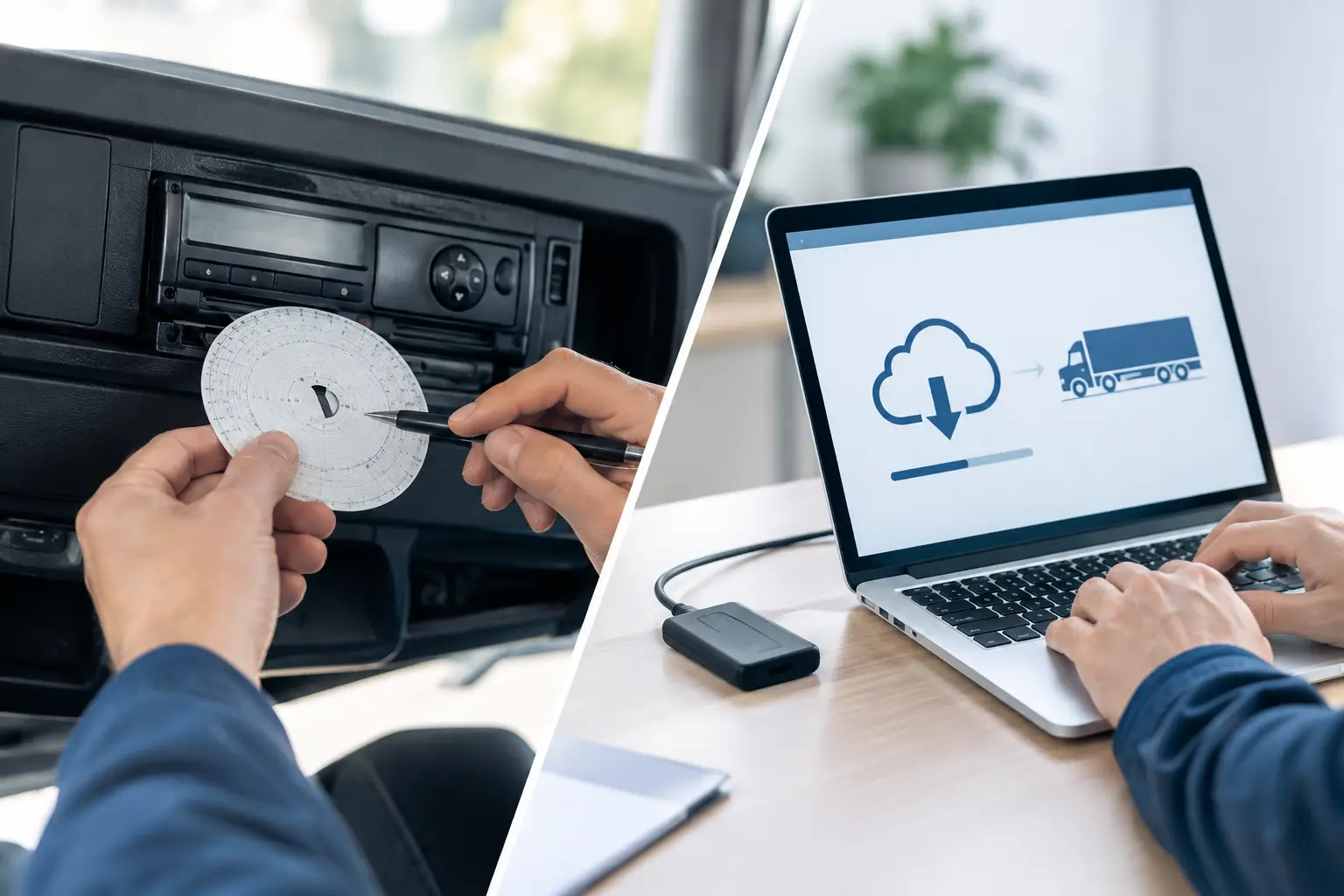
A driver arriving back at base with a card to download should not be the moment your compliance process starts. Yet for many operators, manual tacho versus remote downloads is still a choice between familiar depot routines and a more controlled way to manage driver hours, vehicle-unit data and compliance evidence.
Manual collection can work for a small, local fleet with predictable returns. But it becomes fragile when vehicles are working away, drivers change shifts, or the transport office is already chasing paperwork. Remote downloads change the process from a task dependent on somebody being present into a scheduled control that supports the wider operation.
Manual tacho versus remote downloads: the practical difference
Manual tachograph downloading requires someone to physically collect data from a driver card or vehicle unit. This usually means a driver bringing their card into the office, or a member of the transport team connecting a download device to the tachograph head. Files then need to be transferred, checked, stored and assessed for infringements.
Remote downloading collects the same digital tachograph data through an approved in-vehicle connection and sends it to a central platform. Driver card and vehicle-unit files can be scheduled for download, with the compliance team able to see whether data has been received and where action is needed.
The distinction is not simply about replacing a download key. It is about who carries the responsibility for making the process happen. With manual downloads, the process relies on drivers, depot staff and diary reminders. With remote downloads, the system handles routine collection while people focus on reviewing exceptions and managing risk.
Where manual downloads create operational risk
The main weakness of a manual process is not that it is inherently non-compliant. It is that it has too many handovers. A driver may be on holiday, working from another depot or finishing a shift after the office closes. A vehicle can be away on long-distance work for weeks. One missed reminder can become an overdue file.
UK operators must ensure driver card data is downloaded at least every 28 days and vehicle-unit data at least every 90 days. Many businesses choose more frequent collection to give themselves time to identify issues before they become a pattern. Achieving that schedule manually is possible, but it needs disciplined administration and a clear audit trail.
Manual work also creates a backlog problem. When downloads are left until the end of the week or month, the team is processing historical data. An infringement may be found days after it happened, when the opportunity to speak with the driver, correct planning or provide additional guidance has passed.
For a fleet with a handful of vehicles that return to one yard every night, this may be manageable. For a mixed fleet covering multiple depots, customer sites and overnight work, it quickly becomes a costly use of transport-office time.
The hidden cost is often admin time
The hardware for manual downloads can appear cheaper because it is a one-off purchase. That view overlooks the recurring cost of collecting cards, connecting devices, naming files, chasing missing data and maintaining spreadsheets. It also overlooks the disruption when a compliance administrator is absent or a driver forgets to present their card.
The bigger cost comes when the process cannot keep up with the operation. Late downloads, unreviewed infringements and incomplete records can all make an operator licence audit more difficult than it needs to be.
What remote downloads improve
Remote tachograph downloads allow data to be collected according to a set schedule, whether the lorry is at base, parked at a customer site or working hundreds of miles away. This removes the need to wait for the vehicle and driver card to be physically available at the same location as the compliance team.
A properly configured system gives transport managers a clearer picture of download status. Instead of asking which cards are due, they can see missing files, upcoming deadlines and vehicles that are not communicating. This is a material improvement because a failed download is visible early enough to resolve.
Remote collection also supports faster infringement management. When data reaches the platform regularly, managers can identify repeated rest, break or driving-time issues sooner. The conversation with the driver can then happen while the duty pattern is still current, rather than after payroll has closed or the vehicle has moved on to another contract.
For dispatch teams, the value extends beyond compliance files. Where remote tachograph data is combined with live driver-hours monitoring and vehicle tracking, planners have a better basis for allocating work. They can see who is available, who is approaching a limit and which vehicle is best placed for the next job.
Remote does not mean unattended
Remote downloads reduce routine administration, but they do not remove the operator's responsibility. Someone still needs to review infringements, investigate missing mileage or activity, retain records and take proportionate action. A system can collect the evidence. It cannot conduct the driver debrief or decide whether a route plan needs changing.
The technology also needs the right foundations. The vehicle must have a compatible digital tachograph and suitable remote-download hardware. The business must manage its company card securely, configure download frequencies and check that vehicles are communicating as expected. Poor setup can simply automate a weak process.
Comparing cost, control and resilience
Manual downloads may suit an owner-managed operation with a small number of vehicles, a stable driver team and one operating centre. If every vehicle reliably returns to base and a named person owns the task, physical collection can be a sensible short-term arrangement.
As fleets grow, the calculation changes. A monthly remote-download subscription is easier to budget than the cumulative time spent on manual collection, follow-up and spreadsheet reporting. It can also reduce dependency on one experienced administrator who knows where every file is stored.
Remote systems are particularly valuable for operators running multi-drop work, trunking, agency drivers, night shifts or vehicles based away from the main depot. These are the environments where manual controls tend to fail quietly. The task may look complete because a spreadsheet has been updated, while data from a driver card or vehicle unit is already overdue.
There is a resilience benefit too. Remote access gives managers continuity when office staff are working from different locations or when a depot is disrupted. Compliance information remains available without waiting for a physical device to be passed around.
Choosing the right approach for your fleet
Start with how your vehicles actually operate, not with the price of a download device. Ask how often vehicles return to base, whether cards are routinely missed, how long the team spends chasing data and how quickly infringements are reviewed. If the answer depends on individual memory and paper reminders, the process is carrying unnecessary risk.
Also consider whether tachograph compliance is isolated from the rest of fleet management. Separate systems for downloads, tracking, driver behaviour and maintenance create more logins and more opportunities for information to be missed. A single platform can give a transport manager the context behind a compliance issue, such as the journey, vehicle location and driver activity around it.
Fleetalyse brings remote tachograph downloads together with live driver-hours visibility, GPS tracking and fleet reporting, helping operators turn compliance data into an everyday planning tool rather than a month-end task.
A sensible transition from manual downloading
Moving to remote downloads does not need to be disruptive. Begin by mapping the current process: who downloads cards and vehicle units, where files are stored, how often reports are checked and where missed deadlines occur. This exposes the manual steps that are genuinely necessary and those that exist only because the process has grown over time.
Next, set practical download schedules that are more frequent than the minimum where the operation justifies it. Confirm company-card access, vehicle compatibility and responsibility for checking exceptions. During the first few weeks, compare remote data with your existing records so any configuration or communication problems are found early.
Keep a clear process for drivers and office staff as well. Drivers still need to use their cards correctly, report faults and understand why driver-hours rules matter. The transport team still needs a defined review routine. The difference is that the routine becomes focused on decisions and follow-up, not file collection.
The best tachograph process is the one that still works when the busiest driver is away from base, the compliance administrator is on holiday and the depot is under pressure. That is the practical test worth applying when deciding whether manual downloads are still serving your operation.