

90 Day Tachograph Data Analysis Plan to Reduce DVSA Risk for UK Fleets

Tachograph data analysis turns raw driver card and vehicle unit records into infringement reports, DVSA-ready audit trails, and the operational KPIs that reveal where a fleet loses time and money. Every commercial fleet running under EU or GB domestic drivers’ hours rules needs it. Start today by automating your remote downloads, or pull last month’s driver card data and check it against the working time limits before your next DVSA inspection catches something you missed.
TL;DR:
- Regular automated remote downloads are essential for timely compliance validation and avoiding DVSA penalties, especially as regulations evolve.
- Exception-based reporting highlights critical infringements like daily driving limits, repeat violations, and incomplete driver data for targeted management.
- Combining tachograph data with GPS, fuel, and maintenance info provides a comprehensive operational view and improves incident investigation efficiency.
- Proper storage, security, and regular review of tachograph data are vital to maintain compliance and support external audits or enforcement.
- Enhancing skills in data interpretation and driver communication ensures effective debriefs, reduces repeat infringements, and maximizes operational benefits.
Table of Contents
- What is tachograph data analysis and what does a tachograph record?
- Why DVSA compliance makes tachograph analysis non-optional
- How to collect, store and secure tachograph data
- How to analyse tachograph data for compliance and operational insight
- Checklist for choosing a tachograph analysis approach
- Practical evidence and Fleetalyse proof points
- Connecting tachograph data with your wider fleet management system
- What skills and training does tachograph data analysis actually need?
- Common pitfalls in tachograph data analysis and how to avoid them
- How UK tachograph regulation changes affect analysis practice
- Practical steps to interpret tachograph data and catch inefficiency early
- Author perspective: priority actions for the first 90 days
- Getting started with Fleetalyse
- Sources
What is tachograph data analysis and what does a tachograph record?
Tachograph data analysis is the process of extracting, checking, and reporting on the information a vehicle unit and driver card capture during every journey. The output is what a transport manager actually uses day to day: infringement reports flagging drivers’ hours breaches, working time summaries, and speed or distance traces that show how a vehicle was actually driven, not how the schedule said it should have been driven. Tachograph analysis exists specifically to monitor driver performance and produce the evidence transport managers need for compliance obligations.
A digital tachograph and driver card together log a detailed activity trail. The core data set includes:
- Activity codes (driving, other work, availability, rest) with precise timestamps
- Vehicle unit events, including card insertion and removal, speed violations, and power interruptions
- Distance travelled and recorded speed against the road speed limiter
- Calibration entries confirming the unit’s last inspection
Analogue tachograph charts still appear in a handful of older vehicles, though most UK fleets now run digital units. The key difference is that charts require manual interpretation of hand-drawn traces, whereas digital data downloads directly into software for automated infringement detection.
Why DVSA compliance makes tachograph analysis non-optional
Every operator running vehicles under an operator’s licence answers to the DVSA, and the agency’s expectations on download frequency and record retention are published in detail on Gov. Miss a download deadline or fail to retain records for the required period, and you’re exposed at the roadside, at a maintenance investigation, or during an Operator Compliance Risk Score review.
Pro Tip: Undocumented compliance checks count for very little with the DVSA. If you can’t show a dated record of when an infringement was flagged and what corrective action followed, it’s treated as though no check happened at all.
The practical fallout from weak tachograph oversight tends to follow a familiar pattern: unnoticed drivers’ hours infringements accumulate, DVSA flags them during a routine check, and the operator faces fines or a referral to the Traffic Commissioner. That referral can put the operator’s licence itself at risk. Regular analysis paired with documented driver debriefs breaks that chain early, because it gives you evidence of monitoring rather than just a pile of downloaded files. It also matters if you’re pursuing DVSA Earned Recognition, where KPI evidence showing consistent compliance monitoring is central to qualifying for the scheme’s lighter-touch enforcement approach.
How to collect, store and secure tachograph data
Two collection methods dominate UK fleets. Remote download uses a telematics unit to pull driver card and vehicle unit data automatically over a mobile network, usually on a fixed schedule. Manual download means a member of staff physically connects a reader to the vehicle or driver card, which works for small fleets but scales poorly once you’re managing more than a handful of vehicles across multiple depots.
Whichever method you use, the retention and handling steps stay broadly the same:
- Download vehicle unit and driver card data at the frequency gov.uk specifies for your fleet type.
- Store data with a clear retention schedule, checking gov.uk for the current minimum period rather than assuming last year’s rule still applies.
- Restrict access to personal driver data to authorised staff only.
- Keep a backup copy separate from your primary storage location.
Because driver card data counts as personal data, the ICO’s data protection guidance applies whether you store it on a local server or in the cloud. Cloud storage offers easier remote access and automated backup, but you need contractual assurance from the provider on where data sits and who can access it. Local storage gives you more direct control but shifts the backup and security burden onto your own IT setup.
How to analyse tachograph data for compliance and operational insight
Reporting-by-exception is the technique that separates a fleet drowning in paperwork from one that runs tight compliance with a small team. Rather than reviewing every driver’s every shift, the system flags only the records that breach a rule or fall outside a set tolerance, so your attention goes straight to what needs it.
Not every infringement carries the same DVSA risk. Prioritise:
- Daily and weekly driving limit breaches, which DVSA treats as the most serious category
- Missing or incomplete driver card data, which suggests a compliance gap rather than a one-off mistake
- Repeat infringements from the same driver, which point to a training or scheduling problem rather than an isolated error
KPI dashboards turn that infringement data into management decisions. A hours compliance rate below target across a depot might mean your route planning is unrealistic, not that your drivers are careless. A short list of repeat infringers usually needs one-to-one coaching rather than a fleet-wide policy change. Vehicle utilisation figures pulled from the same data set can also show which assets are underused, informing decisions that have nothing to do with compliance at all.
The workflow that ties this together runs in four steps: an exception alert fires when a driver breaches a threshold, a transport manager investigates the specific circumstances, a debrief with the driver establishes what happened and why, and the corrective action gets recorded against that driver’s file. That last step matters more than most operators realise. A debrief that isn’t written down is a debrief the DVSA will treat as though it never took place.
Checklist for choosing a tachograph analysis approach
Whatever system you’re evaluating, whether that’s dedicated software, a telematics platform, or a managed service, the same core requirements apply. Automation should sit at the centre: look for remote download capability, scheduled reports that land in your inbox without manual intervention, and exception alerts that surface only the infringements worth your time. DVSA-ready exports save hours when an inspection or Earned Recognition audit lands unannounced.
Operational fit matters just as much as compliance features:
- A driver-facing app for viewing availability and receiving alerts directly
- Electronic debrief tools that create a timestamped, signed record of every driver conversation
- Support for mixed fleets, including HGVs, vans, and trailers, without needing separate systems
- Scalability that doesn’t force a system change once you cross a certain vehicle count
Pro Tip: Ask any provider exactly what happens to your data if you cancel. A system that locks your historical compliance records into a proprietary export format leaves you exposed the moment you switch providers, right when you need that history most.
Security and contract terms round out the checklist: confirm data export options, audit trail depth, whether support is UK-based, and what the contract commits you to beyond the first renewal date.
Practical evidence and Fleetalyse proof points
Fleetalyse builds directly against that checklist rather than around it. Remote tachograph downloads run automatically through plug-and-play telematics hardware, removing the manual download step entirely for fleets that have historically relied on someone physically visiting each vehicle. Automated exception alerts flag infringements as they happen rather than at month-end, and KPI dashboards give transport managers the hours compliance rate, repeat infringer lists, and utilisation figures needed for both day-to-day management and Earned Recognition evidence.
The operational gain most operators notice first is time. Manual downloads and spreadsheet-based infringement tracking consume hours every week that a debrief and corrective action log could use instead. The audit trail that results, timestamped downloads, flagged exceptions, recorded debriefs, is exactly what a DVSA inspector expects to see. On data security, Fleetalyse’s approach follows the same baseline the ICO sets out for organisations handling personal data, with UK-based support for setup and troubleshooting.
Connecting tachograph data with your wider fleet management system
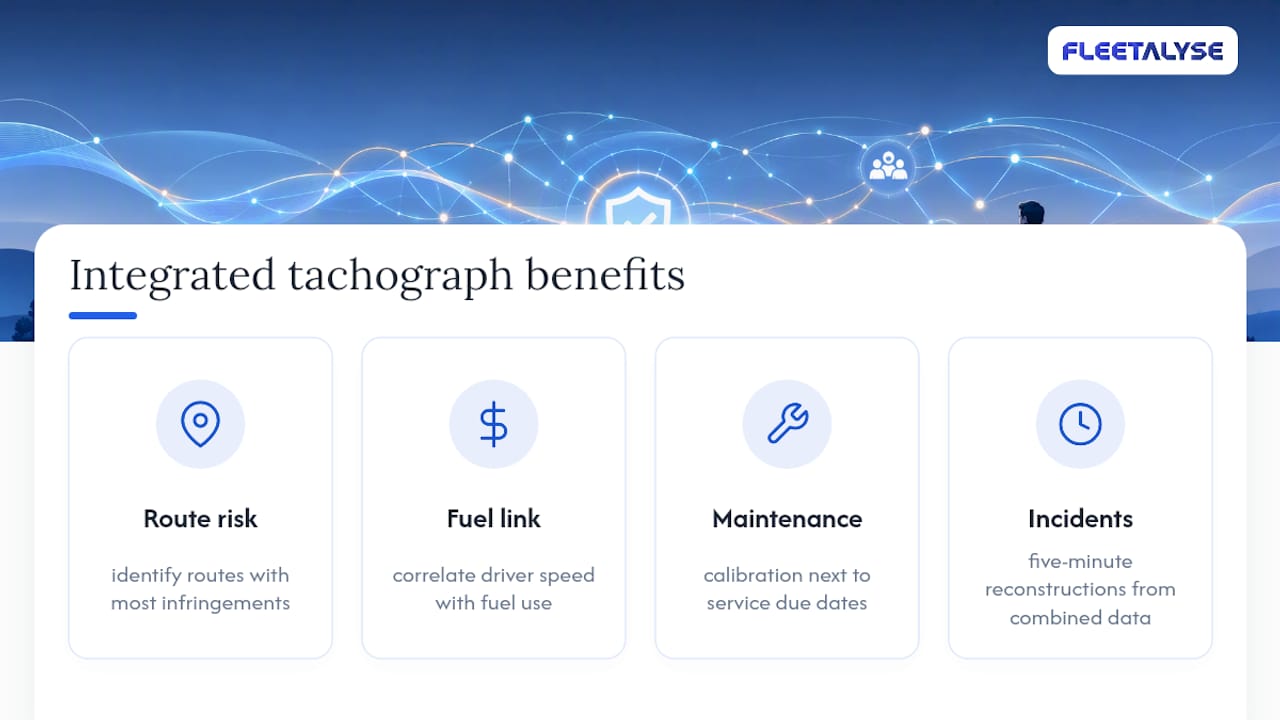
Tachograph data becomes far more useful once it stops living in isolation. On its own, a drivers’ hours report tells you about one driver’s compliance status. Combined with GPS location data, fuel consumption figures, and maintenance schedules inside a single fleet management platform, it tells you something closer to the full operational picture: which routes cause the most infringements, whether a driver’s speed patterns correlate with fuel use, and whether a vehicle due for a service is also the one generating the most exception alerts.
This is where tachograph analysis software earns its place as infrastructure rather than a bolt-on compliance tool. Integrating remote downloads with real-time analysis keeps every part of the picture current, so a transport manager reviewing a route isn’t cross-referencing three separate systems to work out why a particular run consistently runs late or racks up infringements.
The practical benefit shows up most clearly during incident investigation. If a vehicle is involved in an event on the road, having tachograph activity data, GPS breadcrumb trail, and driver behaviour scores in one place turns what used to be a half-day reconstruction into a five-minute lookup. The same integration supports maintenance planning too: a vehicle unit calibration entry sitting next to a service due date means nobody misses a legally required recalibration because it wasn’t on the maintenance team’s radar.
Fleets running mixed assets, HGVs alongside vans and trailers, benefit most from this kind of integration, because compliance rules and operational patterns differ across vehicle types. A single dashboard that separates and correctly interprets each category avoids the kind of misapplied rule that creates false infringement flags and wastes a transport manager’s morning chasing a non-issue.
What skills and training does tachograph data analysis actually need?
Reading a tachograph report well is a skill, not a given, and it’s one that varies enormously between transport managers depending on how they came into the role. Understanding drivers’ hours rules, including the distinctions between EU rules and GB domestic rules, forms the foundation. Without that grounding, an exception alert is just a red flag with no context attached.
Beyond the regulatory knowledge, effective analysis needs a working understanding of what “normal” looks like for your own fleet. A speed pattern that would be alarming on a motorway-heavy long-haul route might be entirely expected on urban multi-drop work. That judgment comes from experience with your own operation’s data, not from a generic training course alone.
Formal training routes exist through organisations offering Certificate of Professional Competence refresher courses and dedicated tachograph analysis modules, often run alongside Driver CPC training providers. Many transport managers build the rest of their capability through the reporting tools themselves, since a well-designed exception report teaches pattern recognition faster than a classroom session ever could.
The skill that’s easiest to underrate is communication. A debrief only works if the driver understands what went wrong and why it matters, and a transport manager who can explain a working time infringement without sounding like they’re reading from a rulebook gets far better compliance outcomes than one who simply issues a warning letter. Investing in that conversational skill pays back more than most people expect, particularly for repeat infringers who need coaching rather than another written warning.
Common pitfalls in tachograph data analysis and how to avoid them
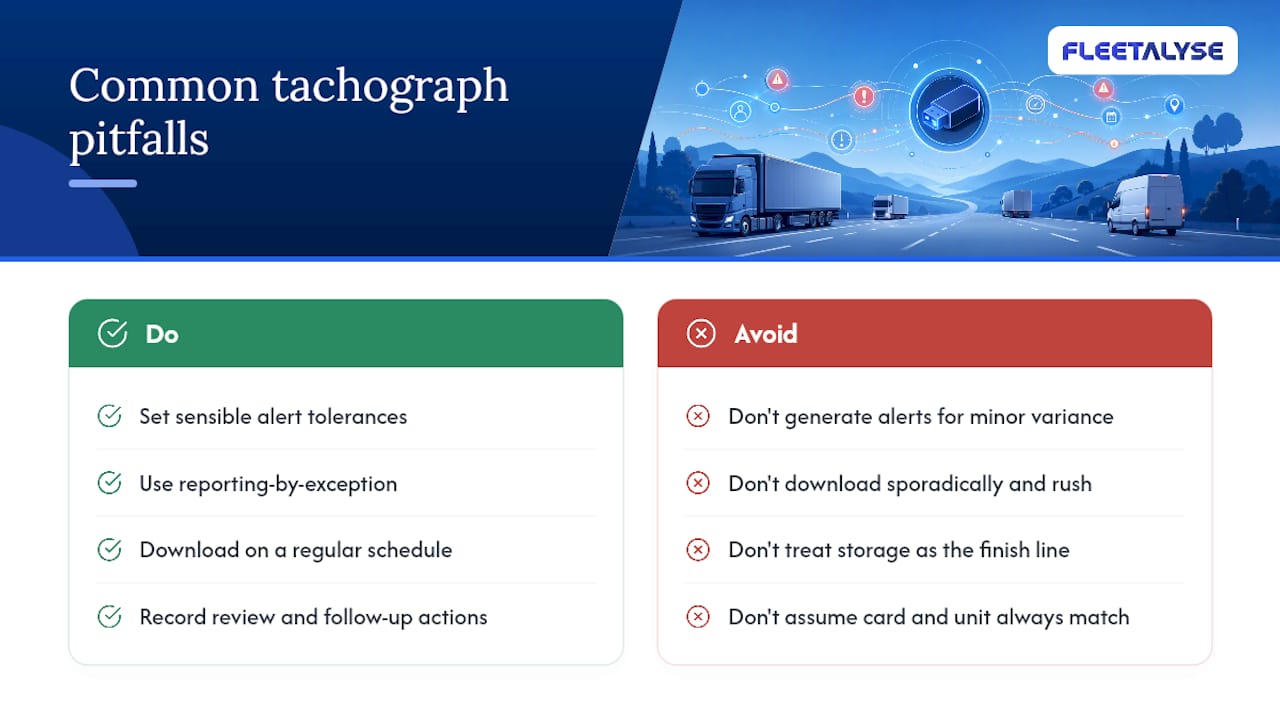
Alert fatigue is the pitfall that undoes more compliance programmes than any other. When every minor deviation generates an alert, transport managers start skimming rather than reading, and the alert that actually matters gets lost in the noise. Fixing this means setting sensible tolerances from the outset and using reporting-by-exception properly, so the system surfaces genuine risk rather than every trivial variance.
Inconsistent download schedules cause a related problem. A fleet that downloads data sporadically, catching up in a rush before an inspection, ends up analysing infringements weeks after they happened, by which point the corrective conversation with the driver has far less impact and the audit trail looks reactive rather than proactive.
Treating storage as the finish line is another common error. Downloading and archiving data satisfies part of the retention obligation, but DVSA enforcement focuses on evidence of monitoring and follow-up action, not simply on whether a file exists somewhere. A folder full of downloaded data with no record of review or debrief doesn’t demonstrate active management.
Card and vehicle unit mismatches also trip up fleets running mixed or hired vehicles, where a driver’s card history doesn’t line up cleanly with the vehicle unit’s own record of who was driving when. This usually needs a manual cross-check process for hired or shared vehicles rather than assuming the automated system will always match records correctly.
Finally, treating analysis purely as a compliance exercise wastes the operational value sitting inside the same data. Utilisation figures, fuel patterns, and driver behaviour scores come from the same downloads used for infringement checking. Fleets that only look at the compliance side leave genuine efficiency gains unclaimed.
How UK tachograph regulation changes affect analysis practice
UK tachograph rules haven’t stayed static, and operators who treat their compliance setup as a one-time configuration tend to fall behind without realising it. Smart tachograph requirements phased in for newly registered vehicles changed what data gets recorded and how, adding automatic recording of border crossings and additional GNSS positioning data compared with earlier digital units. Any analysis software or process built around older tachograph generations needs to account for these expanded data fields, or it risks missing information that DVSA now expects to see referenced during checks.
Retention period requirements and download frequency rules are set out on gov.uk and are worth checking periodically rather than assuming the figure you learned when you started the role still holds. Regulatory guidance gets updated, and a retention schedule built around outdated assumptions is a compliance gap waiting to be discovered during an inspection.
The practical impact for transport managers is that analysis processes need periodic review, not a permanent setup. A checklist or workflow built two or three years ago around an older tachograph generation may not fully capture what a current vehicle unit records, particularly around GNSS and remote communication data. Building a habit of checking gov.uk guidance annually, or whenever fleet vehicles are replaced, keeps your analysis process aligned with what enforcement actually expects rather than what used to be sufficient.
Practical steps to interpret tachograph data and catch inefficiency early
Start every review with the infringement report rather than the raw activity log. It’s the fastest route to the issues that carry real DVSA risk, and it stops you getting lost in hours of driving data before you’ve identified what actually needs attention.
Cross-reference infringements against the driver, the route, and the vehicle before drawing conclusions. A single driver with infringements across multiple vehicles points to a behaviour or scheduling issue. A single vehicle generating infringements across multiple drivers points to a route planning problem or a fault with the vehicle unit itself.
Look at trends across weeks, not single incidents. One late finish rarely means much on its own, but a driver who’s consistently close to the weekly driving limit is heading towards a breach that a single-day view won’t catch until it’s already happened.
Bring vehicle utilisation and fuel data into the same review rather than treating compliance and operations as separate exercises. A vehicle with low utilisation and high fuel consumption per mile often has a maintenance issue that a purely compliance-focused review would never surface. The same download that flags a drivers’ hours infringement can flag an inefficiency costing you far more over a year.
Document every debrief with a dated, signed record, even for minor infringements. Building this habit before an inspection forces it means you’re never scrambling to reconstruct what happened weeks after the fact, and it gives you a genuine pattern to reference the next time the same driver approaches a limit.
Author perspective: priority actions for the first 90 days
Most operators try to fix everything at once and end up fixing nothing well. A sharper approach for the first 90 days: automate downloads first, switch on exception alerts second, then spend weeks three and four resolving your top three recurring infringements rather than chasing every minor one. Start driver debriefing in parallel, even informally, because the habit matters more than the paperwork initially. Prioritising this way cuts enforcement risk faster than trying to build a perfect system on day one. By day 90, aim for a measurable hours compliance rate improvement and a documented debrief for every flagged repeat infringer.
— Vytautas
Getting started with Fleetalyse
Fleetalyse gives transport managers exactly the setup this checklist calls for: remote tachograph downloads that remove manual visits to each vehicle, KPI dashboards built around the hours compliance rate and repeat infringer figures that matter for DVSA and Earned Recognition, and UK-based support when something needs troubleshooting rather than a call centre in a different time zone. Driver behaviour monitoring sits alongside the tachograph data, so a single dashboard covers compliance and operational performance without switching between systems.
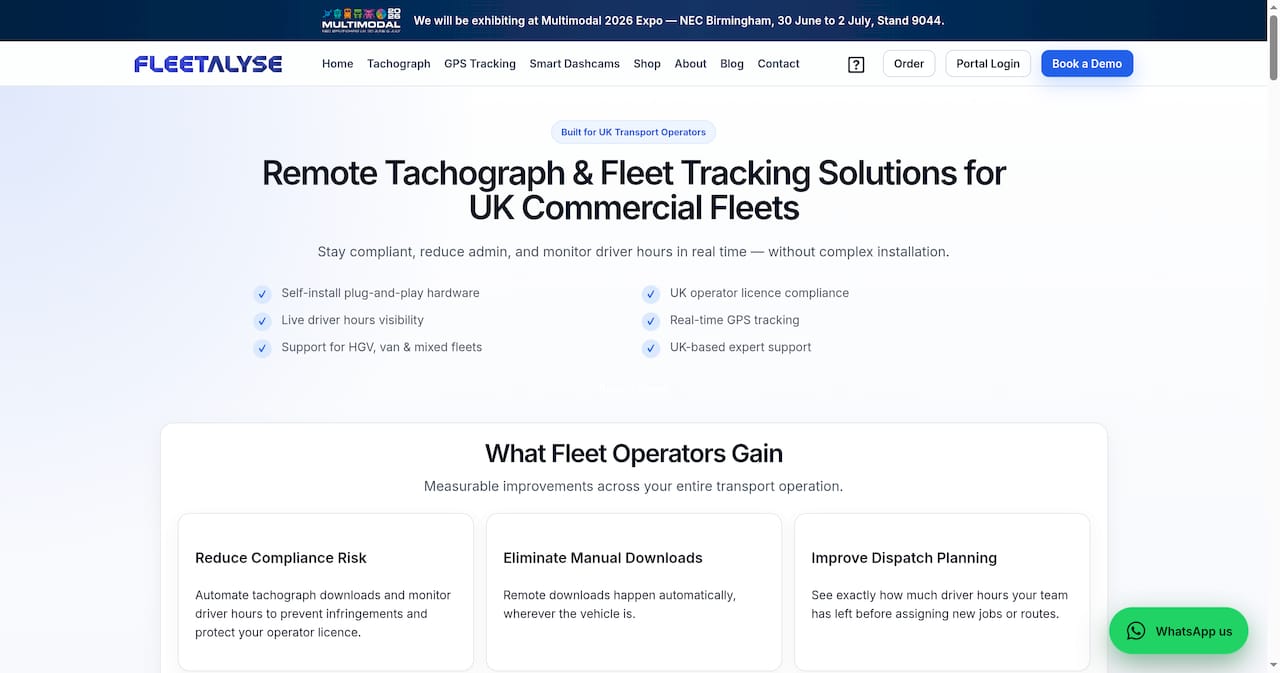
If your fleet is still relying on manual downloads or a spreadsheet to track infringements, the fastest fix is automating the download step and letting exception alerts do the filtering for you. Explore the driver behaviour monitoring features to see how compliance and performance data sit together, or check the unlocked GPS trackers if you need plug-and-play hardware to get remote downloads running without a professional installation. Request a demo to see your own fleet’s data running through the dashboards before committing to anything.
Sources
Gov.uk tachograph guidance, ICO data protection guidance, and Fleetalyse’s remote download guide cover the detail beyond this article.