
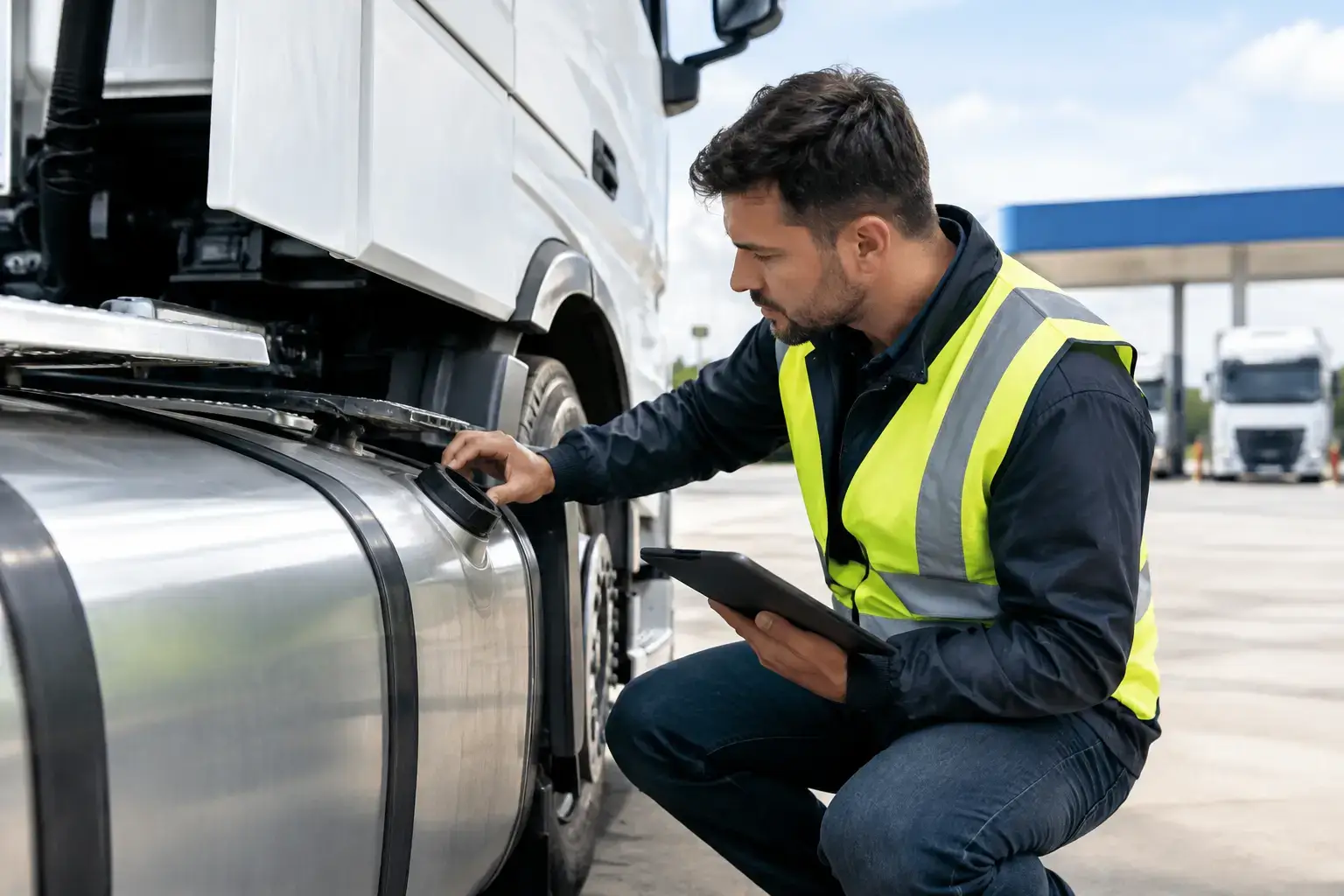
A fuel card transaction that does not match a vehicle’s location is not proof on its own. Drivers may have diverted for a safe parking area, a depot may have recorded mileage late, or a fuel receipt may have been entered incorrectly. But when location, mileage, fuel volume and vehicle usage tell different stories repeatedly, the cost can build quickly. Knowing how to identify fuel theft means spotting those patterns early, investigating fairly and putting controls in place that do not create more admin for the transport team.
For UK operators, fuel theft is not limited to siphoning from a parked lorry. It can include unauthorised fuel-card use, over-fuelling for resale, fuel taken from tanks outside working hours, or fuel charged to a vehicle that was not present. The strongest response combines clear processes with telematics data rather than relying on one report or one person’s judgement.
Start with the difference between fuel loss and fuel theft
Not every poor fuel result is dishonesty. Before investigating an individual driver, rule out operational causes. A vehicle travelling on congested routes, carrying heavier loads, idling at a distribution centre or working through winter conditions will use more fuel. A mechanical fault, such as a leaking fuel line, damaged injector or tyre-pressure issue, can also affect consumption.
The key distinction is whether the loss can be explained by the work completed. If fuel usage rises while miles, engine hours, load profile and route conditions remain broadly stable, it deserves attention. If a vehicle has been stationary overnight but its fuel level drops sharply, that is a more direct warning sign. Context matters, which is why a monthly miles-per-gallon figure alone is rarely enough.
How to identify fuel theft through connected data
Fuel theft is usually found in the gaps between systems. A fuel card provider can show where and when fuel was bought. Vehicle tracking can show where the vehicle was at that time. Engine data, odometer readings and driver records add the operational detail needed to test whether the transaction makes sense.
Match fuel transactions to vehicle location
Compare every fuel purchase against GPS position and journey history. A legitimate transaction should generally align with the vehicle being at, or very close to, the filling station. A discrepancy of a few minutes may be normal where location updates are not continuous or a forecourt has weak signal. A vehicle several miles away, parked at a depot or switched off elsewhere is a stronger concern.
Also look at the time of the transaction. Fuel bought during a planned journey is easier to explain than fuel purchased late at night, during a rest period, or on a day when the vehicle was not allocated work. This check is particularly useful where drivers share cards, vehicles rotate between shifts or fuel cards are retained in cabs.
Look for sudden drops in fuel level
Where vehicle data provides fuel-level readings, create alerts for unusual drops when the ignition is off. A gradual change can reflect sensor variation, parking angle or temperature. A sharp reduction over a short period, especially at an unsecured location, needs investigation.
The location tells you what to check next. Repeated drops at the same lay-by, industrial estate or overnight parking site may indicate a security issue affecting several vehicles. A pattern linked to one vehicle, one shift or one driver may point elsewhere. Either way, do not assume the cause until you have checked for leaks and sensor accuracy.
Compare litres purchased with tank capacity and usage
A transaction that exceeds the usable space in the tank is one of the clearest exceptions to investigate. Calculate expected available capacity using the previous fill, distance travelled and normal consumption for that vehicle. Be realistic: fuel gauges are imperfect, and drivers may fill at different points in the day. The purpose is to identify transactions that are implausible, not to create false alarms over small variances.
Watch for repeated round-number purchases, frequent small fills without a route reason, or unusually high volumes after short journeys. These patterns can indicate card misuse or unauthorised decanting, but they may also reflect route planning, site access or a driver avoiding a more expensive forecourt. Check the full operating picture before drawing conclusions.
Compare fuel performance by comparable work
Averages across an entire fleet can hide the problem. Compare like with like: the same vehicle type, route, payload, driver shift and season where possible. A 44-tonne articulated vehicle on regional trunking should not be benchmarked against a lightly loaded van on local multi-drop work.
Once a fair baseline is in place, flag vehicles that consistently fall outside it. Look for deterioration that cannot be explained by route changes, idling, driver behaviour or maintenance. This can reveal fuel theft, but it can also identify excessive speeding, unauthorised use, poor route adherence or a developing mechanical issue. Each has a cost, and each benefits from early action.
Check the operational warning signs
Data should lead to practical checks, not sit in a monthly spreadsheet. When an exception appears, review the driver’s planned work, delivery schedule, tachograph activity where relevant, vehicle location and fuel receipt. Speak to the driver with the facts available and give them an opportunity to explain the discrepancy.
Common warning signs include:
- fuel purchases made when the vehicle is not at the forecourt;
- fuel-level drops while parked with the ignition off;
- litres purchased that do not fit the tank’s expected available capacity;
- repeated consumption that is materially worse than comparable vehicles; and
- purchases outside authorised times, routes or operating areas.
One warning sign may have an innocent explanation. Several connected exceptions are much harder to dismiss. Keep an audit trail of what was found, what was checked and the outcome. This protects the business if disciplinary action becomes necessary and helps identify weaknesses in the process even where theft is not proven.
Build controls that make theft harder
The best anti-theft measures reduce opportunity without making legitimate refuelling difficult. Start with fuel-card rules that reflect how the fleet actually operates. Cards should be assigned to a named driver or vehicle, protected by a PIN and limited to appropriate products. Set transaction limits that suit the vehicle’s tank size and work pattern, rather than applying a generic cap that causes operational delays.
At the depot, control access to bulk tanks, record opening and closing stock, and reconcile deliveries against dispensed volume. Cameras, lighting and secure parking are worthwhile where vehicles regularly stand overnight. Locking fuel caps and anti-siphon devices can deter opportunist theft, although they will not identify card misuse or deliberate internal fraud.
Clear driver communication is equally important. Explain that fuel use is monitored to manage costs, vehicle condition and security, not simply to catch people out. Drivers are often the first to report a leaking tank, a suspicious forecourt transaction or attempted siphoning. A reporting culture is more useful than a rulebook nobody trusts.
Use alerts, but avoid alert fatigue
Real-time exception alerts can reduce the time between an incident and a response. A transport manager may want immediate notification of a significant fuel-level drop outside a depot, a fuel transaction away from the tracked vehicle, or a purchase above a defined threshold. These are sensible triggers because they are specific and actionable.
Too many alerts create noise. Set thresholds by vehicle class and operating pattern, then review them after the first few weeks. A long-haul unit working nights needs different tolerances from a local van returning to base each evening. The goal is not to investigate every variance; it is to make serious anomalies visible before they become a recurring cost.
An integrated platform such as Fleetalyse can bring vehicle location, journey history, driver activity and fuel reporting into one operational view. That reduces the time spent exporting reports and comparing disconnected systems, while giving managers the evidence needed to investigate an exception properly.
Respond fairly when an anomaly is found
If you suspect fuel theft, preserve the evidence before confronting anyone. Record the transaction details, vehicle position, journey history, fuel readings, relevant receipts and any available depot or site footage. Check whether another authorised driver had access to the vehicle or card, and whether a mechanical inspection is required.
Keep the investigation proportionate. An unexplained £20 variance is not handled in the same way as repeated high-value transactions that conflict with vehicle tracking. Follow your company policy, involve the appropriate manager or HR support where necessary, and avoid accusations before the evidence has been tested. A fair process protects good drivers and gives the business a defensible basis for action where misconduct is established.
Fuel is one of the fleet costs that can quietly escape attention because each individual exception looks small. Treat fuel data as an operational control, checked against where vehicles were, what work they completed and how they were driven, and the picture becomes far clearer. The result is not just a better chance of finding theft, but tighter planning, earlier maintenance intervention and more control over every litre purchased.