
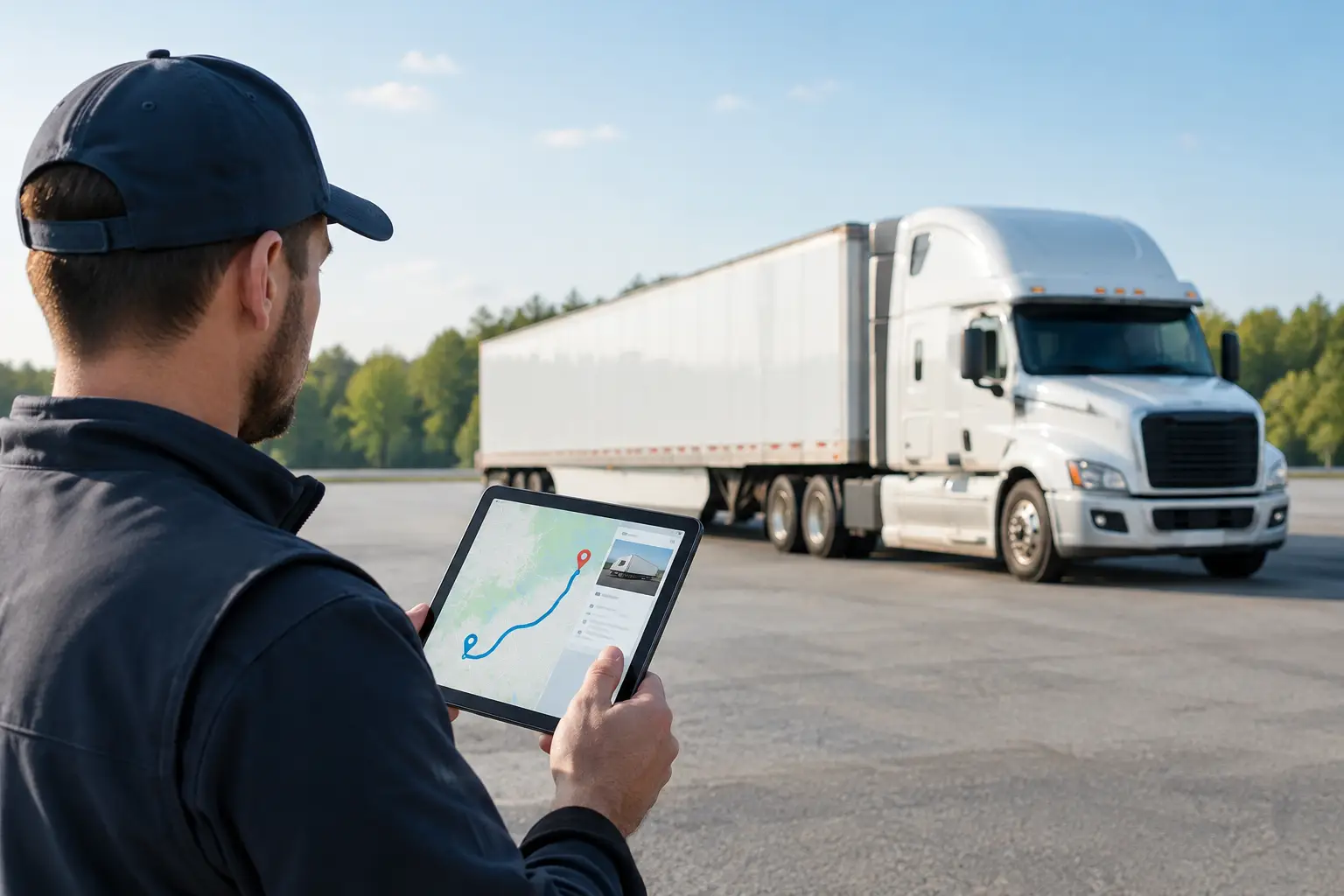
A trailer can be one of the most valuable assets on a transport operation, yet it is often the least visible. It may be parked at a customer site, left in a third-party yard, swapped between tractors or waiting at a depot with no clear record of its next job. The ability to track trailer movements turns that uncertainty into useful operational information.
For UK operators, trailer tracking is not simply about seeing a dot on a map. It gives transport teams a dependable record of where assets are, how they are being used and when attention is needed. That supports better dispatch planning, reduces avoidable hire costs and helps protect the assets that keep work moving.
Why trailer visibility is harder than vehicle visibility
A lorry normally has a fixed driver, an ignition event and a planned route. A trailer operates differently. It can be uncoupled, moved by another vehicle, parked for days or sent to a location outside the control of your own depot team. If its movements are recorded only through job sheets, phone calls and spreadsheets, the information will quickly fall behind reality.
This creates familiar daily problems. A planner may believe a curtain-sider is available when it is still loaded at a customer site. A depot may hire in equipment because an owned trailer cannot be located quickly. A trailer can remain idle for weeks without anyone noticing, while another is worked beyond its planned maintenance interval.
Live GPS trailer tracking gives the team a single, current view of each asset. More importantly, it provides a history of movement rather than relying on somebody remembering where a trailer was last seen.
How to track trailer movements effectively
Effective trailer tracking starts with the right information, not just the right hardware. Location matters, but it becomes operationally useful when it is viewed alongside trailer status, movement history, geofences and planned work.
Fit tracking that works independently of the tractor
A trailer needs its own tracking device. Relying on the tractor unit only shows where the vehicle is, not where the trailer remains after uncoupling. An independent GPS tracker continues to report its position when the trailer is parked, transferred or held at a customer premises.
For many fleets, self-install hardware is the practical choice. It avoids taking trailers out of service for lengthy installations and makes it easier to equip a large mixed estate. However, device selection should reflect the operating environment. Trailers working across long-distance routes, customer yards and secure compounds may need more frequent reporting than trailers used mainly within a local distribution network.
Power source also matters. A tracker should be suited to the trailer and expected reporting schedule, particularly where an asset may stand idle for extended periods. The aim is dependable visibility without creating another maintenance task for the workshop.
Use geofences to make location data actionable
A map showing dozens or hundreds of trailers can become background noise. Geofences make tracking more useful by creating virtual boundaries around locations that matter to the operation, such as depots, customer sites, workshops, ports and approved parking areas.
When a trailer enters or leaves a geofenced site, the system can create a time-stamped event. This helps planners confirm arrivals and departures without chasing drivers or calling site contacts. It can also highlight exceptions, including an asset leaving a secure location outside expected hours or remaining on a customer site longer than agreed.
The most useful geofences are not necessarily the most numerous. Start with operationally significant locations where delays, handovers or unplanned movements have a commercial impact. Too many alerts can lead to teams ignoring the ones that matter.
Record movement history for investigation and planning
A current location answers one question: where is the trailer now? Movement history answers the questions that usually follow. When did it arrive? How long did it remain there? Which route did it take? Has it moved since it was allocated to a job?
This history is valuable when resolving customer queries, investigating damage or identifying unproductive dwell time. If a trailer has spent several days in an unfamiliar location, the transport office can act before it becomes a lost asset or a missed collection.
It also improves planning over time. A fleet may find that certain customer sites routinely hold trailers longer than expected, or that particular equipment types are regularly positioned in the wrong region. These are planning issues that a single location check will not expose.
Turn trailer data into better dispatch decisions
Trailer tracking is most useful when dispatch staff can see it alongside vehicle availability and driver activity. A planner needs to know more than the nearest trailer. They need to know whether it is at the right location, suitable for the load, available for collection and likely to remain there.
Consider a loaded trailer due for collection from a customer site. Without live data, the planner may allocate a tractor unit based on an expected completion time. With current trailer movement information, they can see whether the asset has actually arrived, whether it has left the site or whether it has been stationary for longer than planned. That allows the job to be reassigned early rather than discovering a problem after a driver has travelled to site.
There is a trade-off here. Tracking data supports decisions, but it does not replace clear transport processes. Teams still need accurate trailer IDs, job allocation discipline and a straightforward method for recording trailer defects, load status and handovers. GPS can show that a trailer is at a site; it cannot always confirm whether it is empty, roadworthy or ready to load.
Reduce loss, unauthorised use and wasted hire spend
Trailers are mobile assets with a high replacement cost and, in some cases, limited physical security. A tracking device improves the chance of recovering a missing trailer by providing a last known or live location. Alerts for unexpected movement can bring an issue to attention much earlier than a periodic yard check.
Unauthorised use is not always theft. It may be an unapproved inter-depot transfer, a subcontractor retaining a trailer beyond the agreed period or equipment being moved to a site without the transport office being informed. A clear movement record gives managers facts to work from and makes asset responsibility easier to manage.
The financial benefit also extends to utilisation. Before hiring a trailer, the planner can check whether an owned asset is available nearby. Before purchasing more equipment, management can assess whether the current fleet is genuinely at capacity or simply poorly positioned. These decisions need context, but reliable location and dwell data make the conversation more productive.
Connect trailer tracking with maintenance control
A trailer that is difficult to locate is also difficult to maintain. Missed inspections, overdue servicing and unresolved defects can create operational disruption and compliance exposure. Tracking provides the location intelligence that helps the workshop plan work around the actual position of the asset.
For example, if a trailer is due for inspection but will be at a customer site for the next week, the team can plan collection or schedule an alternative before the deadline becomes urgent. If it is already back at depot, maintenance can be arranged while it is available rather than taking it out of service during a busy period.
The strongest approach brings tracking and maintenance reminders into the same fleet management process. Fleetalyse helps operators view trailer locations alongside wider fleet activity, maintenance requirements and compliance information, reducing the need to piece together updates from separate systems.
Set sensible alerts and ownership rules
Alerts should prompt action, not create a stream of notifications that nobody has time to review. Start with the situations that carry the greatest operational risk: movement outside agreed hours, departure from a secure yard, extended dwell at a customer location and trailers approaching planned maintenance dates.
Assign each alert type to a role. The transport office may manage customer-site dwell, the depot team may investigate out-of-hours movement, and the workshop may own maintenance-related exceptions. When responsibility is clear, data becomes part of the working day rather than another report waiting to be read.
It is also worth agreeing how long a trailer can remain at key locations before it is escalated. The right threshold depends on the job type, customer agreement and local operating pattern. A 24-hour alert may be appropriate for a high-turnover distribution trailer but unrealistic for equipment supporting a longer construction or event contract.
Measure utilisation, not just movement
A trailer that moves frequently is not automatically well utilised. It may be travelling empty, being repositioned unnecessarily or spending excessive time waiting between jobs. Equally, a trailer that has not moved for several days may be performing exactly as expected on a static contract.
Review tracking data against the planned purpose of each trailer. Look for assets that have remained inactive beyond their expected cycle, equipment repeatedly held at the same customer site and trailers that regularly require costly repositioning. This helps distinguish genuine spare capacity from assets that are simply not being managed closely enough.
The goal is not to monitor every movement for its own sake. It is to give dispatch, compliance and depot teams a shared view of the trailer estate, so decisions are based on current evidence rather than assumptions. When the next urgent collection comes in, knowing exactly what is available and where it is can protect both the job and the margin.