

Vehicle service intervals: a practical UK guide

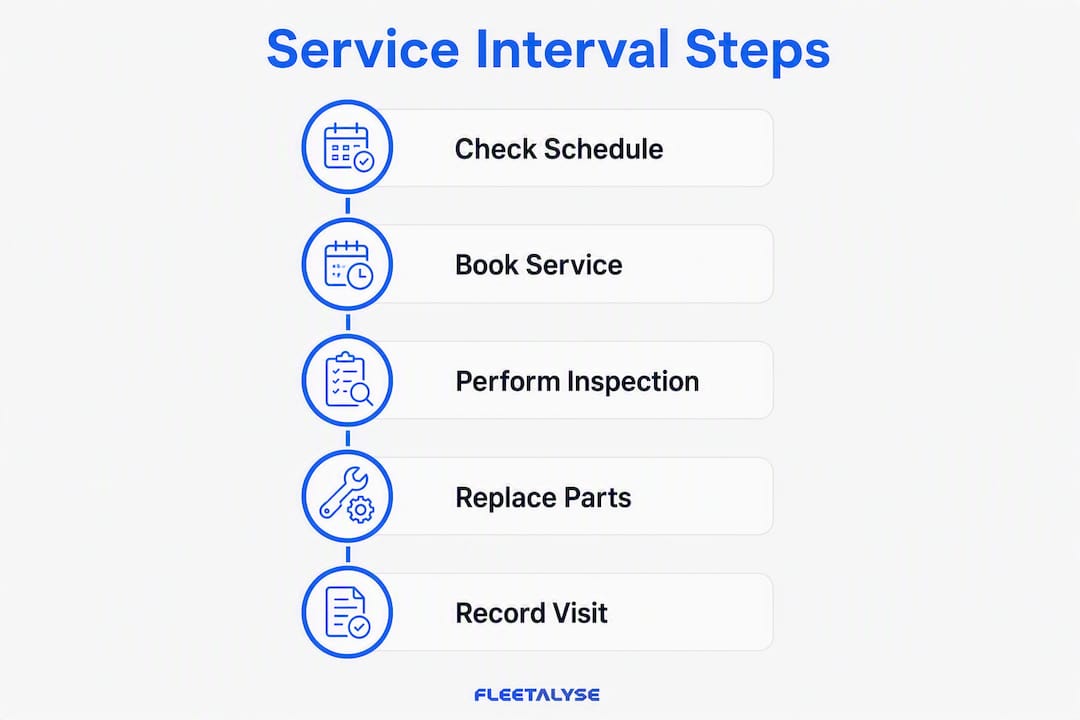
Service your vehicle at least once a year or when it reaches the manufacturer’s recommended mileage threshold, whichever comes first. Most manufacturers set this at the recommended mileage or time interval, though your exact figure lives in your owner’s manual or on your vehicle’s onboard maintenance display. Following that schedule protects your warranty, keeps the vehicle roadworthy, and preserves resale value. The RAC recommends checking your service book and manufacturer guidance before booking, Ford UK publishes model-specific schedules on its owner portal, and DVSA/GOV.UK sets the statutory framework for MOT and roadworthiness in the UK. Your immediate next step: open your owner’s manual, glance at the instrument cluster for any service alert, and book accordingly.
Quick actions to take right now:
- Check your owner’s manual or manufacturer website for your model’s exact schedule.
- Look at your instrument cluster or onboard display for any active service reminder.
- Confirm your last service date and mileage against the current odometer reading.
- Book a service if you are within 1,000 miles or one month of the due point.
Table of Contents
- What is a service interval and why does it matter?
- What types of service are there and what does each include?
- How do you find your car’s official maintenance schedule?
- When should you service more frequently than the standard schedule?
- What happens if you miss a service in the UK?
- How long does a service take and what does it cost in the UK?
- Main dealer, independent garage or mobile mechanic: which is right for you?
- How do service intervals differ for electric vehicles and hybrids?
- How fleet operators can automate and manage service intervals
- Key takeaways
- The gap between knowing your schedule and actually keeping it
- Fleetalyse keeps your fleet’s service schedule on track automatically
- Useful sources and where to find official guidance
What is a service interval and why does it matter?
A service interval is the maximum time or mileage that should pass between scheduled maintenance visits, whichever trigger arrives first. Manufacturers calculate these windows based on how quickly engine oil degrades, how fast brake components wear, and how long safety-critical fluids remain effective under normal operating conditions.
The practical consequences of ignoring that window go beyond a warning light. Missed services can void manufacturer warranty cover, since most warranty terms require documented proof that the vehicle was maintained to schedule. The DVSA does not mandate a service as a legal requirement in the same way it mandates an MOT, but a vehicle with no service history is harder to sell and harder to insure at a competitive rate. The RAC consistently notes that a full, stamped service history is one of the strongest indicators of a well-maintained used vehicle.
Good maintenance is also simply cheaper than reactive repairs. Catching a worn timing belt or low brake fluid at a scheduled visit costs a fraction of the bill that follows a failure on the road.
What types of service are there and what does each include?
Service terminology varies between manufacturers and garages, but most UK workshops recognise two main levels.

Interim service
An interim service is a lighter check typically carried out every six months or 6,000 miles, whichever comes first. It suits high-mileage drivers who cover more than 12,000 miles a year and need an oil change between full services.
Typical items covered:
- Engine oil and filter replacement
- Top-up of all fluid levels (coolant, brake fluid, power steering, screen wash)
- Visual inspection of lights, wipers and horn
- Tyre condition, pressure and tread depth check
- Visual check of brake pads and discs
Full or major service
A full service is more thorough and is usually aligned with the annual or around 12,000-mile threshold, as most manufacturers recommend a service at least once a year or 12,000 miles, whichever comes first. It covers everything in an interim service plus a wider set of inspections and replacements.
Typical additions at a full service:
- Air filter and cabin pollen filter replacement
- Spark plug inspection or replacement (petrol engines)
- Fuel filter check (diesel engines)
- Brake fluid condition test and replacement if due
- Drive belt and auxiliary belt inspection
- Suspension, steering and exhaust visual check
- Battery condition test
- Tyre rotation where applicable
Manufacturer terminology differs: Ford calls its schedule a “Ford Service Plan,” BMW uses its Condition Based Service system, and some manufacturers bundle checks into numbered service visits. Always cross-reference the specific scope against your owner’s manual rather than assuming a garage’s “full service” matches your manufacturer’s definition.
How do you find your car’s official maintenance schedule?
Guesswork is the enemy of a good service history. Follow these steps to locate your exact, model-specific intervals.
- Open the owner’s manual. The maintenance schedule section lists every service task, the mileage trigger, and the time trigger. This is the primary source and the one a warranty claim will be judged against.
- Check the service book. Your vehicle’s stamped service book records what was done and when. If you bought the car used, gaps in the stamps are a signal to investigate.
- Visit the manufacturer’s website. Ford UK, Vauxhall, Toyota and most major brands publish online owner portals where you can enter your registration or VIN to retrieve the correct schedule.
- Read the instrument cluster. Many modern vehicles display a service countdown in miles or days. BMW’s Condition Based Service system, for example, monitors oil life, driving profile and elapsed time to forecast individual service tasks rather than applying a fixed mileage rule.
- Understand the ‘whichever comes first’ rule. If your schedule says 12,000 miles or 12 months, a vehicle that covers only 6,000 miles a year still needs a service at the 12-month mark. Time degrades oil and seals even when the vehicle sits idle.
- Identify severe-use schedules. Manufacturers such as Kia publish a separate severe-use maintenance schedule alongside the standard one. If your driving conditions qualify, that schedule takes precedence.
When should you service more frequently than the standard schedule?
Standard intervals assume what manufacturers call “normal” driving. A significant proportion of UK drivers operate outside that definition without realising it.
Severe driving conditions include:
- Frequent short trips where the engine never reaches full operating temperature (common in urban UK commuting)
- Extended idling, such as delivery vehicles waiting at loading bays
- Heavy stop-start traffic in city centres
- Towing a trailer, caravan or heavy load regularly
- Driving on roads treated with salt or grit (a UK winter reality)
- Dusty or muddy off-road conditions
- Prolonged driving in mountainous terrain
Fuel type and propulsion also shift the picture. Diesel engines in urban use accumulate soot in the diesel particulate filter faster than the standard schedule anticipates. Hybrids running primarily on electric power may reach the time trigger before the mileage trigger, meaning the annual date becomes the governing rule. Pure EVs have no engine oil to change but still need brake fluid, coolant and cabin filter attention on a schedule.
Pro Tip: If three or more severe-use conditions apply to your typical driving week, switch to the manufacturer’s severe-use schedule and note the rationale in writing. That note, kept with your service invoices, supports any future warranty discussion.

What happens if you miss a service in the UK?
Missing a service does not automatically void your warranty, but it shifts the burden of proof onto you. Under UK consumer law, a manufacturer can decline a warranty claim if it can demonstrate that the failure resulted from inadequate maintenance. A stamped service book and dated invoices are your evidence that maintenance was carried out correctly.
The MOT and a scheduled service are separate obligations. The MOT is a statutory annual safety inspection required by law for vehicles over three years old, administered under DVSA rules. It tests roadworthiness at a point in time but does not replace the preventive work a service carries out. A vehicle can pass its MOT and still be overdue for an oil change or a brake fluid replacement.
Missing a service weakens your warranty position, reduces resale value, and increases the risk of a mechanical failure that a routine inspection would have caught. The cost of catching up is almost always lower than the cost of the failure it prevents.
Resale value is a concrete concern. A buyer or dealer will discount a vehicle with gaps in its service history, and a private sale with no service records is harder to complete at the asking price.
If you realise you have missed a due service:
- Book it immediately and do not wait for the next scheduled date.
- Ask the garage to stamp the service book and provide a dated, itemised invoice.
- Note the current mileage and date on the invoice so the gap is documented.
- If the vehicle is under warranty, contact the manufacturer’s customer service line to confirm the missed service has not affected cover before any fault arises.
How long does a service take and what does it cost in the UK?
Time and cost vary by vehicle, service level and provider, but realistic planning ranges help you budget sensibly.
Typical durations:
- Interim service: 1–2 hours
- Full or major service: 2–4 hours, occasionally longer for older or more complex vehicles
Ballpark UK cost ranges:
- Interim service: roughly £80–£150 for most mainstream cars
- Full service: roughly £150–£300, rising to £400 or more for prestige or specialist vehicles
- Main dealer rates typically sit at the upper end; independent garages often charge less for the same scope of work
Several factors move the final figure: the grade of oil specified by the manufacturer, whether genuine or OEM-equivalent parts are used, local labour rates (London and the South East tend to be higher), and the age and complexity of the vehicle.
Some workshops suggest additional fluid flushes or services that go beyond manufacturer requirements. These are sometimes legitimate but are often upsell opportunities. Before agreeing to any extra work, ask the technician to show you where the manufacturer schedule specifies it. If it is not in the manual, you are entitled to decline.
Pro Tip: Get at least two written quotes before booking a full service. Ask each garage to confirm which specific tasks are included so you are comparing like for like, not just headline prices.
Main dealer, independent garage or mobile mechanic: which is right for you?
| Factor | Main dealer | Independent garage | Mobile mechanic |
|---|---|---|---|
| Parts | Genuine manufacturer parts as standard | OEM-equivalent or genuine; ask upfront | OEM-equivalent; limited parts range on site |
| Warranty knowledge | Highest; direct access to manufacturer technical data | Good for experienced independents; varies | Variable |
| Cost | Typically highest | Often considerably lower than dealer rates | Competitive for basic work |
| Convenience | Fixed location; may offer courtesy car | Fixed location; often more flexible booking | Comes to you; no travel needed |
| Scope of work | Full range including complex diagnostics | Full range at most reputable garages | Best suited to routine servicing; limited for major repairs |
| Service record | Stamped and logged on manufacturer system | Stamped book and invoice | Invoice only; confirm stamp availability |
When choosing, ask these questions before you book:
- Will the service follow the manufacturer’s schedule exactly, or a generic checklist?
- Which grade and brand of oil will be used, and does it meet the manufacturer’s specification?
- Will genuine or OEM-equivalent parts be fitted, and can you see the specification?
- Will the service book be stamped and a full itemised invoice provided?
- Is the garage registered with a recognised trade body such as the RAC Approved Network or the Independent Garage Association?
Red flags to watch for: vague verbal quotes with no written breakdown, pressure to authorise additional work before the inspection is complete, and any reluctance to provide a stamped service record.
How do service intervals differ for electric vehicles and hybrids?
Pure EVs remove the engine oil change from the schedule entirely, but that does not mean they are maintenance-free. Manufacturer EV schedules list a distinct set of checks and replacement intervals that owners often underestimate.
Items that still need regular attention on a pure EV:
- Brake fluid: EVs use regenerative braking heavily, which means the hydraulic brakes are used less often. Paradoxically, this can allow moisture to accumulate in the brake fluid faster than on a petrol car, so the time-based replacement interval matters more, not less.
- Cabin pollen filter: typically annual or at intervals according to the model and manufacturer recommendations.
- Tyres: EVs are heavier than equivalent petrol cars, which accelerates tyre wear. Rotation and pressure checks are more important, not less.
- Battery coolant: high-voltage battery thermal management systems use coolant that requires periodic inspection and eventual replacement.
- High-voltage system checks: these must be carried out by a technician with the appropriate EV qualifications; not all independent garages are equipped.
Hybrids combine an internal combustion engine with an electric motor, so they carry both sets of maintenance requirements. The ICE side still needs oil changes, spark plugs (if petrol) and belt inspections. The electric side needs the checks listed above. BMW’s dynamic maintenance system monitors both propulsion modes and adjusts service forecasts accordingly, which illustrates why following the manufacturer’s onboard alerts is particularly important for hybrid owners.
How fleet operators can automate and manage service intervals
For a single vehicle, a calendar reminder works. For a fleet of ten, thirty or a hundred vehicles, manual tracking creates gaps that cost money and compliance standing.
The case for automated fleet maintenance scheduling rests on three practical realities: missed service windows increase repair costs, undocumented maintenance weakens resale value, and DVSA roadworthiness obligations require operators to demonstrate that vehicles are maintained to a defined standard.
Implementation steps for fleet operators
- Collect baseline data. Record the current mileage, last service date, service type and applicable schedule (normal or severe) for every vehicle in the fleet. This is the foundation everything else builds on.
- Map duty cycles to the correct schedule. Vehicles in severe-use conditions need tighter intervals. Use telematics data on trip length, idle time and load to classify each vehicle correctly and document that classification.
- Set automated reminders. Configure alerts at 1,000 miles or 30 days before each vehicle’s due date, whichever arrives first. Driver behaviour data feeds directly into this: a vehicle whose telematics show repeated short trips and heavy idling should trigger a severe-schedule reminder, not a standard one.
- Integrate with workshop booking workflows. An alert that sits in a dashboard but never reaches the workshop is worthless. Connect reminders to your booking system so a service slot is reserved automatically when the threshold is reached.
- Capture and centralise every invoice. Consistent, centralised service records improve resale value, support warranty claims and demonstrate compliance to the DVSA. Scan and attach every stamped invoice to the vehicle’s digital record on the day of service.
Operational pitfalls to avoid:
- Over-servicing because reminders are set too conservatively wastes budget; calibrate thresholds to the manufacturer schedule, not arbitrary round numbers.
- Ignoring dynamic oil-life alerts because they do not align with a fixed calendar date. Sensor-driven maintenance systems exist precisely because fixed intervals are imprecise; trust the data.
- Failing to update records after a service. A reminder that is not reset after the work is done will either fire again immediately or fall out of sync with the actual service history.
For haulage operators and mixed fleets covering HGVs, vans and trailers, the scheduling complexity multiplies. A preventive maintenance schedule built around telematics data rather than paper calendars is the practical answer to keeping every asset in the fleet compliant and on the road.
Key takeaways
Following the manufacturer’s service schedule, documenting every visit, and switching to a severe-use plan when conditions demand it are the three actions that protect your warranty, resale value, and roadworthiness in the UK.
| Point | Details |
|---|---|
| Follow manufacturer intervals | Service at least annually or at the specified mileage threshold, whichever comes first. |
| Document every service | A stamped service book and dated invoice are your proof for warranty claims and resale negotiations. |
| Assess your driving conditions | Switch to the severe-use schedule if short trips, heavy idling, towing or salt-road exposure apply regularly. |
| MOT is not a service | The annual MOT tests roadworthiness at a point in time; it does not replace preventive maintenance work. |
| Fleetalyse for fleet operators | Automated telematics-driven reminders and centralised service records replace manual calendars and reduce missed service windows across mixed fleets. |
The gap between knowing your schedule and actually keeping it
There is a version of fleet maintenance management that looks fine on paper: a spreadsheet, a shared calendar, a well-meaning reminder email. Then a driver covers an extra 2,000 miles in a fortnight because of a contract surge, the calendar date passes without the mileage being checked, and a vehicle goes three months past its due point. Nobody intended it. The system just was not built for the reality of how fleets actually operate.
The conventional wisdom says “just set a reminder.” That advice is not wrong, but it is incomplete. A reminder tied to a fixed date ignores mileage. A reminder tied to mileage ignores time. A vehicle sitting in a yard for six weeks still needs its annual service. What actually works is a system that watches both triggers simultaneously, knows which schedule applies to which vehicle, and escalates automatically when a threshold is crossed.
The other thing that gets underestimated is the cost of the gap between a service alert and a booked appointment. Operators who reconcile their telematics alerts against their workshop booking logs weekly, rather than monthly, catch that gap before it becomes a compliance issue. The vehicles that end up overdue are almost never the ones with no reminder system. They are the ones where the reminder fired and nobody acted on it within the booking window.
Automation does not remove the need for human judgement. It removes the need for humans to remember things that a system can track more reliably.
Fleetalyse keeps your fleet’s service schedule on track automatically
Missed service windows cost more than the service itself. For fleet operators running HGVs, vans, trailers or mixed assets across the UK, the real risk is not forgetting a single vehicle; it is the cumulative drift that happens when manual tracking cannot keep pace with actual vehicle usage.
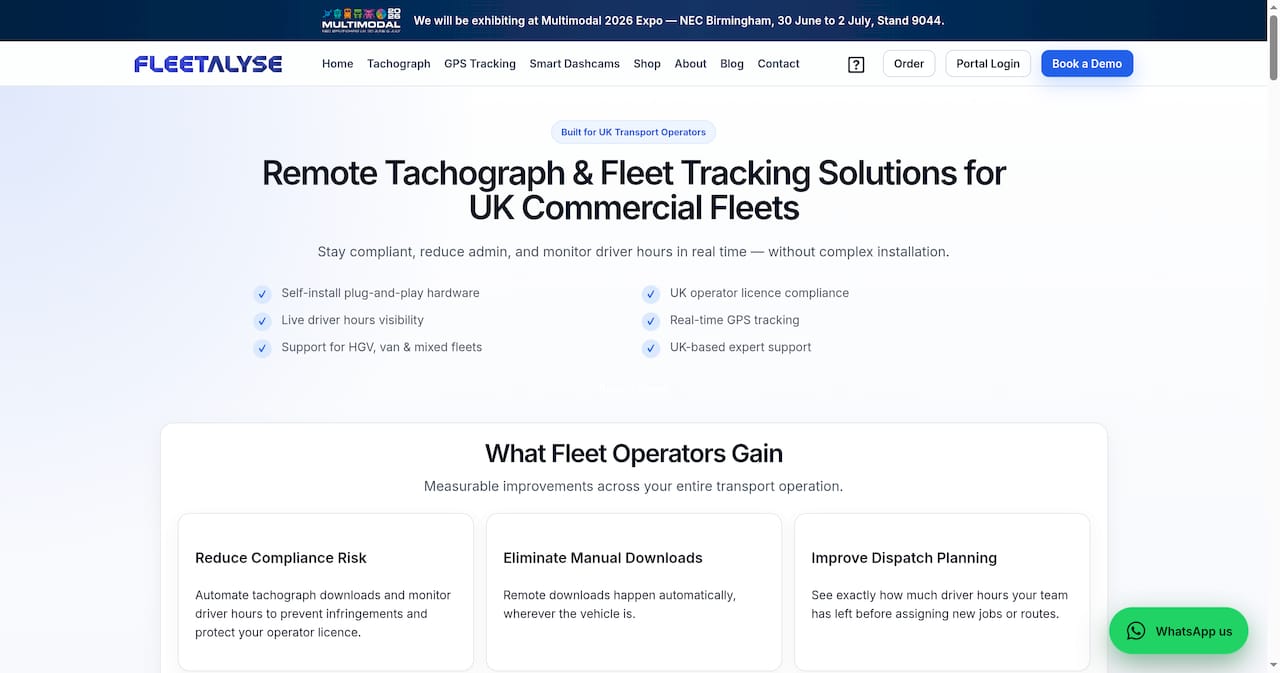
Fleetalyse connects GPS telematics data directly to your maintenance schedule, triggering automated service reminders based on live mileage and elapsed time, not a static spreadsheet. Driver behaviour monitoring feeds into the system too, so vehicles operating under severe-use conditions get flagged for tighter intervals without you having to audit each one manually. Every service record is stored centrally, giving you a complete, auditable history for every asset in the fleet.
Whether you operate three vans or a hundred mixed assets, Fleetalyse gives you the visibility to stay ahead of every due date. Request a demo or browse compatible GPS trackers for your fleet to get started.
Useful sources and where to find official guidance
Use these references to verify manufacturer schedules and UK regulatory requirements directly.
- DVSA / GOV.UK — the statutory authority for MOT rules, roadworthiness standards and operator licence requirements in the UK. Use this to confirm legal obligations, not service schedules.
- Your vehicle’s owner’s manual — the primary source for your exact service intervals, fluid specifications and severe-use criteria. Keep a physical copy in the vehicle and a digital scan somewhere accessible.
- Manufacturer owner portals (Ford UK, Vauxhall, Toyota, BMW, etc.) — most allow you to enter your registration or VIN to retrieve model-specific maintenance schedules and service history records.
- RAC — practical guidance on service types, what to expect at a garage, and how to check a used vehicle’s service history. The RAC Approved Garage Network is a useful starting point when choosing an independent workshop.
- Consumer Reports car maintenance guidance — US-market source, but the underlying maintenance principles and advice on avoiding unnecessary upsells are directly applicable. Treat manufacturer-specific intervals as US figures and verify against your UK owner’s manual.
- Manufacturer EV and hybrid maintenance pages — Tesla, BMW, Nissan and others publish EV-specific service schedules online. Cross-reference these with your owner’s manual for the definitive interval list.
Keep a physical copy of every stamped service invoice alongside your service book, and maintain a digital record centrally if you operate a fleet. Those documents are your evidence in any warranty discussion or resale negotiation.