
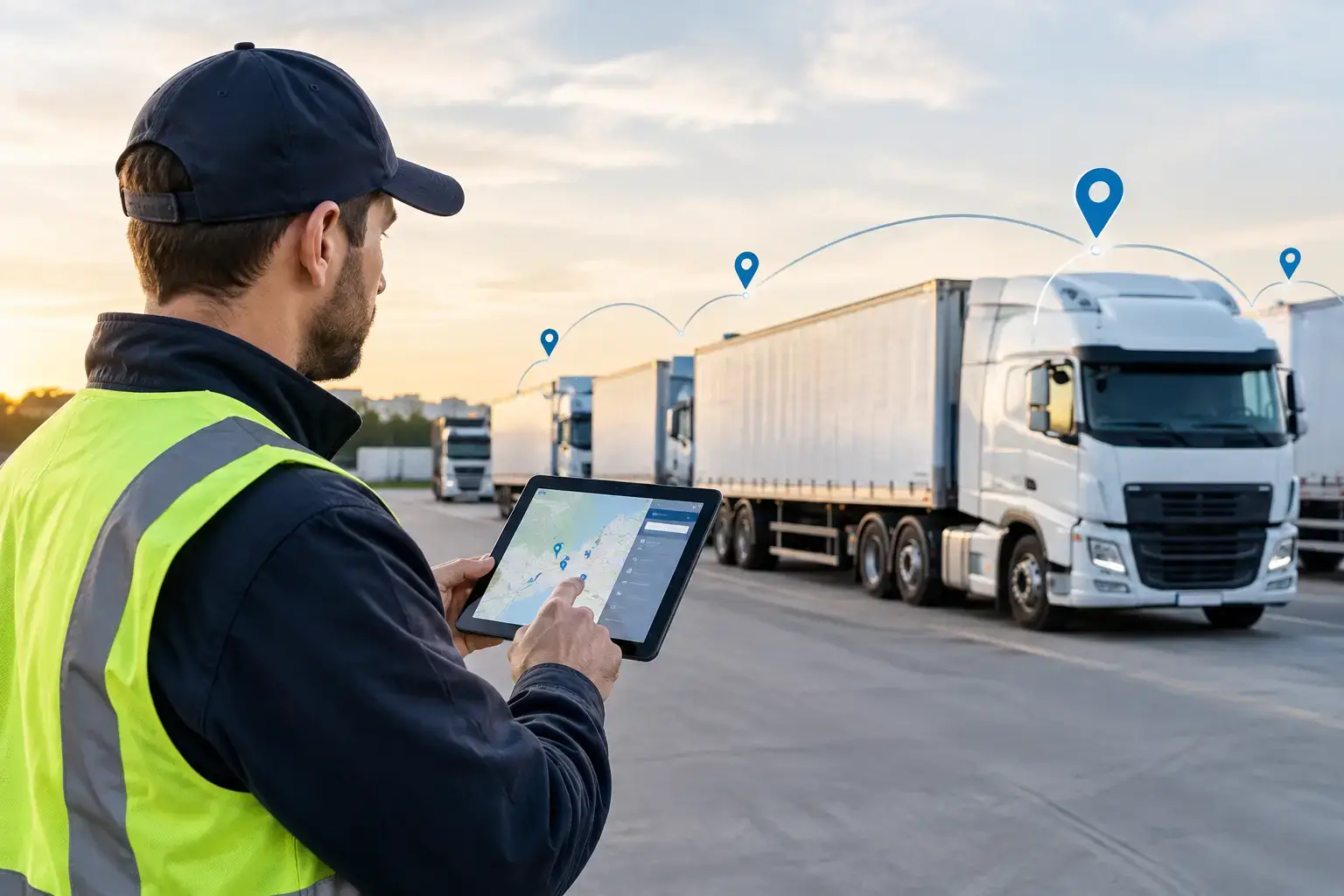
A trailer can be one of the most valuable assets in a transport operation, yet it is often the hardest to account for. If your team has ever spent the morning phoning depots, checking yard notes or asking drivers where a particular trailer was dropped, you already know why use trailer tracking is a practical operational question, not a technology trend.
Unlike powered vehicles, trailers can be left at customer sites, parked in overflow yards, exchanged between units or sit unused for days. Without a reliable location record, dispatch decisions slow down, utilisation becomes difficult to measure and a missing trailer can quickly become a costly problem. Trailer tracking gives transport teams a clearer, current view of every asset from one platform.
Why use trailer tracking for day-to-day control?
The immediate benefit is simple: your team can see where each tracked trailer is without relying on paperwork, memory or calls between depots. That matters most when a vehicle arrives to collect a load and the assigned trailer is not where the planning board says it should be.
Live or regularly updated location data helps planners confirm whether the right trailer is available, identify assets left at customer premises and direct drivers with confidence. Instead of treating trailers as static equipment once they leave the yard, they become visible operational assets.
For a busy haulage business, this can remove a surprising amount of wasted time. A dispatcher no longer needs to interrupt drivers to establish a trailer's location. Depot staff do not have to walk a large site looking for a specific unit. Managers can investigate exceptions using a clear record rather than trying to reconstruct movements after the event.
Better dispatch decisions when plans change
Transport plans rarely remain fixed for an entire shift. A collection runs late, a vehicle develops a fault, a customer changes a delivery slot or a driver needs to be reassigned. In those moments, knowing the location of available trailers helps the team make a workable decision quickly.
Trailer tracking can show which assets are at the depot, which are with customers and which have been stationary elsewhere for longer than expected. When paired with vehicle tracking, planners can see the relationship between tractor units and trailers rather than viewing each part of the operation in isolation.
This is particularly useful for mixed fleets, multi-drop work and operations that use several yards. It can also prevent unnecessary dead mileage. If a suitable trailer is already close to the next collection point, there may be no reason to send a unit back to base simply because the location information was missing.
Improve trailer utilisation before buying more assets
A shortage of trailers is not always a shortage of trailers. Sometimes it is a shortage of accurate information about where they are and how often they are used.
Tracking data gives managers a factual view of asset movements, dwell time and periods of inactivity. If several trailers have remained at customer locations for extended periods, that may point to an issue with collection procedures, commercial terms or allocation discipline. If trailers are repeatedly parked at one depot while another site hires in equipment, the problem may be distribution rather than fleet size.
This information supports better investment decisions. Before adding trailers to the fleet, a transport manager can review whether existing assets are being used effectively. Equally, if data confirms a genuine capacity constraint, there is a stronger business case for purchasing or leasing additional equipment.
Utilisation data should be interpreted with context. A trailer parked for several days is not automatically underused. It may be part of a contracted drop-and-swap arrangement, held for a seasonal customer or awaiting a planned backload. The value of tracking is that it gives the operation evidence to distinguish planned dwell time from avoidable inactivity.
Reduce the impact of lost or unauthorised trailer movements
Trailers are vulnerable because they are frequently uncoupled and may spend time outside a secure depot. A tracking device cannot replace physical security measures, but it provides an additional layer of awareness when an asset moves unexpectedly.
Location history can help establish when a trailer last moved, where it travelled and where it was last reported. That is useful if a trailer has been collected by the wrong unit, moved without authorisation or cannot be found after being left at a customer site.
Geofence alerts can add further control where they suit the operation. For example, a team may want notification when a trailer leaves a designated depot, enters a customer location or moves outside expected hours. Alerts need sensible configuration. Too many notifications create noise and are soon ignored, so focus them on movements that require an operational response.
The aim is not to monitor every metre a trailer travels. It is to make exceptions visible early enough for the team to act.
Make maintenance planning more disciplined
Trailers need the same operational attention as the rest of the fleet. Regular safety inspections, tyre checks, brake maintenance, lighting repairs and defect management all depend on knowing where the asset is and when it can be brought into the workshop.
Trailer tracking gives maintenance teams a better chance of planning around the real location of equipment. If a trailer is due for inspection but has been standing at a customer site for two weeks, the team can arrange recovery or collection before the deadline becomes urgent. If it is likely to return to a particular depot, the work can be scheduled there instead of creating avoidable disruption.
A tracking platform should support maintenance reminders and clear asset records, rather than leaving teams to cross-reference separate spreadsheets. For operators managing HGVs, vans and trailers, one view of vehicle and trailer status makes it easier to see which assets need attention and which are ready for allocation.
Tracking does not remove the need for proper inspection processes or clear responsibility for defects. It does, however, reduce the chance that maintenance is delayed simply because nobody can locate the trailer when it is needed.
Strengthen accountability across depots and customers
Trailer handovers can create gaps in responsibility. A unit may be dropped in one location, moved by another driver and collected days later by a different depot. If records are manual or inconsistent, it can be difficult to establish what happened when questions arise.
A location and movement history gives teams a shared point of reference. It can support conversations with customers about trailers retained beyond agreed periods, help investigate disputed collection times and make internal handovers more transparent.
This is not about using tracking data to assign blame for every delay. It is about replacing assumptions with an accurate operational record. That approach is especially valuable when multiple depots, subcontractors or customer sites are involved.
How trailer tracking fits with compliance management
Trailer tracking is not a substitute for tachograph compliance. Trailers do not record driver hours in the way that a tachograph-equipped vehicle does. But trailer visibility complements the wider control needed by UK operators.
When vehicle tracking, driver hours monitoring, remote tachograph downloads and trailer locations sit together, managers can make better decisions with fewer disconnected systems. A planner can check vehicle availability, understand driver time constraints and locate the appropriate trailer without moving between spreadsheets and separate supplier portals.
For an operator licence holder, this joined-up view helps make daily management more controlled. It supports proper planning, clearer maintenance scheduling and a more reliable audit trail around fleet activity. Fleetalyse is designed around this practical combination of compliance and live fleet visibility, rather than treating trailer tracking as a standalone map feature.
What to look for in a trailer tracking system
The right setup depends on how your trailers operate. A local fleet that returns to base every evening may need different update frequency and alert settings from a national operation where trailers spend long periods at customer sites.
Start with reliability. The device must be suitable for trailer use, fitted securely and capable of reporting useful location information without creating a maintenance burden of its own. Battery life, reporting intervals and network coverage all affect how useful the data will be.
Then consider how the data will be used. A map alone is not enough if the team still has to export information into spreadsheets to investigate dwell time, plan servicing or identify inactive assets. Look for a platform that makes location history, geofences, reporting and maintenance activity accessible to the people managing the fleet.
Implementation also matters. A system that is difficult to fit, configure or explain to depot teams can delay the value it is meant to deliver. Clear pricing, straightforward hardware and a single platform for trailers, vehicles and compliance data make adoption easier.
Trailer tracking earns its place when it helps your team find assets faster, use them more effectively and act on exceptions before they become disruption. The strongest result is not simply knowing where a trailer is on a map. It is running a fleet where that information helps every department make the next decision with greater confidence.